
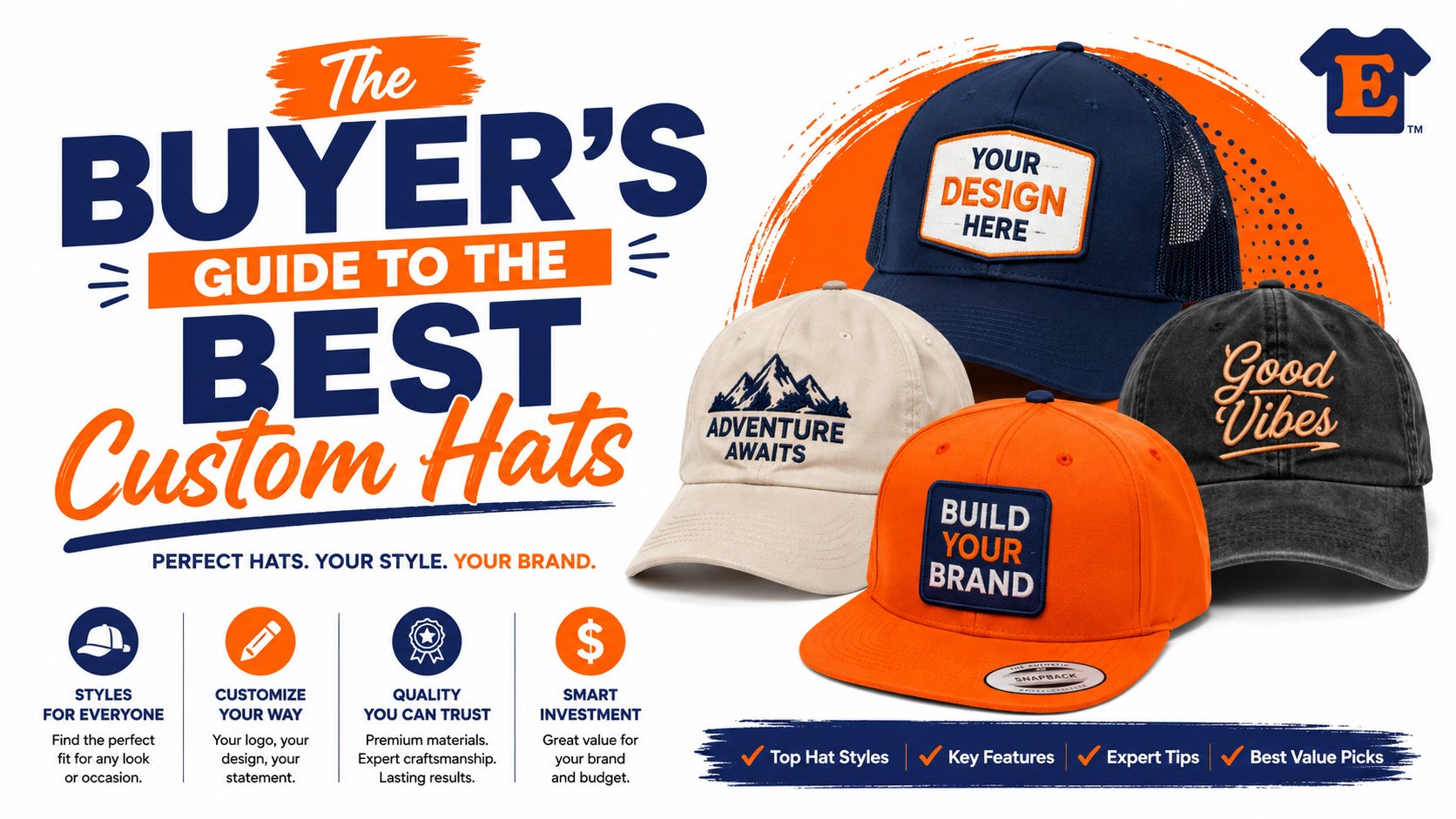
You need hats for a launch, a tournament, a vendor booth, or a staff team. The date is locked. The artwork is still moving around in email. Somebody on the team wants premium embroidery, somebody else wants the cheapest option, and nobody wants boxes to show up after the event.
That's where most custom hat orders go sideways.
The best custom hats aren't just about picking a popular cap and dropping a logo on the front. The right choice depends on who will wear it, how fast you need it, what kind of decoration will hold up, and whether the hat needs to look like polished brand merch or quick-turn event gear. That decision matters more now because the category keeps growing. The global hat market was valued at USD 10 billion in 2023 and is projected to reach around USD 19.66 billion, with a CAGR of 7.8% from 2025 to 2032, according to hat customization market statistics.
Why Custom Hats Are a Must-Have for Your Brand
A hat does a different job than a shirt.
Shirts often become event-day apparel. Hats stick around. People wear them on errands, at the gym, on job sites, at practices, and on weekends. If your brand mark lands well on a hat, it can keep showing up long after the original event is over.
Where hats earn their keep
For businesses, hats work especially well when the goal is repeat visibility without asking people to wear a full branded outfit. A clean cap with a sharp logo feels useful. It doesn't feel like forced promo.
That matters for:
- Staff uniforms that need a more finished look than a printed tee alone
- Trade shows and conferences where your team needs to be easy to spot
- Retail merch tables where buyers want something practical
- Outdoor crews and event teams that need shade and branding in one item
- School, sports, and club orders where people want wearable spirit gear
Hats succeed when the wearer would choose them even without the logo. That's the standard.
Why buyers keep coming back to hats
A good custom hat solves several problems at once. It gives you a branding surface, covers sizing better than many apparel items, and travels well for events and pop-ups. It also fits a wide range of audiences, from contractors and coaches to brewery fans and startup teams.
The strongest orders usually start with one simple question: where will this hat be worn?
If the answer is “everywhere,” then hats belong in the mix. If the answer is “only for one event,” you still may want hats if your audience values practical merch over disposable swag.
What makes a hat order go right
The buying process gets easier when you sort it into three decisions:
- Style and material
- Customization method
- Deadline reality
Most online guides spend a lot of time on style and not enough on deadline pressure. In real production, speed changes everything. A great hat picked too late is still the wrong hat.
Choosing Your Hat Style and Material
Style comes first because it controls both the look and the decoration options. A polished corporate cap, a breathable trucker, and a soft beanie can all be the “best custom hats,” but not for the same audience.

Start with the wearer
A few practical pairings tend to work:
- Structured baseball caps fit businesses, schools, teams, and uniforms. They hold shape well and usually give logos a cleaner front-facing presentation.
- Unstructured caps feel softer and more casual. They suit lifestyle brands, coffee shops, creative merch, and relaxed retail looks.
- Snapbacks skew younger and sharper. They work for streetwear-inspired branding and bolder graphic direction.
- Trucker hats are event-friendly, breathable, and easy to wear in warm climates.
- Beanies make sense for cold-weather teams, winter merch, and cuff embroidery.
- Bucket hats lean trend-driven and work best when the audience already likes that silhouette.
Material changes the result
Fabric isn't a small detail. It affects structure, breathability, print compatibility, and how premium the finished piece feels.
Cotton and twill usually give you a classic cap look. Polyester tends to be the better pick for athletic or performance use. Mesh-back styles help when the hats will be worn outdoors for long stretches or in humid conditions.
If you're ordering embroidered caps, fabric choice matters even more. A stable front panel gives the stitching room to sit cleanly. If you want a deeper read on that, this guide to best fabrics to embroider on is worth reviewing before finalizing blanks.
A practical example with a proven trucker style
The Richardson 112 is popular for good reason. Its hybrid polyester-front and cotton-mesh-back construction gives you a dependable front area for embroidery and a cooler wear experience in hot conditions. According to this Richardson 112 embroidery guide, it offers a 4" x 2.5" embroidery field that can handle up to 6,000 stitches without distortion, and its mesh back dissipates heat 40% faster than solid fabrics.
That combination makes it a strong choice for:
- Outdoor promotions where guests will wear the hat all day
- Hospitality and brewery merch where trucker styles already fit the brand
- Sports events and humid-weather activations where breathability matters
- Mid-range branded merch that needs to feel solid without getting overly technical
Don't choose the hat style you like best in a vacuum. Choose the one your audience is already comfortable wearing.
What usually works and what usually doesn't
A mismatch causes more disappointment than bad decoration.
Here's the common pattern:
| Hat type | Best use | Watch out for |
|---|---|---|
| Structured cap | Uniforms, corporate branding, teams | Can feel too formal for relaxed merch |
| Trucker hat | Outdoor events, retail merch, warm climates | Not every brand wants the casual look |
| Performance cap | Sports, field crews, summer use | Some logos look too stiff if overbuilt |
| Beanie | Seasonal merch, winter teams | Limited placement area |
| Bucket hat | Youthful campaigns, trend-led merch | Audience fit has to be right |
Comparing Customization Methods
After selecting a hat, the decoration method determines if the final product appears premium, promotional, or purely functional. For most orders, the primary discussion focuses on embroidery, screen printing, and DTF.

Embroidery for the classic branded look
Embroidery is still the standard when the hat needs to look professional. It adds texture, dimension, and a more finished appearance than a flat print.
That's not just shop preference. Custom hats rank third in the custom swag space and account for 9% of total custom apparel sales, and embroidery remains the gold standard, according to Custom Ink's custom hats guide.
Embroidery is a strong fit when you need:
- Corporate logos
- Uniform hats
- Team and coaching caps
- Premium resale merch
- Simple designs with clean shapes
Its main limit is detail. Tiny text, thin outlines, and complicated gradients rarely improve when translated into stitches. If a logo needs every small visual element preserved, embroidery may not be the right tool.
Screen printing for bold and simple event work
Screen printing on hats can be excellent, but only on the right blanks. It works best when the front panel is smooth and stable enough to take ink cleanly.
This method usually makes sense when:
- You have a bold front graphic
- The design needs a flat, colorful look
- The order leans toward promotional or event-driven use
- You're using a style that accepts the method well
Screen printing is often the practical answer for giveaway hats and one-day campaigns. It can also be a budget-friendly move at higher volume, especially when the artwork is straightforward.
The catch is compatibility. Not every cap style prints well. If the blank isn't right, the result won't be either.
DTF when detail matters more than texture
DTF is useful when you want more image detail, more color freedom, or quicker flexibility on smaller runs. It gives you options when embroidery would simplify the art too much and screen printing would require the wrong blank or too much setup friction.
For logos with color shifts, detailed illustration, or artwork that needs to stay visually intact, DTF is often the cleaner answer. It's also part of why many buyers now look beyond only stitched hats.
If you're comparing methods across product types, this page on heat transfer custom shirts gives a useful baseline for how transfer decoration behaves in broader apparel production.
If the logo is simple and the brand wants polish, stitch it. If the artwork is detailed and deadline pressure is real, printed transfer methods deserve a hard look.
Side by side decision guide
| Method | Best for | Strength | Limitation |
|---|---|---|---|
| Embroidery | Uniforms, branded merch, clean logos | Premium look and durability | Fine detail can get lost |
| Screen printing | Event hats, bold graphics, select blanks | Strong color impact | Blank compatibility is narrower |
| DTF | Full-color art, smaller runs, rush needs | Detail and flexibility | Less textured than embroidery |
What works in practice
Buyers sometimes over-focus on what looks impressive on a mockup. Production reality is different.
A few practical calls:
- Choose embroidery if the hat has to signal trust, polish, or permanence.
- Choose screen printing if the event is fast-moving and the artwork is bold enough to read from a distance.
- Choose DTF if your artwork is doing the heavy lifting and you don't want stitches changing the design.
Design and Sizing Best Practices
Good artwork can still fail on a hat if it isn't adjusted for the surface. Caps curve. Seams interrupt artwork. Front panels vary. The best custom hats usually come from simpler design decisions, not fancier ones.

Design for the shape, not just the logo
A logo that works beautifully on a website header may feel cramped on a cap front.
Keep these rules in mind:
- Prioritize legibility. If text is tiny, simplify it.
- Respect negative space. A hat front needs breathing room.
- Avoid overfilling the panel. Bigger isn't always cleaner.
- Use contrast well. Dark thread or ink on a dark cap rarely helps anybody.
- Think about seam placement. Center seams can interfere with finer art.
File quality matters more than people think
The easiest production jobs start with clean files. Vector files are ideal because they scale cleanly and keep edges sharp. Raster files can work if they're high quality, but low-resolution art creates delays, redraws, and approval issues.
Mobile ordering tools streamline the process. The TSE mobile app makes it easier to upload art, review design direction, and keep an order moving when you're not sitting at a desktop. For teams handling event prep, that speed matters. It also helps when one person approves artwork while somebody else manages the order.
A hat design should read clearly from a few feet away. If it only works when zoomed in on a screen, revise it before production.
Use decoration-aware design choices
Different methods need different art discipline.
For embroidery, cleaner marks usually win. For printed decoration, more detail can survive, but placement still matters. Don't treat every hat like a mini poster.
A short visual walkthrough can help when you're evaluating front panel placement and logo scale:
Sizing and fit decisions that reduce problems
Fit questions usually show up late, but they should be addressed early.
The main categories are straightforward:
- Snapback gives adjustable sizing and broad team-friendly flexibility.
- Flexfit feels cleaner and more fitted, but you need better size planning.
- Fitted looks sharp for the right audience, though it's less forgiving for mixed-group orders.
- Hook-and-loop or strapback works well when comfort and quick adjustment matter.
If your audience is a mixed event crowd, adjustable hats are usually the safer call. If you're producing retail merch for a very specific look, fitted and flex styles may make more sense.
Balancing Price Speed and Volume
Most buyers think they're making one decision. They're making three at once.
They want the lowest price, the fastest turnaround, and the best-looking result. Sometimes you can hit all three. Often you need to decide which one matters most.
How volume affects cost
Larger orders usually spread setup and production effort across more units. Small orders, especially when each piece needs attention, often cost more per hat. That doesn't make small runs a bad idea. It just means the economics are different.
For startups, creators, and one-off event needs, small runs can still be the right move because they reduce inventory risk. You test demand before committing to a deeper order.
Speed changes the math
Rush production isn't just standard ordering on a shorter clock. Faster timelines affect blank availability, decoration choices, approval windows, and what level of design revision is realistic.
That's why “best custom hats” can mean different things depending on the deadline:
- For a retail merch drop, the best choice may be a premium embroidery blank with more time built in.
- For a last-minute event, the best choice may be the hat and method that can be produced cleanly without missing the date.
- For staff uniforms, consistency often matters more than squeezing out the lowest unit cost.
Finding the Best Custom Hats for Your Budget
A simple framework helps.
| Priority | Best approach |
|---|---|
| Lowest unit cost | Increase volume and keep artwork simple |
| Fastest turnaround | Use available blanks and decoration methods that fit the schedule |
| Most premium look | Choose stronger hat structure and embroidery-friendly designs |
| Lowest risk | Start with a small run and reorder based on demand |
The mistake buyers make is insisting on a premium, highly specific blank with complex art on an emergency timeline. Sometimes that works. Often it creates avoidable compromises.
If the event date can't move, build the order around what can be produced reliably, not around an ideal mockup from two weeks ago.
The T-Shirt Envy Advantage for Your Custom Hats
Most custom hat guides assume you've got plenty of time. In actual buying situations, that's often the one thing you don't have.
That gap is real. A market-gap discussion around rush custom hats notes that 70% of 200+ small business users on forums reported frustration with 2 to 4 week lead times. If you're ordering for a pop-up, tournament, conference, launch, or late-breaking staff need, those timelines don't help.

Where speed and quality have to meet
One practical option is custom embroidered hats from T-Shirt Envy, especially for buyers who need embroidery, DTF, or rush production with more flexibility than a standard long-lead online order. The shop's model includes 1-hour, same-day, and 24-hour services, plus no minimums for rush orders, which makes it relevant for everything from one-off event caps to larger branded runs.
That matters because the normal trade-offs are familiar:
- Cheap and fast can look temporary
- Premium and polished can take too long
- Bulk-friendly programs can be clumsy for short runs
- Small urgent orders often get pushed to the back of the line
A shop built around rapid production handles those pressures differently. It can be a fit for event planners, small businesses, creators, school groups, and teams that need hats without a long planning runway.
Ordering without the usual friction
The other piece buyers underestimate is admin. Artwork approval, reorder consistency, and production visibility can become bigger headaches than the hat choice itself.
The TSE mobile app helps with that side of the process. You can upload artwork, manage orders on the go, and keep tabs on production status without chasing updates across email threads. For recurring business or team orders, that kind of workflow matters almost as much as the decoration method.
“Quick, Quality, Printing!™” works as a simple standard here. If a hat order can't hit all three well enough for the job, it isn't the right production plan.
Caring For Your Custom Headwear and Final Thoughts
A good hat should last, but only if it's treated like decorated gear instead of throw-in-the-wash clothing. Most damage comes from heat, crushing, or rough cleaning.
Simple care rules that protect the finish
Use these habits:
- Spot clean first when possible, especially on embroidered fronts
- Skip harsh wash cycles that can distort the crown or stress decoration
- Air dry the hat instead of forcing heat on it
- Store it with shape in mind so the front panel doesn't collapse
- Handle sweat bands and inner panels gently if the hat sees frequent wear
For embroidered hats, preserving shape is almost as important as protecting the stitching. For printed hats, friction and heat are usually the bigger enemies.
What to remember before you order
The best custom hats are the ones that match the job.
Choose the style based on the audience, not your personal favorite. Match the decoration method to the artwork, not just the trend. And if the deadline is tight, treat speed as a real production variable from the start.
A clean trucker for an outdoor promo, a structured embroidered cap for staff uniforms, or a detailed DTF hat for a pop-up can all be the right answer. The wrong answer is waiting too long, overcomplicating the art, or choosing a blank that fights the decoration method.
If you're ready to turn artwork into wearable merch without the usual back-and-forth, start your next order with T-Shirt Envy. Download the TSE mobile app, upload your design, and get your project moving with the kind of turnaround that fits real event deadlines.


