
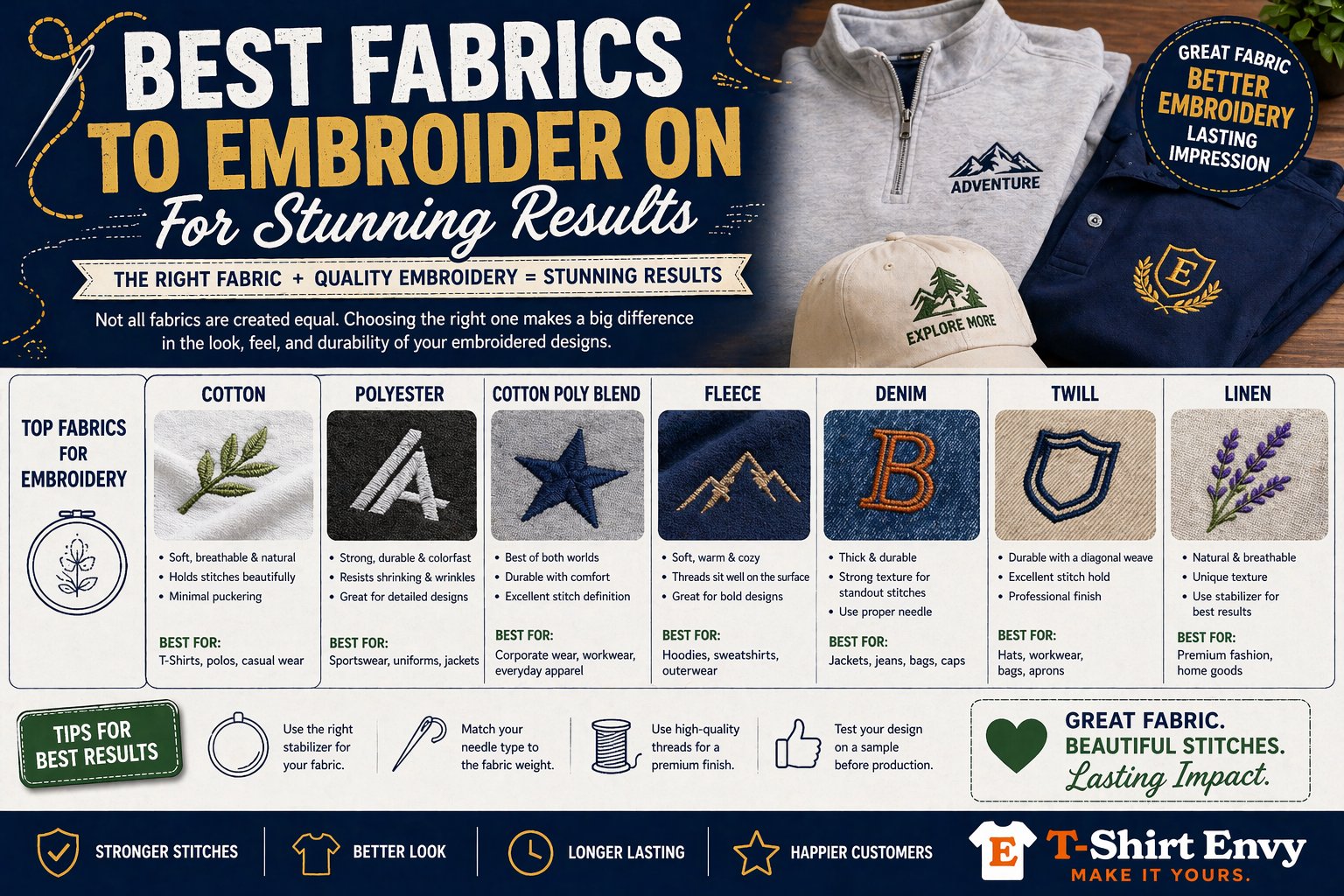
If you're choosing garments for a logo, staff uniform, team polo, or merch drop, embroidery usually sounds simple at first. Pick a shirt, add stitches, done. Then a key question quickly emerges. What fabric will hold embroidery cleanly without puckering, twisting, or looking cheap after a few washes?
That question matters more than most buyers expect. A sharp embroidered logo depends as much on the garment as the digitized file. The wrong fabric can bunch under the needle, distort the shape of letters, or make an otherwise strong brand mark look uneven. The right fabric gives the thread something solid to sit in, so the finished piece looks crisp, durable, and worth wearing.
Embroidery Excellence Starts with the Right Fabric
A lot of custom apparel projects start with the same goal. Someone wants a more polished look than print alone can give. It might be a contractor ordering work polos, a school buying spirit wear, or a startup wanting hats and quarter-zips that feel established from day one.
The challenge isn't the idea. It's the garment selection.
Embroidery rewards good fabric and exposes bad fabric fast. Thin shirts that feel fine on a hanger can shift in the hoop. Stretchy athletic tops can warp around dense logos. Lightweight synthetics can end up showing every pull of the thread. When that happens, the logo gets blamed, but the fabric was usually the main problem.
Practical rule: If the material can't stay stable while the machine runs, the embroidery won't look stable when it's finished.
Shops that produce clean embroidery consistently don't guess on fabric. They look at structure first. Weight, weave, stretch, surface texture, and intended use all matter. A restaurant polo has different needs than a canvas tote. A school hoodie behaves differently than a silky performance tee. The fabric has to match both the design and the job the garment needs to do.
That matters even more when the order has to move quickly. If you're uploading art, approving garments, and trying to outfit a team on a deadline, you need decisions that work the first time. That's why smart buyers narrow the choice early. They don't ask only, "What looks good?" They ask, "What will embroider well?"
If you're placing orders while moving between meetings, jobsites, or events, the TSE mobile app makes that process easier. You can upload artwork, review product choices, and keep an order moving without being tied to a desktop.
Why Fabric Weave and Weight Are Critical for Embroidery
A logo that looks sharp on one garment can look stressed, wavy, or heavy on another, even with the same file and the same machine settings. The difference is usually the fabric. Embroidery adds tension, needle penetrations, and thread build-up. If the base fabric shifts, the stitching will show it.
Fabric structure decides how much forgiveness you have in production. Weave affects stability. Weight affects how well the fabric carries stitch density. Get both right, and the design runs clean with less correction on press day. Get them wrong, and you start compensating with extra stabilizer, reduced density, slower machine speeds, or a different decoration method altogether.

Woven fabric usually behaves better than knit
Wovens give the needle a firmer grid to work with. Threads are locked in a fixed over-under pattern, so the fabric resists shifting while the design sews. That is why button-downs, twill goods, canvas bags, and structured workwear usually produce cleaner outlines and sharper small text.
Knits are different. They stretch by design, which helps comfort but works against embroidery. A polo or tee can still embroider well, but the margin for error gets smaller. Hooping tension, stabilizer choice, underlay, and logo density all matter more on knits than on a stable woven.
In production, the pattern is consistent:
Structured wovens handle logos, satin borders, and block lettering with fewer surprises.
Knits and stretch fabrics need more control to avoid tunneling, edge distortion, and puckering.
Soft, drapey garments often look better with print decoration unless the logo is small and light.
That last point matters. Some shirts are excellent for comfort and poor for embroidery. If you're comparing blanks for different decoration methods, this guide to the best fabric for custom t-shirts helps sort out what wears well versus what holds stitches well.
Weight determines how much stitching the fabric can support
Weight is the second filter I use after weave. A fabric can feel nice in hand and still be too light for the logo planned for it.
Lighter materials tend to show stress first. Dense fills, wide satin columns, and layered underlay can pull the fabric inward, which creates rippling around the design. Midweight fabrics are usually the safest range for everyday embroidered polos, tees, and casual layers because they balance comfort with enough body to support the thread. Heavier fabrics can carry larger or denser embroidery more cleanly, especially on outerwear, bags, aprons, and workwear. Guidance compiled by Maggie Frames on fabric weight for embroidery notes that lighter fabrics need more support, midweight fabrics are the most versatile, and heavier fabrics handle dense stitching better.
That does not mean heavier is always better. Heavy fabric can swallow fine detail, especially if the surface is coarse. A bulky sweatshirt fleece, for example, may support a left-chest logo well but still blur tiny lettering.
What usually fails first
Most embroidery defects trace back to movement. The machine is repeating the same action thousands of times. If the fabric shifts during that process, the finished logo records that movement.
| Problem | What it usually means |
|---|---|
| Puckering around the logo | Fabric is too light, too stretchy, or under-stabilized |
| Distorted circles or text | Hooping stretched the garment or the weave isn't stable enough |
| Gaps in fill areas | The surface shifted and the stitches couldn't sit evenly |
| Rippling after washing | The fabric and thread reacted differently over time |
The fix is not always more embroidery technique. Sometimes the right call is a different garment. Sometimes it is a different decoration method.
Tight weave gives you more design options
Tight, even weaves make embroidery easier to control because the needle meets consistent resistance across the design area. Small text reads better. Borders stay cleaner. Filled shapes hold their edge instead of breaking up across an uneven surface.
Loose weaves, slub textures, and very fluid fabrics narrow the safe design range. They can still work, but only if the artwork is simplified and the stitch count is kept under control. That is one reason experienced shops review the logo and the garment together instead of approving decoration in isolation.
This is also where strategy matters. If the garment is thin, stretchy, heat-sensitive, or too drapey for the logo size requested, embroidery may not be the best answer. DTF often produces a cleaner result on those pieces with less distortion and less setup risk. The best outcome comes from matching the fabric to the decoration, not forcing every garment into embroidery because it sounds premium.
The Champions The Best Fabrics to Embroider On
Some fabrics are more forgiving, more consistent, and better-looking under stitches. If the goal is clean logos, reliable production, and apparel that still looks strong after repeat wear, these are the materials that stay at the top of the list.

100 percent cotton
If you want the safest all-around answer for the best fabrics to embroider on, start with cotton. 100% cotton, especially heavyweight or quilting varieties with tight, even weaves and thread counts from 130–250, remains the foundational and most recommended fabric for embroidery because it combines stability, breathability, and a soft hand feel that works well for t-shirts and polos, according to MFG Merch's embroidery fabric guide.
Cotton does a few things very well in production:
It stays predictable: A tight woven cotton surface gives needles and thread a dependable path.
It presents clean detail: Small lettering and simple logos read better when the surface doesn't shift.
It wears well visually: Cotton tends to keep that premium, classic embroidered look buyers expect.
Quilting cotton is especially useful for detailed work because the weave is smooth and stable. For branded apparel, sturdy cotton polos, woven cotton shirts, and heavier cotton sweatshirts are practical choices when the design needs to look sharp without fighting the fabric.
Denim
Denim is one of the most satisfying fabrics to embroider when the design and placement make sense. It has body, it resists distortion, and it can handle thread density better than lighter fashion fabrics.
That doesn't mean every denim garment behaves the same. Soft washed denim with stretch can still move more than expected. But structured denim jackets, overshirts, and heavy utility pieces usually give embroidery the support it needs.
Denim works best when you want:
Bold chest logos
Back yoke details
Sleeve hits
Fashion merch with a rugged finish
Denim gives embroidery a strong frame. It doesn't need the design to do all the visual work.
One caution. Dense fills on very small areas can make denim feel stiff. Clean linework, badge-style logos, and medium-density designs usually look better than trying to force a highly packed graphic into a tight spot.
Canvas and twill
Canvas and twill are workhorses. They don't get talked about as much as cotton polos or caps, but they produce some of the cleanest embroidery in the shop.
Canvas is excellent for tote bags, aprons, utility pouches, and durable promo items. Twill is a favorite for uniforms, structured shirts, patches, and some headwear. Both fabrics offer the kind of surface that lets logos sit flat and stay readable.
They shine when you need embroidery on products that take abuse. Trade show bags, staff aprons, equipment totes, and jobsite gear all benefit from fabrics that can support thread without deforming around it.
Here's the practical comparison:
| Fabric | Why it works | Best use cases |
|---|---|---|
| Cotton | Stable, breathable, smooth hand feel | Polos, tees, woven shirts, sweatshirts |
| Denim | Structured and durable | Jackets, overshirts, fashion merch |
| Canvas | Firm and dependable | Bags, aprons, accessories |
| Twill | Clean surface with structure | Uniforms, workwear, patches, hats |
Linen blends deserve a spot too
Linen on its own can vary a lot by weave and finish, but linen-cotton blends in the medium-weight category are a strong option for decorative apparel and refined casual pieces. They offer texture without giving up too much stability, which is useful when you want embroidery to feel less corporate and more styled.
The main thing is to avoid treating every textured fabric as equal. Some textured garments look great blank but don't give the needle enough consistency for precise logo work. Linen-cotton blends tend to be safer because they balance visual character with stitch support.
What usually gives the crispest result
If a customer asks for the sharpest possible embroidery across common apparel categories, three choices rise quickly:
Structured cotton
Denim
Canvas or twill
Those fabrics don't solve every problem on their own, but they give the machine the best chance to produce a logo that looks intentional, balanced, and professional.
Embroidering Performance Fabrics and Blends
Performance apparel is everywhere now. Staff polos, athletic quarter-zips, team jerseys, and moisture-wicking tops are popular because they feel modern, hold color well, and fit the pace of active work. They also create more embroidery headaches than standard woven cotton.
That gap shows up in a lot of advice online. Many guides push natural fibers first, but polyester still matters because its durability, wrinkle resistance, and colorfastness make it a practical choice for frequent-wash polos and jerseys, as noted in this guide to modern embroidery fabrics from Clever Poppy.

Why polyester blends can look great and still be tricky
A polyester polo often delivers the sleek, professional finish buyers want for offices, sales teams, golf events, and branded staff wear. On the rack, it can look sharper and more modern than a basic cotton shirt.
Under the needle, though, polyester blends can slip, stretch, and react badly to excess density. Some moisture-wicking garments are thin enough that even a clean digitized logo can cause rippling if the setup isn't right. That's why one polyester shirt can embroider nicely while another from a similar category turns into a problem fast.
The common trouble spots are:
Stretch in the knit: The hoop can distort the fabric before stitching even starts.
Thin construction: The logo may overpower the shirt.
Heat sensitivity: Pressing and finishing need more care than heavier woven goods.
Long-term movement: Some poly garments can bunch after washing and drying if the stitch area is too rigid for the fabric.
What actually helps on performance garments
Shop technique matters more than garment marketing. The same logo that runs clean on a structured polo may fail on a lightweight athletic knit unless the setup changes.
The first adjustment is usually support. Cut-away stabilizer is often the safer choice on stretch blends because it keeps supporting the stitched area after production. Tear-away alone can leave the design vulnerable on knits that keep moving in wear.
Needle choice matters too. A ballpoint needle can help on some knits because it moves between fibers instead of piercing them as aggressively. Hooping also has to stay controlled. If you stretch the shirt to get it tight, the logo may relax into distortion the moment it comes out of the hoop.
For headwear and structured accessories built from synthetic blends, shape matters just as much as fiber. A stable front panel can take embroidery well even when the material isn't a classic natural fiber. Buyers looking at cap options can compare styles through this custom embroidered hat collection.
Design choices need to change too
Performance apparel usually rewards restraint. A left-chest logo tends to work better than a wide, dense fill. Small badge art often outperforms thin script. Clean shapes win.
Good production on these garments usually means:
Simplifying tiny details so the logo stays readable
Reducing heavy fill areas that can pucker the knit
Avoiding overbuilt designs on very light shirts
Respecting placement so seams, vents, and stretch zones don't interfere
A quick machine demonstration helps show how much setup affects the result.
On performance apparel, the best embroidery isn't the most aggressive version of the design. It's the version the fabric can support without fighting back.
Cotton versus polyester for premium results
For long-term stitch stability, cotton often remains the safer premium option. For a slick, professional presentation right away, polyester polos are still a common go-to. That's the honest trade-off.
If the garment is meant for hard daily use, frequent washing, and a modern uniform look, a poly blend can be a strong choice. If the priority is a classic embroidered finish that stays relaxed and natural over time, cotton usually gives you more margin for error.
When Embroidery Isnt the Best Choice And What to Do Instead
Embroidery isn't the right answer for every garment. Good shops know that. Better shops say it before production starts.
Some materials fight stitches so hard that even a careful setup won't produce the result most customers want. Very lightweight synthetics, delicate fashion fabrics, and highly stretchy activewear can all reach the point where embroidery becomes more risk than upgrade.

The red flags
If a garment is thin, slippery, or elastic enough to move in multiple directions, embroidery may distort it. That problem gets worse when the design is detailed or the stitch count is high.
Materials that often raise concern include:
Featherweight polyester tops that bunch easily
Silky or delicate fabrics that show needle impact
Super-stretch athletic pieces that don't recover evenly after hooping
Light windbreaker-style shells that can wrinkle around the logo area
These garments aren't bad. They're just built for movement and lightness, not for carrying a field of thread.
Why DTF is often the better move
For stretchy or delicate fabrics, DTF printing is often the smarter decoration method. It delivers vibrant, detailed graphics without forcing repeated needle penetrations through material that can't support embroidery cleanly.
That's especially useful when the artwork includes:
Fine detail
Full color
Soft gradients
Larger placements
Lightweight garments that can't handle stitch density
DTF also makes sense when the customer wants visual impact more than texture. If the goal is a bright front graphic on an athletic tee, embroidery can be the wrong tool for the job.
The most professional recommendation isn't always embroidery. It's the decoration method that fits the garment.
Use the fabric to decide the method
A simple decision filter helps.
| Garment type | Better choice |
|---|---|
| Structured polo with a left-chest logo | Embroidery |
| Canvas tote or twill cap | Embroidery |
| Thin performance tee with a detailed chest graphic | DTF |
| Stretchy activewear with a large multicolor design | DTF |
| Durable jacket with a clean logo | Embroidery |
Buyers save time and money by not forcing one decoration style onto every blank. If the garment is stable and the design is compact, embroidery usually wins on premium feel. If the fabric is delicate or the artwork needs color and detail without puckering, DTF is often the better result.
That kind of call builds trust because it puts the finished garment first.
Technical Secrets for Flawless Professional Embroidery
A job can start with the right blank and still go bad on press. I see it all the time. The fabric is fine, but the logo puckers, the edges sink, or the garment twists because the setup did not match the material.
Professional embroidery is a chain of decisions. Stabilizer, hoop tension, needle type, thread, and digitizing all shape the result. Get those parts right, and a simple left-chest logo looks clean, balanced, and built to last.
Match the stabilizer to the garment
Stabilizer does the support work the fabric cannot do on its own.
Use the wrong backing and the embroidery may look acceptable coming off the machine, then distort after the garment relaxes or goes through a wash cycle. That is why shops that care about consistency match backing to fabric behavior, not just garment category.
A practical breakdown looks like this:
Tear-away stabilizer fits stable woven fabrics that already hold their shape well.
Cut-away stabilizer gives knits, stretch fabrics, and softer garments the long-term support they need behind the stitching.
Wash-away stabilizer helps with temporary topping or support when you do not want visible backing left behind.
Heat-away stabilizer works for materials that should not be exposed to moisture.
For a basic polo logo, backing choice can make the difference between a smooth finish and a ring of puckering around the design.
Weight and density have to stay in balance
Every fabric has a limit. Push too much stitch density into a garment that cannot carry it, and problems show up fast. Pulling, tunneling, stiffness, and edge distortion usually trace back to a design that is too heavy for the blank.
The fix is not just reducing size. It is planning the file for the garment. Left-chest logos usually hold up best when the design stays compact, open enough to breathe, and clean enough to read without packing thread into every small shape. Dense fills and tiny details often look better on structured jackets, bags, or caps than on lightweight polos or tees.
This is also where embroidery and DTF split. If artwork needs fine detail, soft blends, or a larger decorated area, forcing it into stitches can hurt both appearance and wearability. A good shop says that up front.
Hooping should secure the garment, not stretch it
A lot of distortion starts before the first stitch runs.
If the fabric gets pulled tight in the hoop, it often rebounds after stitching and throws the logo out of shape. The goal is steady support while the garment stays in its natural position. Hooping should control movement, not create tension.
Good hooping habits include:
Keep the fabric flat: Smooth it into place without stretching it.
Watch the grain: Let the garment rest naturally before tightening the hoop.
Check seam interference: Plackets, hems, pockets, and panel joins can shift tension across the design area.
Run a sample first: One test piece usually exposes movement, misalignment, or registration issues before a full production run.
Hooping should hold the garment still, not force it into a new shape.
Needles and thread change the finish
Needle choice affects more than penetration. It affects how the fabric recovers around the stitch.
Sharp needles work well on many woven fabrics because they cut a clean path through stable material. Ballpoint needles are the safer call for knits and stretch blends because they move between fibers instead of punching through them as aggressively. That reduces snagging and helps the fabric keep its shape.
Thread choice matters too:
| Component | Best use |
|---|---|
| Sharp needle | Stable woven fabrics |
| Ballpoint needle | Knits and stretch blends |
| Polyester thread | Durability and frequent washing |
| Rayon thread | Decorative shine where appearance matters most |
For uniforms, workwear, school apparel, and anything that gets washed hard, polyester thread usually wins. Rayon can look great, but shine is not much help if the garment needs to survive heavy use.
Clean digitizing prevents expensive mistakes
Bad digitizing ruins good garments.
A logo file has to be built for thread, fabric, and placement. Underlay, stitch direction, density, pull compensation, and sequencing all need to fit the blank you are running. A file that works on a cap can fail on a soft polo. A file built for twill can overwhelm a knit.
That is why strong production starts with proper embroidery design digitization instead of dropping the same generic file onto every garment style. Good digitizing protects the fabric, keeps lettering readable, and helps the finished piece look intentional rather than overworked.
Start Your Flawless Embroidery Project Today
The best fabrics to embroider on aren't just the ones that look good in a catalog. They're the ones that stay stable in production, support the stitch count, and still wear well after the garment leaves the shop. That's why structured cotton, denim, canvas, twill, and carefully chosen blends keep showing up in strong embroidery work.
The bigger takeaway is simpler. Fabric decides whether embroidery feels premium or problematic. If the blank is stable and the design fits the garment, embroidery can boost a brand fast. If the material is too delicate or too stretchy, a different decoration method may deliver a better result.
That decision matters for more than appearance. It affects durability, readability, comfort, and how professional the finished piece feels when someone puts it on. Buyers who understand that make better choices on uniforms, merch, event apparel, school gear, and promotional products.
This is also where a reliable production partner earns their place. You shouldn't have to guess whether a logo belongs on cotton pique, canvas, denim, or a performance polo. You shouldn't have to figure out stitch density, stabilizer type, or whether the design should be embroidered at all. The best results come from matching the artwork, fabric, and decoration method before the first item goes into production.
For teams ordering on tight timelines, that kind of support saves rework and wasted blanks. It also makes repeat ordering much easier. If you're managing apparel for a business, school, fundraiser, or event, the TSE mobile app adds another layer of convenience by letting you upload designs, manage orders, and track progress while you're on the move.
When the goal is polished custom apparel done right, speed only helps if quality stays locked in. That's what strong embroidery requires. That's also what buyers mean when they want Quick, Quality, Printing!™ without compromises.
Start your custom order with T-Shirt Envy and get expert help choosing the right garment, the right decoration method, and the right finish for your brand. Download the TSE mobile app to upload designs, manage bulk orders, and keep production moving from anywhere. Experience Quick, Quality, Printing!™ with T-Shirt Envy.


