
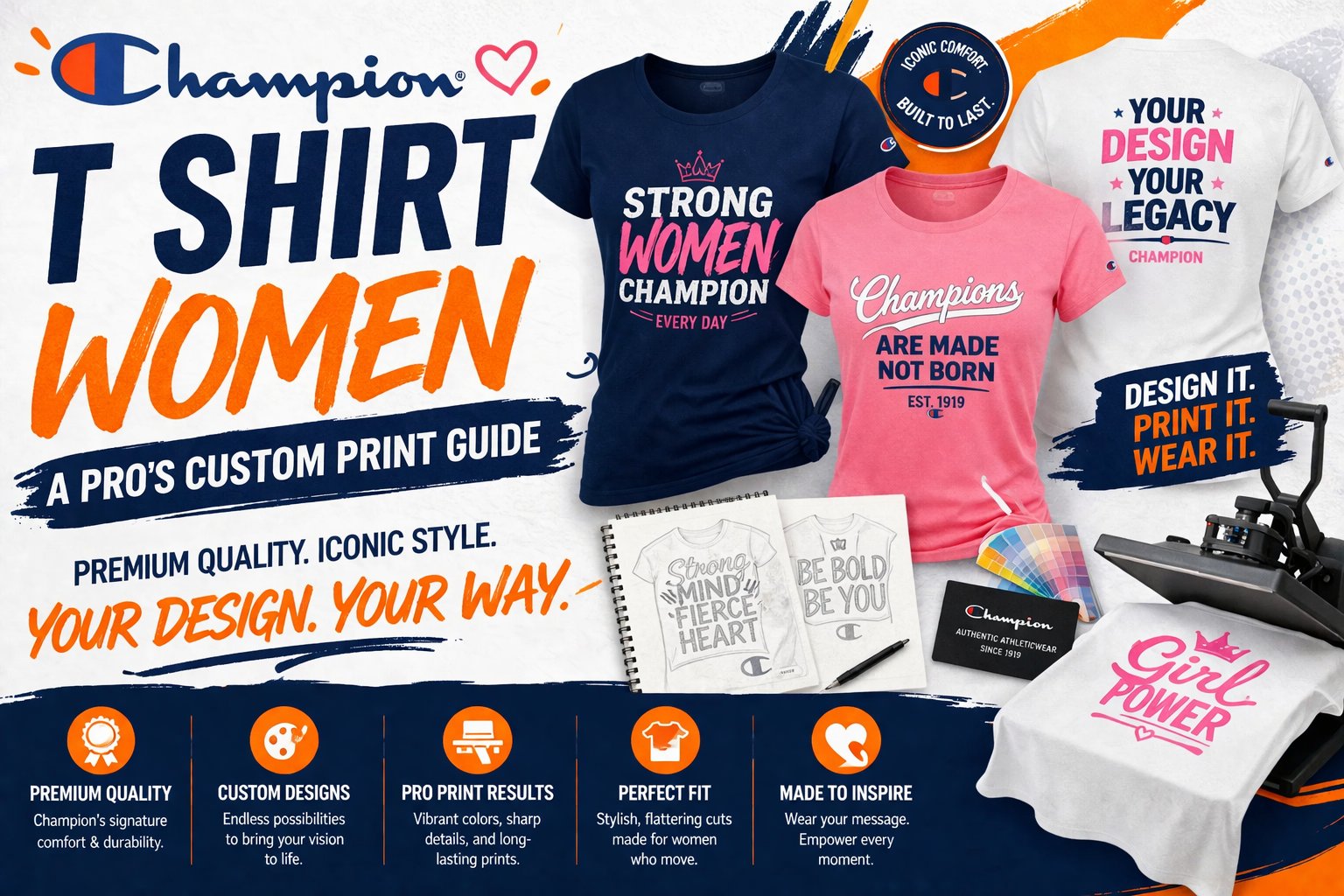
Meta description: Champion t shirt women guide for custom printing, sizing, and fabric choices. Get better results for teams, events, and branded apparel.
You need shirts that look right, fit right, and arrive on time. That sounds simple until you start comparing women’s cuts, fabric blends, print methods, and wash performance on a champion t shirt women order.
Most retail pages help you choose a color or neckline. They do not help you decide whether your logo should be embroidered, whether a performance tee can handle DTG well, or how much shrinkage to plan for in a school or staff order. That is where buyers lose time and money.
Your Guide to the Perfect Custom Champion T-Shirt
A lot of buyers land on Champion for the same reason. The brand already carries weight, especially for schools, teams, fundraisers, staff apparel, and event merch. The shirt feels familiar before your design ever goes on it.
The problem is that most existing content stops at retail styling. Coverage of Champion women’s t-shirts focuses on store availability, cropped fits, crew necks, and athletic basics, while leaving a real gap around customization for small businesses, events, and teams. That gap matters because searches for “Champion t-shirt custom” rose 28% year over year in major markets including the US, UK, and Australia, with peaks during event-heavy periods, according to this market-gap summary tied to retail coverage.
That tells you something useful. Buyers are looking for custom answers, not just product pages.
What usually goes wrong
The first mistake is picking the shirt based only on style.
The second is choosing a print method before checking the fabric content.
The third is skipping fit testing because the deadline feels tight.
Those three mistakes create most avoidable problems in a women’s order. A sharp design on the wrong blank still underperforms. A great blank in the wrong fit still gets left in drawers. A bulk order without wash planning turns into a sizing headache after the first laundry cycle.
Tip: Treat the blank, the fit, and the decoration method as one decision, not three separate ones.
What to decide before you place the order
Start with the actual use case. A launch tee, a team shirt, conference staff apparel, and spirit wear should not be built the same way.
Ask these questions first:
- Who will wear it: Staff members, athletes, volunteers, customers, or guests all have different comfort expectations.
- How often it will be worn: A one-day event shirt can tolerate choices that a weekly uniform should not.
- What the design requires: Fine detail, bold logos, names and numbers, and premium branding all point to different decoration methods.
- What matters most: Soft feel, athletic performance, polished appearance, budget control, or reorder consistency.
If you sort that out early, the rest gets easier.
The practical standard to aim for
For first-time buyers, the best outcome is not just a good-looking shirt. It is a shirt that still works after wear, washing, and repeat use.
That is the standard behind Quick, Quality, Printing!™. Speed matters, but the order also has to survive real life. Champion can absolutely do that. You just have to match the right women’s blank to the right job.
Decoding Fabric and Fit for Flawless Results
Champion has real credibility in women’s athletic apparel. In 1968, the brand launched Lady Champion, a line of mix-and-match PE uniforms for female athletes, and in 1977 it introduced the first comfortable women’s sports bra. That history helped make Champion blanks a trusted choice for schools, teams, and events, as noted in this Champion heritage overview.
That heritage matters because buyers do not just read the design on a shirt. They also read the brand on the neck label or sleeve.

Fabric first, decoration second
When clients choose a champion t shirt women blank, fabric should lead the decision.
Cotton usually gives you the easiest path for soft, detailed direct printing. It tends to be the friendliest canvas when your artwork has shading, gradients, or a more natural ink feel.
Blends are often the better call for uniforms and repeat wear. They usually balance softness, structure, and daily practicality better than fashion-first options.
Performance fabrics need more caution. They can be excellent for outdoor crews, athletic teams, or active events, but they are less forgiving if the decorator does not know how to handle synthetic content correctly.
A deeper look at fabric behavior helps when you are comparing options for printability and comfort. This guide on the best fabric for t-shirts is useful if you are still deciding between cotton, blends, and sport-focused materials.
Fit is where many bulk orders slip
Women’s tees are not one-shape products. Champion offers silhouettes that can read very differently once they are on actual people.
A classic fit is usually easier for mixed groups. It gives you more room for varied body types and lowers the risk of the shirt feeling too narrow through the chest or waist.
An athletic or slimmer cut can look sharper, but it asks more from your sizing process. It is a better match when the group has approved the fit in advance or when brand presentation matters more than maximum roominess.
Consider the vibe you want:
- Classic fit: Better for staff shirts, reunions, volunteer groups, and broad-size orders.
- Athletic fit: Better for training groups, premium merch, and more specific branding.
- Cropped styles: Better for fashion-driven drops, not ideal for general event wear.
- Longer lengths: Better for comfort-focused teams and everyday uniforms.
Key takeaway: Champion works best when you choose the blank for the wearer first, then for the artwork. That order prevents most regret.
Why Champion is often worth the extra thought
A Champion blank usually carries higher perceived value than an unknown shirt. That helps when you want the finished piece to feel like apparel people chose, not something they were handed.
For schools, creator merch, team gear, and polished event apparel, that difference is meaningful. If the shirt already feels credible before printing, your branding has less work to do.
Matching Your Design to the Right Print Method
Your artwork does not fail because the design is bad. It fails because the decoration method does not fit the fabric, the quantity, or the wear conditions.
That is the core decision in any champion t shirt women project.

What each method does best
A quick way to narrow your choice is to match the method to the design style, not just the shirt.
- DTG: Best when the art has lots of detail, shading, or a full-color look and the shirt is print-friendly for direct ink.
- DTF: Strong option when you need vibrant graphics on a wider range of fabrics, especially trickier blends.
- Screen printing: Strongest for simple, bold art in larger runs.
- Embroidery: Best when the goal is a polished, elevated logo rather than a large graphic.
- Sublimation: Best on polyester garments built for dye-based decoration.
Where the technical details matter
A good example is the Champion CHP130 Women’s Sport Soft Touch T-Shirt, which is 89% recycled polyester and 11% spandex. On that shirt, successful DTG requires a poly-blend specific pretreatment at 320-350°F for 60-90 seconds, and success rates drop 40-60% without it. During curing, spandex elasticity can cause up to 15-20% shrinkage if overheated, so conveyor speed has to be monitored carefully to protect wash performance and reduce bleed risk, according to the technical printing notes for the CHP130.
That is why buyers should not assume “DTG works on everything.” It can work very well, but synthetic performance tees need a shop that understands pretreatment, cure control, and heat sensitivity.
Choosing Your Customization Method
| Method | Best For | Fabric Compatibility | Durability | Cost Profile |
|---|---|---|---|---|
| DTG | Detailed art, gradients, photo-style prints, short runs | Best on print-friendly cotton and some blends with proper prep | Good when matched to the right garment and cure settings | Best for smaller orders and complex full-color designs |
| DTF | Complex graphics, names, numbers, varied apparel types | Very versatile across cotton, blends, and many synthetics | Strong for active use when applied correctly | Flexible for small to mid-size orders |
| Screen Printing | Bold logos, simple layouts, larger quantities | Excellent on many common t-shirt fabrics | Very durable for repeated wear | Strong value on larger runs |
| Embroidery | Left chest logos, premium uniforms, branded staff apparel | Works across many garments where stitching suits the fabric | Very strong for long-term wear | Higher premium look, often best for smaller decorated areas |
| Sublimation | All-over or permanent dye effect on polyester | Best on polyester-specific garments | Excellent because the design becomes part of the fabric | Most practical when the garment and artwork fit the process |
A more detailed breakdown of method trade-offs is worth reviewing if you are stuck between transfer and direct printing. This comparison of direct-to-film vs direct-to-garment helps clarify which path usually makes more sense.
Tip: If your shirt has stretch, moisture-management fabric, or a slick hand feel, ask the printer about heat exposure before approving the method.
A simple decision filter
Use this sequence:
- Check the fiber content. Cotton, blend, or performance synthetic.
- Look at the artwork. Tiny detail behaves differently than a bold logo.
- Think about wear. A team training shirt takes different abuse than conference merch.
- Check order size. Some methods become much more practical as quantity rises.
- Choose the finish you want. Soft print, bold transfer look, stitched logo, or dye-based permanence.
That five-step check saves more orders than any trend-based advice.
Nailing Sizing and Measurements for Every Body
Sizing errors cost more than print errors because they affect the entire order. A logo can be fixed on a reprint. A bad fit usually means the wrong shirt was chosen in the first place.
Start with a real sample, not just the chart
Champion women’s styles can vary a lot between classic and athletic cuts. A size chart helps, but a physical sample tells you what the chart cannot.
For team, school, or staff orders, use a wear-test approach:
- Compare two fits: Put a classic fit and a slimmer fit on real members of the group.
- Measure a favorite shirt: Pit-to-pit width, body length, and sleeve feel matter more than tag size alone.
- Check movement: Have people sit, reach, and bend. That exposes tightness fast.
- Review the intended print area: A women’s cut can change how large front graphics feel on-body.
If your artwork has to scale across several sizes, this reference on t-shirt design sizes helps keep placement and proportion cleaner.
Shrinkage is not a side note
Independent tests on Champion CP20 tees found 5-8% length shrinkage after 20 machine washes at 40°C. User reviews also note that athletic cuts can loosen in the arms after about 10 wears. Champion’s 2025 Max Comfort line aims to reduce that shrinkage to 4%, according to this summary of fit and wash concerns.
That matters for uniform orders.
If the shirt starts trim and then shortens through washing, the buyer will hear about it. If the arm area relaxes with wear, the shirt may still be comfortable, but it will not present the same way over time.
Key takeaway: If your group is between sizes, and the chosen Champion style has a trimmer cut, ordering with shrinkage in mind is usually safer than ordering for a just-right first try-on.
A practical measuring routine
Use this routine before approving bulk quantities:
- Order or inspect a sample in the exact style.
- Wash and dry it the way your group is likely to handle it.
- Re-measure body length and width.
- Have at least a few wearers try it after laundering.
- Adjust the size mix only after that test.
A short visual guide can help if your team needs to standardize how they measure and compare shirts:
What to do for mixed groups
For broad-size event orders, the safest move is usually a more forgiving cut.
For recurring uniforms, use the exact same style number each time if it performs well. Consistency matters more than chasing a slightly trendier silhouette on every reorder.
Why Champion Heritage Matters for Your Brand
Some blanks are just blank garments. Champion is not.
When you choose Champion for a women’s custom project, you are borrowing equity from a brand with a long athletic history. That can raise the perceived value of a school shirt, a team top, a creator drop, or an event tee before anyone comments on the print.
Brand credibility shows up in wear rates
People tend to keep and rewear apparel that feels legitimate as clothing, not just promotional material. That is why brand heritage matters.
Champion’s women’s story is especially relevant here. The brand entered the category early with Lady Champion in 1968, a mix-and-match PE uniform system that became widely used in schools worldwide. It later introduced the first comfortable women’s sports bra in 1977. That track record helped establish Champion as a durable choice for women’s sportswear and made the brand’s blanks popular for schools, teams, and events, as covered in the earlier source on Champion’s history.
That is useful if your custom shirt needs to land as more than giveaway merch.
When heritage helps the finished product
Champion makes the most sense when you want the final shirt to communicate one of these signals:
- Athletic credibility: Strong fit for sports-related groups, school apparel, and wellness brands.
- Familiar quality: Helpful when the audience will notice the blank brand.
- Streetwear crossover: Useful for creator merch and design-led drops.
- Longer shelf life: Better chance the shirt gets worn again instead of parked in a drawer.
Tip: If your audience already recognizes the brand, you can often keep the printed design cleaner. The blank is already doing part of the communication work.
The trade-off to accept
You still have to respect the garment. Heritage does not solve fit issues, poor art placement, or the wrong decoration method.
What it does do is give your project a stronger starting point. That is often the difference between a shirt people wear once and a shirt they reach for on purpose.
Smart Ordering with T-Shirt Envy
Once the garment, fit, and print method are settled, the ordering process should get easier, not harder. That is where speed, flexibility, and communication matter most.

A good custom partner needs to handle two very different jobs well. The first is the one-off or rush order. The second is the coordinated multi-size, multi-person bulk order where consistency matters more than anything.
What makes ordering smoother
The strongest setup is one that removes friction at the exact points where buyers usually get stuck:
- Artwork upload: You should be able to send a design fast, even if it still needs cleanup.
- Mockup approval: Approving placement from a phone matters when multiple decision-makers are involved.
- Order tracking: Deadlines feel manageable when you can check status without chasing emails.
- Flexible quantities: Some projects need one shirt. Others need a full event run.
- Rush capability: Tight schedules are normal in merch, school, and event work.
That is why the TSE mobile app matters. It gives buyers a practical way to upload designs, manage orders on the go, and keep tabs on production without turning the project into a long email thread.
Where the service model helps
T-Shirt Envy is built around fast-turn custom apparel, including 1-hour, same-day, and 24-hour services, with no minimums for rush orders, plus options across DTG, DTF, screen printing, embroidery, and sublimation. The shop also supports bring-your-own items, in-house graphic design, and bulk ordering for teams, businesses, and events.
For repeat buyers, TSE Club adds useful benefits such as exclusive online ordering for same-day printing and delivery, members-only pricing, frequent specials, open houses and training, and complimentary shirt prints.
That combination matters because Champion orders often fall into two pressure-heavy categories. Either the deadline is close, or the size run is broad. Sometimes both happen at once.
The practical advantage
If you are coordinating conference apparel, team shirts, reunion tees, school spirit wear, or creator merch, the best ordering system is the one that lets you move quickly without losing control over fit, art, and timeline.
That is the point of Quick, Quality, Printing!™ in real terms. Fast is useful only if the order is still right when the box opens.
Start Your Custom T-Shirt Project Today
A strong champion t shirt women order comes down to a few smart calls made early. Pick the right blank for the actual use case. Match the decoration method to the fabric, not just the artwork. Test sizing before the bulk order goes live. Plan for wash behavior if the shirts will be worn often.
Do that, and Champion becomes a very strong platform for custom apparel. You get a recognizable brand, a practical range of women’s fits, and enough decoration flexibility to serve schools, businesses, teams, and events well.
The hard part is not finding a shirt. It is getting every decision aligned so the final product looks good, wears well, and arrives when you need it.
Ready to move from ideas to finished shirts? T-Shirt Envy makes it easy to launch custom Champion apparel with fast turnaround, pro print options, and flexible ordering. Start your custom order today, or download the TSE mobile app to upload artwork, approve designs, and track production from anywhere. Experience Quick, Quality, Printing!™ with T-Shirt Envy.


