
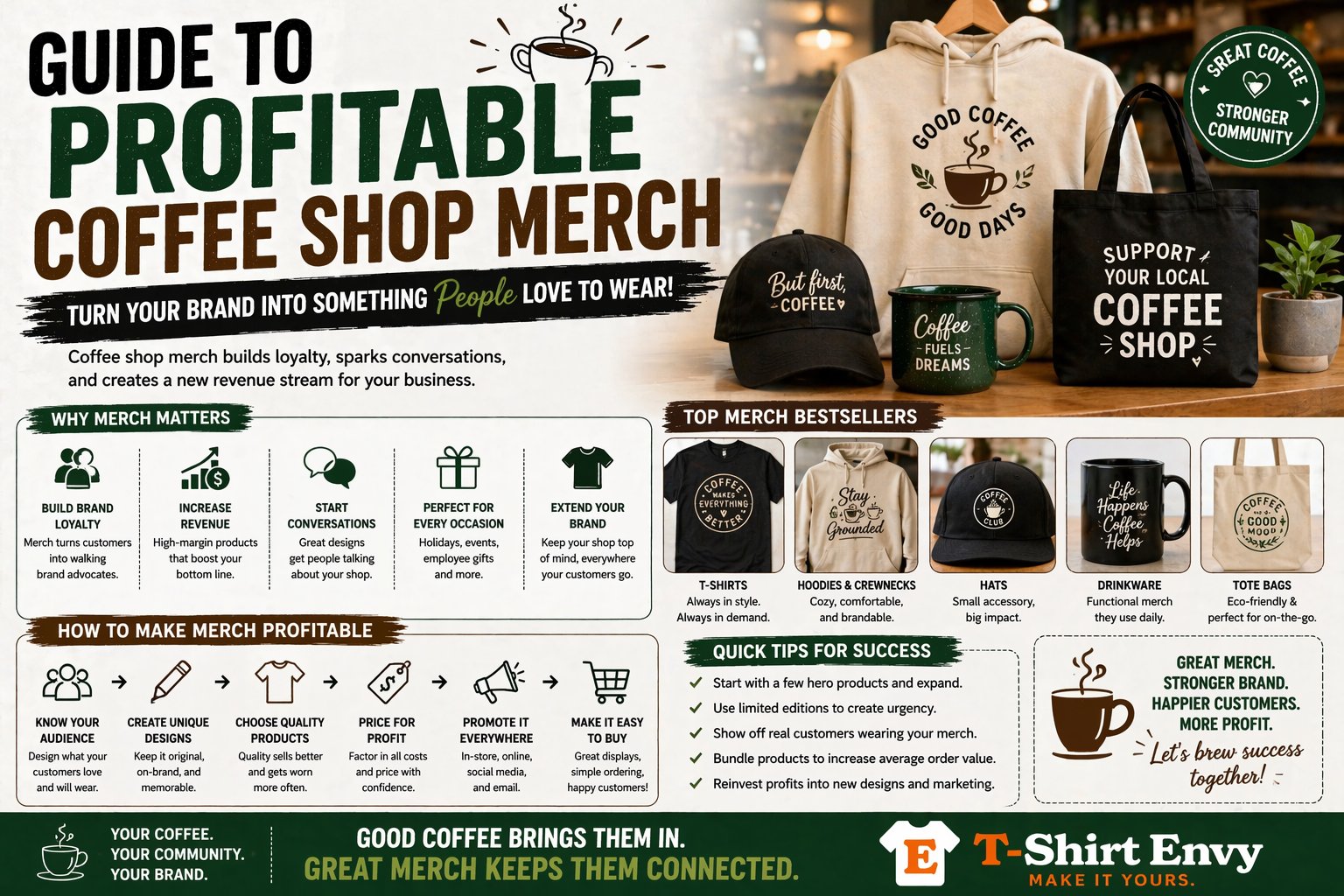
A Guide to Profitable Coffee Shop Merch
The rush is steady. Your baristas know the regulars by name. Customers ask about your beans, post your drinks, and keep reaching for one more way to take the shop home with them. A shirt. A mug. A hat that feels like your brand, not a throwaway souvenir.
That demand matters because merch can add sales without adding pressure to the bar. It gives customers a way to buy into the brand between visits, and it puts your shop in kitchens, offices, and back seats where your cups cannot go.
For a small cafe, it’s not a question of whether merch can work. It is how to build it without tying up cash in boxes of unsold inventory.
That is where a flexible approach wins. Small test runs, rush reorders, and no-minimum options let owners learn what customers will actually buy before committing to larger quantities. That keeps risk down, protects cash flow, and helps each reorder get smarter.
Strong coffee shop merch usually does three things well. It fits the identity customers already love. It leaves enough margin to be worth the shelf space. It is ordered in a way that keeps you agile instead of stuck with dead stock in the back room.
Merch does not need to be complicated. The shops that make money from it treat it like a focused retail line. They choose a few products with clear demand, match the print method to the item and order size, and use inventory discipline to test, restock, and grow profitably.
Your Coffee Shop Is Thriving, Now What?
Saturday hits, the line stays deep for three hours, and the register looks strong. Then the rush ends. Seats open up, drink volume levels off, and the next question gets harder to ignore. How does the shop keep growing without adding more labor, more equipment, or more square footage?
Merch is often the cleanest answer.
It gives a busy cafe another way to earn from the brand it has already built. A good mug, hat, or sweatshirt keeps selling after the latte is gone, and it keeps the shop visible in kitchens, offices, and school drop-off lines. That kind of reach matters for small businesses because it turns customer loyalty into repeat retail revenue.
The upside can be meaningful. As noted earlier, coffee businesses have seen 21% income growth from custom mugs and apparel sales alone. The takeaway is simple. Merch deserves the same attention as any other profit center.
The mistake is treating it like a side table of souvenirs. Profitable merch works better as a small retail line with clear goals, target margins, and a fast feedback loop. That matters even more for independent cafes, where cash tied up in slow inventory hurts twice. Once when you buy it, and again when it sits.
Agility is what separates the smart merch programs from the expensive ones. Start with a few items customers are already likely to buy. Order small test runs. Reorder fast when something hits. If a design stalls, change it before you sink more money into it. No-minimum and rush-order options make that possible, especially for seasonal drops, event weekends, or quick collaborations inspired by proven coffee shop event swag ideas.
That approach protects cash flow and improves ROI. You learn what your regulars want, instead of guessing from a wholesale catalog.
The shops that win here do not chase the biggest collection. They build the most responsive one.
Planning Your Merch Menu Beyond the T-Shirt
The first mistake most shops make is assuming more options means more sales. In practice, too many weak options usually create clutter, tie up cash, and make the display look confused.
Industry guidance points the other way. 80% of coffee shop revenue comes from 20% of inventory, and successful shops often keep branded merchandise to 4 to 6 core product categories to reduce carrying costs by 30% to 40%, according to Barista Underground’s coffee shop merchandising guidance.

Pick hero products first
Start with the items that naturally fit cafe behavior. People already carry drinks, wear casual apparel, and buy small lifestyle goods. That makes a few categories especially practical:
Branded mugs and tumblers work because they connect directly to the product you already sell.
T-shirts and sweatshirts work when the design stands on its own and doesn’t feel like staff uniform leftovers.
Hats are strong for simple marks, icons, and stitched logos.
Tote bags make sense if your customers grab beans, pastries, notebooks, or market goods.
Whole bean bags paired with merch can create giftable bundles without forcing a huge product expansion.
A good merch menu feels edited. Customers should understand it in seconds.
Match the product to your shop personality
A neighborhood cafe with handwritten specials and local art on the walls shouldn’t launch merch that looks like it came from a tech conference. A modern espresso bar with a stripped-back black-and-cream identity shouldn’t suddenly sell loud novelty graphics unless that contrast is intentional.
Use your space as the filter. Look at:
Your cups and menu boards
Your interior materials
The tone of your social posts
What staff already wear
What customers photograph
Those signals tell you what belongs.
If the merch looks disconnected from the cafe, customers notice immediately. The shelf may be full, but it won’t move.
Build a small collection with range
A strong first drop usually includes one easy-buy item, one premium-feel item, and one visual statement piece.
Here’s a simple way to think about it:
| Product role | What it does | Good fit |
|---|---|---|
| Entry item | Easy impulse purchase | Mug, sticker-style graphic tee, tote |
| Premium item | Raises perceived brand value | Embroidered cap, heavyweight hoodie |
| Signature item | Becomes the talking piece | Illustrated shirt, seasonal mug, local-culture design |
That balance helps you avoid a shelf full of same-price, same-purpose products.
Test before you expand
Don’t start by ordering every colorway and every size breakdown you can imagine. Start narrow. One strong black tee can outperform six average options. One mug customers love beats three forgettable versions.
Seasonal events can help you test without overcommitting. A local market, anniversary party, latte competition, holiday bundle, or pop-up gives you a reason to try a focused run. If you want more ideas for event-driven apparel, this guide to event swag ideas for branded merchandise is useful for adapting retail products to short selling windows.
The point is discipline. Good coffee shop merch is curated. Great coffee shop merch earns its space.
Designing Merch That Brews Real Excitement
Design is where many coffee shops either create demand or kill it.
Customers don’t buy apparel just because your logo exists. They buy pieces that feel wearable, giftable, or collectible. That means your merch design has to do more than stamp your name across a chest.

Color matters early. Research cited by Perfect Daily Grind notes that consumers make purchase decisions within 90 seconds, and 62% to 90% of that decision can be based on color. The same article explains that, in coffee presentation, colors like yellow can suggest acidity while pink can suggest sweetness, shaping perceived value and interest. You can review that in Perfect Daily Grind’s piece on packaging and merchandise design.
Design for wearability first
A shirt that looks great as a social post but awkward on a person won’t reorder well. Wearability comes from restraint.
Three approaches usually work:
Small mark placement for customers who want subtle branding
Bold back graphic for shops with strong illustration, typography, or neighborhood identity
Series-based designs tied to roasts, seasons, or local references
What usually doesn’t work is random logo placement with no visual hierarchy. That’s where merch starts looking promotional instead of desirable.
Build a color system, not random color choices
If your brand already has a palette, use it with discipline. If it doesn’t, build one before printing anything.
A useful coffee shop merch palette often includes:
One core neutral like black, cream, or heather gray
One signature brand color that customers already associate with the cafe
One accent color used selectively for seasonal drops or limited graphics
That system helps shelves look intentional. It also helps online product photos feel cohesive.
For owners who need help preparing artwork, this walkthrough on how to design prints for T-shirts is a good starting point for turning a rough idea into print-ready art.
Know the file basics before you order
This part saves a lot of frustration.
If you’re printing a simple logo, vector art is ideal because it scales cleanly. If you’re using an illustration or photo-based graphic, you need a high-resolution raster file prepared at print size. Low-quality screenshots, social media exports, and tiny web graphics usually produce weak results.
Use this quick check before sending art:
Logo mark should be in a vector format when possible
Illustration file should be high resolution at final print dimensions
Colors should be intentional, not pulled from multiple mismatched assets
Backgrounds should be transparent when the garment color is part of the design
A visual demo can help if you’re comparing screen-ready art with files that still need cleanup.
Let the merch say something
The strongest coffee shop graphics usually communicate one of four things:
Place
Neighborhood pride, city references, local landmarks, or inside jokes your customers recognize.Craft
Roasting, espresso, brewing tools, cup profiles, or coffee language used with taste.Mood
Early mornings, work sessions, weekend rituals, rainy-day cafe energy.Community
The feeling that your cafe is where people gather, create, and return.
A good cafe logo can sell a mug. A great concept can sell out a shirt.
If your brand team is small or nonexistent, a printer with in-house art support can help clean up files, adjust placement, and prepare production-ready versions before you commit.
Choosing the Right Print Method for Your Vision
Print method affects cost, look, speed, reorder flexibility, and what products make sense to carry. This choice shouldn’t be treated like shop jargon. It’s a business decision.
Coffeehouse sales in the United States grew 97% between 1998 and 2003, according to the USDA Economic Research Service’s coffee consumption review. That growth helped establish the modern cafe as a retail environment, not just a beverage counter. Today’s merch programs need the same flexibility. Some designs belong in small test runs. Others should scale cleanly for events, staff wear, and repeat bestsellers.

DTG for detailed designs and low-risk testing
Direct to Garment, or DTG, is a strong fit when your coffee shop merch includes full-color artwork, gradients, painterly illustrations, or small-batch testing.
Use DTG when:
Your art has many colors and you don’t want to simplify it
You’re testing a new design before committing to volume
You need no-minimum flexibility for a quick drop or event
You want soft-hand prints on apparel
DTG is especially useful for first collections because it lowers the risk of betting big on unproven graphics.
Screen printing for repeat winners
Screen printing shines when you already know a design sells and you want efficient production for larger runs. It works well for cleaner graphics, stronger spot colors, and repeat orders where consistency matters.
Screen printing makes sense when:
The design is simpler
You’re ordering in volume
You want strong visual impact with durable ink laydown
The same shirt will be reordered regularly
This is often the right move for staff shirts, anniversary tees, and your proven bestseller graphic.
Embroidery for premium brand signals
Embroidery isn’t right for every design, but when it fits, it raises perceived value fast. Hats, jackets, aprons, and some heavier garments benefit from stitched logos and icon marks.
Embroidery works best when:
Your artwork is clean and not overly detailed
You want a textured, premium finish
You’re selling hats or outfitting staff
Your brand leans classic, refined, or minimal
A compact stitched icon on a cap can outperform a large printed logo if your audience prefers understated merch.
Compare by goal, not by hype
Here’s the simplest way to choose:
| Goal | Better fit |
|---|---|
| Test a new multicolor design fast | DTG |
| Reorder a proven shirt in volume | Screen printing |
| Add premium texture to hats or outerwear | Embroidery |
If you’re comparing digital print paths for apparel art, this explanation of direct-to-film vs direct-to-garment printing helps clarify when each process makes operational sense.
One practical option in this category is T-Shirt Envy, which offers DTG, DTF, screen printing, embroidery, rush production, and no-minimum ordering through its website and the TSE mobile app. That kind of flexibility is useful when a coffee shop wants to test one graphic this week and reorder a different bestseller later without rebuilding the whole process.
Choose the print method that matches the product’s job. Don’t force every design through the same production lane.
A Smart Strategy for Ordering and Inventory
A busy Saturday can trick a shop into overbuying. Ten customers ask about your new tee, two buy it, and suddenly a full size run plus a second color feels justified. That is how cash gets stuck on a shelf.
Most coffee shops lose money on merch by ordering too wide, too early. The safer, more profitable play is to test narrow, learn fast, and reorder only what earns the space.
Use small tests to find the winners
Start with a tight drop. One shirt, one hat, one mug is enough to read demand without turning your stockroom into a guessing game.
Watch the signals customers give you in real time:
What gets picked up and handled
What staff members keep hearing comments about
What sells as a gift
Which sizes move first
Whether the same item sells online and in-store
That mix matters. A design people compliment is not always a design they buy. A mug that moves steadily at the register can beat a shirt everyone loves on Instagram but never converts on.
Small-batch ordering gives you room to adjust before a weak item becomes a write-off.
Build around reorder speed
Reorder speed changes the math. If your printer can turn around short runs quickly, you can carry less inventory, test more ideas, and keep more cash available for the parts of the business that already work.
That is why no-minimum and rush options matter so much for small shops. They are not just production features. They are risk-control tools.
Useful tactics include:
Pre-orders for special drops or anniversary designs
Short-run tests for new artwork
Rush fills before markets, festivals, or collaborations
Staff wear doubling as a demand test when customers ask to buy what the team is wearing
I usually advise owners to treat the first order as market research that happens to generate revenue. Once an item proves itself, then it earns a deeper buy.
Operational flexibility matters for that reason. Quick, Quality, Printing!™ has value when it helps you order based on demand instead of hope.
Let sustainability become part of your process
A lot of coffee shops want sustainable merch. The hard part is verifying what a supplier means by it. An article from Convert.com on finding product selling angles points out a broader guidance gap around sustainability claims, especially when businesses are trying to translate broad values into specific product decisions: this article on identifying product selling angles and the sustainability guidance gap.
Handle that gap with better questions, not broader marketing language.
Use a vendor checklist like this:
Garment sourcing
Ask where the blanks come from and whether the supplier can explain their sourcing standards clearly.Ink and print process
Ask what type of inks are used and whether the process minimizes waste for small runs.Packaging choices
Ask how items are packed and whether excess packaging can be reduced.Claim language
Don’t market the merch as “eco-friendly” unless you can explain what that means in plain language.
Clear answers build trust. Vague promises create returns, skepticism, and awkward staff conversations at the counter.
Manage it on the go
Coffee shop owners are rarely sitting at a desk. Ordering has to fit between deliveries, shift changes, and service rushes. The TSE mobile app is useful for uploading art, placing apparel orders between shifts, checking production status, and managing reorders without being tied to the back office.
That kind of access helps when merch becomes an active retail category instead of a side project. You need a process that fits the pace of the shop and lets you restock winners fast, without adding a pile of admin work.
Pricing for Profit and Launching With a Bang
Pricing coffee shop merch is where many owners get timid. They price from fear instead of value. If the product looks good, fits the brand, and is presented well, it shouldn’t be priced like an apology.
Start with a simple formula. Use your total landed cost as the baseline, then apply a multiplier that supports margin, replacement, and promotional flexibility. The exact multiplier depends on the item, your customer base, and your positioning, but the goal is straightforward: the retail price has to leave room for profit after production, display, and occasional markdowns.

Price with context, not guesswork
A few practical checks help:
Compare against your own brand level
If your cafe presents as specialty, design-forward, and polished, your merch should be priced accordingly.Protect your premium items
Hats, embroidered goods, and heavier garments usually need more margin than entry items.Leave room for bundles
A shirt-and-beans or mug-and-gift-card pairing can move units without training customers to wait for discounts.Don’t undercut your best design
If one piece is the obvious standout, price it like the hero product it is.
Launch like it matters
A merch launch should feel like an event, even if it’s small. That energy tells customers the collection is worth noticing.
A practical launch checklist:
Put staff in the merch early
If baristas wear the new shirt or cap before launch day, customers start asking about it.Tease one design at a time
Show details, not the whole collection at once. A sleeve print, back graphic, or mug handle close-up builds curiosity.Create a dedicated display zone
Don’t scatter product around the register. Group it so the collection reads as intentional.Pair merch with your menu
Bundle a shirt with beans, or position mugs near retail coffee and brew gear.Give launch day a reason
Tie it to an anniversary, artist collaboration, seasonal menu change, or neighborhood event.
Train the team to sell naturally
Your staff doesn’t need a script. They need a few casual prompts.
Try lines like:
“That design just came in this week.”
“That cap has been getting a lot of attention.”
“We’ve got the shirt version if you like that graphic.”
Short, easy mentions work better than hard selling.
Start Brewing More Than Just Coffee
Coffee shop merch works when it’s treated like a retail system, not a random collection of branded items. Pick a tight product mix. Design for real customers, not just your own taste. Choose print methods based on the job each item needs to do. Keep inventory flexible so you can test, learn, and reorder with confidence.
Done well, merch gives your shop another way to earn, another way to be seen, and another way for customers to stay connected to the space you’ve built.
If you’re ready to turn your cafe identity into apparel that sells, start with a focused collection and a production plan you can manage. Visit T-Shirt Envy to start your custom order today, or download the TSE mobile app to upload designs, place orders on the go, and keep your next merch drop moving.


