
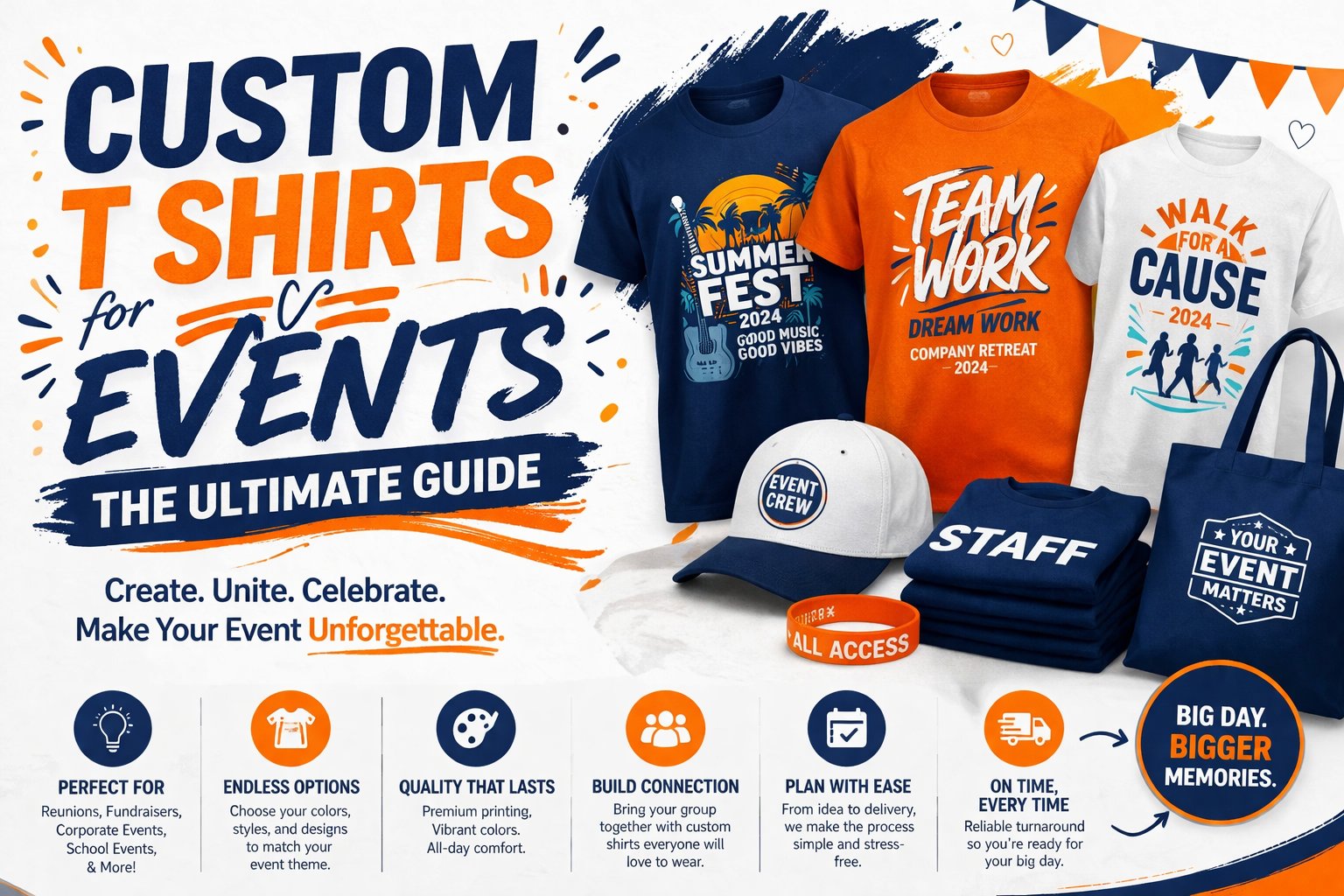
Meta description: Custom t shirts for events made simple. Learn planning, print methods, design, rush logistics, and ordering tips for high-stakes event apparel.
The week before an event is where apparel mistakes show up. The sponsor updates the logo. Two speakers ask for different shirt sizes. Someone notices the volunteer shirts are on the wrong garment color. Then the question lands on your desk: can we still get custom t shirts for events done right, on time, and without handing out shirts people never wear?
I’ve learned this the hard way on conferences, races, staff activations, reunion weekends, and sponsor-heavy launches. Event shirts are not a side task. They affect check-in flow, staff visibility, attendee experience, sponsor satisfaction, and the photos people post after the event.
Done well, a shirt becomes part uniform, part souvenir, part moving signage. Done badly, it becomes a box of leftovers and a day-of headache.
The Power of the Perfect Event T-Shirt
Three days before a festival, nobody cares about theory. You care about whether the shirts will arrive, whether the print will hold up, and whether the volunteers at the registration table can find the right sizes fast.
That pressure is one reason custom apparel keeps growing as an event category. The global custom t-shirt printing market was valued at USD 5.16 billion in 2024 and is projected to reach USD 9.82 billion by 2030, growing at a CAGR of 11.5%, with demand driven by sports competitions, corporate conferences, and personal celebrations according to Grand View Research’s custom t-shirt printing market analysis.

Why event shirts matter more than many anticipate
A good event shirt does several jobs at once:
Creates instant team visibility for staff, vendors, volunteers, and security support
Gives attendees a takeaway that can outlast the event itself
Supports sponsor exposure when logos are handled clearly and professionally
Helps unify the room at retreats, races, meetups, and company events
I’ve seen organizers treat shirts like a last-minute merchandise add-on. That usually leads to rushed art approvals, wrong print methods, and poor size planning.
The common failure points
Apparel problems often stem from a short list of mistakes:
Starting too late and losing time to approvals.
Choosing the wrong print method for the artwork or garment.
Underestimating size mix and overordering the wrong sizes.
Ignoring distribution logistics until boxes land at the venue.
Trying to save money in the wrong place, usually on garment quality or proofing.
Tip: If the shirt affects staff operations, sponsor visibility, or attendee check-in, treat it like production, not swag.
A well-run shirt order protects the event from avoidable friction. It also gives you one less fire to put out when unexpected event-day surprises start rolling in.
Your Event T-Shirt Master Plan
The cleanest apparel orders start backward. Begin with the event date, then work in reverse until every approval, production step, and delivery checkpoint has an owner.
Build the timeline backward
If your event is on Friday, your shirt plan should already answer these questions:
When is final headcount locked
When do sponsor logos close
When does artwork get approved
When does production start
When do shirts arrive or get picked up
When are they sorted for distribution
A simple working timeline looks like this:
| Milestone | What needs to happen |
|---|---|
| Event week | Sort shirts by team, role, or attendee type |
| Final production window | No more design changes unless you accept rush limitations |
| Approval window | Final art, sizes, garment color, and print locations confirmed |
| Design window | Collect logos, names, themes, sponsor requirements |
| Planning start | Set goals, budget, quantities, and use case |
The exact dates depend on your event. The point is to separate creative decisions from production decisions. When teams blur those together, they burn time.
Set the job objective first
Not every shirt has the same job.
A volunteer shirt needs visibility. A VIP gift shirt needs better feel and fit. A race shirt may need performance fabric. A trade show staff polo needs a more polished finish than a bachelor party tee.
Ask these first:
Is this shirt for staff identification, merch sales, guest experience, or sponsor branding?
Will people wear it once, or do you want repeat wear after the event?
Does the shirt need to feel premium, or just function cleanly for a single day?
Does the garment need to match the event environment, such as outdoor heat, indoor conference halls, or athletic use?
Those answers affect everything else.
Budget the parts that change cost
Event teams often ask for a shirt price before they’ve defined the specs. That never goes well.
Your total cost usually moves based on:
Quantity
Garment quality
Print method
Number of print locations
How many revisions and approvals are needed
How tight the deadline is
If you need to keep spend under control, simplify the variables that add complexity. One clean front print on the right garment is usually stronger than an overloaded front, back, and sleeve layout on a cheap shirt.
Key takeaway: People remember a shirt that fits well and looks intentional. They do not remember how many print locations you squeezed in.
Estimate quantity without guessing blindly
For open-registration events, perfection is impossible. You are managing risk, not predicting every body in the room.
A practical approach:
Known staff and volunteers get counted by name and size.
Speakers, sponsors, and VIPs get confirmed individually.
General attendees are estimated using registration data, prior event history, or audience profile.
Buffer units are held for swaps, damaged items, and late additions.
If you know your audience skews athletic, fashion-forward, student-heavy, or family-based, your size mix will change. If you do not know, keep your order balanced and avoid loading too heavily into the smallest or largest sizes unless registration tells you otherwise.
Plan the distribution before production finishes
Experienced organizers save hours through this step.
Decide early whether shirts will be:
handed out at check-in
placed on seats
packed into welcome bags
distributed by team lead
shipped to remote participants
That choice changes how you label boxes, sort sizes, and structure the order itself. If each volunteer captain gets one labeled box, your event morning runs smoother. If everything arrives mixed by size only, your team creates a sorting project on-site when they should be solving bigger problems.
Use tools that reduce approval lag
Approvals often stall because files are scattered across email threads. A mobile workflow helps when the person approving the shirt is in a venue walk-through or on a sponsor call. The TSE mobile app is useful here because it gives teams a way to upload art, review order details, and track production without waiting to get back to a desktop.
That matters more than people think. Many event apparel errors are not printing problems. They are communication problems.
Choosing the Right Print Method for Your Event
Bad shirt orders often start with a design that was fine, placed on the wrong method. If you match the print process to the job, you get cleaner results and fewer complaints.

Start with the event use case
For rush event work, these are the four methods organizers ask about most:
DTG
DTF
Screen printing
Embroidery
Each solves a different problem. The trick is not asking which one is “best.” The right question is which one fits your artwork, garment, quantity, and deadline.
DTG when the art is detailed and the run is small
Direct-to-Garment, or DTG, is the method I reach for when an event needs full-color artwork fast and the quantity is limited.
Per Custom Tees Now’s event printing overview, DTG is ideal for full-color, photorealistic designs on a tight deadline, can reach up to 1440 dpi resolution, and maintained 92% color retention after 20 washes.
That matters for:
speaker gifts
premium attendee shirts
art-heavy event merch
short-run staff apparel with complex branding
DTG usually feels softer than people expect, especially on cotton. It also handles gradients, photos, and multi-color art without the setup burden that comes with traditional screens.
DTF when durability matters most
Direct-to-Film, or DTF, has become a strong option for event teams that need vivid color and tougher wear across different garment types.
The same source notes that DTF proved 30% more durable than other methods in lab tests, and ties that concern to the fact that 55% of buyers regret method choices due to fading or cracking. For event apparel, that matters when shirts will be worn repeatedly, packed tightly, or printed on garments that do not suit DTG as well.
DTF is useful for:
team shirts that take abuse
mixed-fabric orders
bright logos on trickier garments
event apparel where long-term durability matters more than ultra-soft feel
If you’re deciding between the two, this breakdown on DTF vs DTG for custom apparel can help frame the tradeoffs.
Screen printing for volume and bold simplicity
Screen printing still makes sense for larger runs with simpler artwork. If the event shirt has a bold logo, limited colors, and a predictable quantity, this can be the most practical route.
It works especially well for:
volunteer shirts
charity walk shirts
team uniforms
crowd-facing giveaway tees
The main caution is setup. Screen printing is less forgiving when the art keeps changing or the quantity stays low.
Embroidery for a polished staff look
Embroidery is not the answer for every event shirt, but it shines on polos, hats, jackets, and premium staff pieces. If your front-of-house team needs a cleaner presentation, embroidery often looks more intentional than a printed chest logo.
I usually reserve it for:
conference staff polos
hospitality teams
sponsor-facing crews
executive or presenter apparel
Printing Method Decision Matrix for Events
| Method | Best For | Feel & Durability | Cost Profile | Ideal Quantity |
|---|---|---|---|---|
| DTG | Full-color, detailed art on cotton | Soft feel, strong for the right garment and use | Good for short runs and rush art-heavy jobs | Small runs |
| DTF | Durable, vibrant prints across varied fabrics | Strong durability with a slightly different hand feel | Useful when durability and flexibility matter | Small to mid runs |
| Screen Printing | Bold graphics and standardized event shirts | Durable and proven for straightforward designs | Efficient when volume is high and art is stable | Mid to large runs |
| Embroidery | Polos, hats, jackets, premium staff wear | Textured, durable, professional finish | Higher perceived value for logo-based branding | Small to mid runs |
Tip: Choose the shirt’s purpose first, then the print method. Organizers who reverse that order usually compromise on either speed or quality.
When the printer, garment, and artwork align, you get the result every event team wants: Quick, Quality, Printing!™ The phrase sounds simple. The planning behind it is not.
Designing Shirts People Want to Wear
The fastest way to waste your budget is to print a shirt that only makes sense inside the event bubble. If the design looks like a crowded sponsor sheet or a rushed clip-art concept, people wear it once, if that.
The market is moving toward more expressive event apparel. According to The Brainy Insights report on the custom t-shirt printing market, pre-made graphic designs accounted for over 57% of the market in 2024, while custom artwork with personalized messages is the fastest-growing segment, projected at a 12.1% CAGR through 2030. That lines up with what event teams already feel on the ground. People want shirts that feel specific, not generic.

Start with one clear idea
A wearable event shirt usually has one main message.
That might be:
the event name
a memorable phrase
a strong graphic
a sponsor lockup handled with restraint
a location or year treated as a secondary detail
What fails is trying to make the shirt do everything at once. If the front has a giant title, five logos, two dates, a QR code, and a slogan, nobody knows where to look.
Use hierarchy and placement
Think of shirt design like stage signage. The viewer should understand it in a glance.
A simple structure often works best:
Front chest or full front for the main identity
Back for supporting elements like schedule groups, sponsor clusters, or lineup lists
Sleeve for a small accent, not a rescue mission for leftover information
If staff need to be recognized instantly, use larger, cleaner front art. If the shirt is meant to become a keepsake, give the design more personality and less operational text.
Prepare artwork correctly
Many delays often start here. Event teams send screenshots, social graphics, or low-quality files and expect them to print cleanly on fabric.
Use a checklist:
Vector files when available for logos and typography
High-resolution raster files when vector art does not exist
Transparent backgrounds when the art should float on the shirt
Final approved colors matched to the garment
Print-size awareness so details do not become unreadable
If you need a stronger foundation, this guide on how to design prints for t-shirts is a useful starting point.
For a quick visual walkthrough, this video covers core design thinking for shirt graphics:
Match the garment color to the art
Organizers often approve art on a white digital mockup and forget the actual shirt is navy, sand, forest, or heather gray. Ink and garment color work together. They are not separate decisions.
A few practical rules help:
Light ink on light garments often loses impact.
Thin outlines disappear first.
Highly detailed art shrinks badly on smaller print areas.
Redrawing weak sponsor logos is better than forcing bad files into production.
Key takeaway: A shirt design is successful when a stranger can understand it quickly and still want to wear it later.
If your team does not have a designer, in-house graphic support can save the order. The TSE mobile app also helps when multiple stakeholders need to upload draft artwork, review changes, or approve a corrected file while moving between meetings.
Mastering Order Logistics and Distribution
Shirt ordering gets most of the attention. Shirt distribution is where event teams either look organized or overwhelmed.
Build a usable size plan
If you have registration data, use it. If you do not, build a practical mix and keep extra flexibility in the middle sizes.
For known groups, collect exact sizes. For broad attendee groups, avoid overconfidence. Event apparel is one of those categories where a rough but thoughtful estimate beats a fake sense of precision.
A few habits help:
Separate staff from attendees because the fit preferences may differ
Identify premium groups early such as speakers, sponsors, or paid VIPs
Decide whether women’s cuts are needed based on your audience and registration process
Hold swap inventory together rather than scattering extras across boxes
Sort before the event, not during it
The best distribution table is boring. Boring means everything is pre-labeled, grouped, and easy to hand out.
Use one of these systems:
By person for small teams, speakers, and internal staff.
By function for volunteers, security, production crew, and exhibitors.
By size station for large attendee pickup.
By day for multi-day events with changing shirt requirements.
If boxes arrive unsorted, assign a sorting window before venue load-in becomes chaotic. Do not let your registration team discover that job at 6:30 a.m.
Plan for swaps and late changes
People forget sizes. New staff get added. Someone wants a looser fit after check-in. That is normal.
Prepare for it operationally:
Keep a small swap stock at one controlled table.
Appoint one person to approve exceptions.
Track special allocations for late-added speakers, VIPs, or sponsors.
Keep marker labels or printed lists with each box.
Use ordering tools that support moving parts
Bulk event orders often involve many decision-makers. One person handles sponsorship. Another owns volunteer operations. Someone else signs off on branding. A central system helps reduce version confusion.
That is where the website ordering flow and the TSE mobile app can make event management simpler. Teams can place orders, upload files, and check production status without chasing one long email chain.
Think through the handoff experience
Distribution is part of event hospitality. A smooth pickup table signals competence. A messy shirt pile signals that other details may also be slipping.
I like to brief the check-in team on three things only:
where each category of shirts is stored
who handles swaps
what to say when a requested size is unavailable
That keeps the line moving and protects the guest experience.
How T-Shirt Envy Solves Event Emergencies
Rush apparel work is where vendors get exposed. Many shops can print shirts. Fewer can absorb last-minute changes without turning your event into a gamble.
One fact explains the gap. A 2025 industry report found that 68% of event organizers cite turnaround time as their biggest obstacle to using custom apparel, while only 12% of printing providers globally offer sub-24-hour services, according to this industry report summary on event apparel turnaround barriers.

When the sponsor changes late
A common problem: a sponsor gets added after the shirt was “final.” The organizer does not want to rework the entire order, but the sponsor expects visibility.
In that situation, a rush-capable printer matters more than a low quoted price from a vendor with no flexibility. Rush custom shirt ordering options are relevant here because the primary issue is no longer just printing. It is damage control.
When the count was wrong
This happens constantly. A conference underestimates volunteers. A family reunion grows after the RSVP deadline. A trade show team realizes they need extra branded shirts for setup crew and day-two staffing.
T-Shirt Envy is one option built for that reality. It offers 1-hour, same-day, and 24-hour services with no minimums for rush orders, plus DTG, DTF, screen printing, embroidery, and support for apparel and accessories. For event teams, that means the conversation can stay practical. What changed, what still needs to happen, and what method fits the deadline?
When the artwork is not production-ready
Another emergency looks smaller than it is. The file arrives as a screenshot, the logo background is wrong, or the art was designed for social media instead of fabric.
In-house design support matters in these moments because you may not need a “new design.” You may just need clean production art, fast, with someone who understands print limitations.
Tip: The best emergency vendor is the one that can tell you what must change, what can stay, and what can still be delivered today.
Why repeat organizers care about workflow
If you run multiple events a year, the true value is not only fast printing. It is having a repeatable ordering system. Membership programs such as the TSE Club can help frequent organizers with priority service, exclusive online ordering for same-day printing and delivery, and simpler reorders for recurring staff apparel or event series.
That matters when your spring fundraiser, summer activation, and fall conference all need different shirts but the same operational speed.
Make Your Next Event Unforgettable
The best custom t shirts for events do more than fill a merch table. They help people find staff, recognize sponsors, remember the day, and feel part of something shared.
The work gets easier when you treat apparel like a production item. Set the timeline backward. Pick the print method based on the use case. Keep the design clear. Plan sizing and distribution before the boxes arrive. Leave room for late changes, because they always come.
That is the difference between a shirt order that creates stress and one that supports the whole event.
If you need to move fast, start now while you still have decision room. Download the TSE mobile app to upload artwork, manage order details, and keep production visible while you’re on the go.
Start your custom order today. Get your bulk event order started now. Experience Quick, Quality, Printing!™ with the right plan behind it.
Frequently Asked Questions
What should I do with leftover event shirts
Keep a small reserve for staff replacements, speaker gifts, or post-event giveaways. After that, use leftovers intentionally. Save them for next-year promotion if the design is evergreen, donate them if appropriate, or turn them into contest prizes rather than letting boxes sit in storage.
Are there eco-friendly options for event shirts
Yes, depending on the garment and print approach available for your order. Ask about recycled or more sustainability-focused apparel choices, and discuss water-based or lower-impact printing options where they fit the design and deadline.
How do I handle shirts for a multi-day event or teams in different cities
Split the order by day, role, or destination before production starts. Label cartons clearly and decide whether shirts should ship in one bulk delivery or in separate drops. For remote coordination, the ordering process is easier when everyone can review details through the website and the TSE mobile app.
For fast-turnaround event apparel, rush reorders, and on-the-go order management, start with T-Shirt Envy. Download the TSE mobile app, upload your design, and get your custom event order moving today.


