
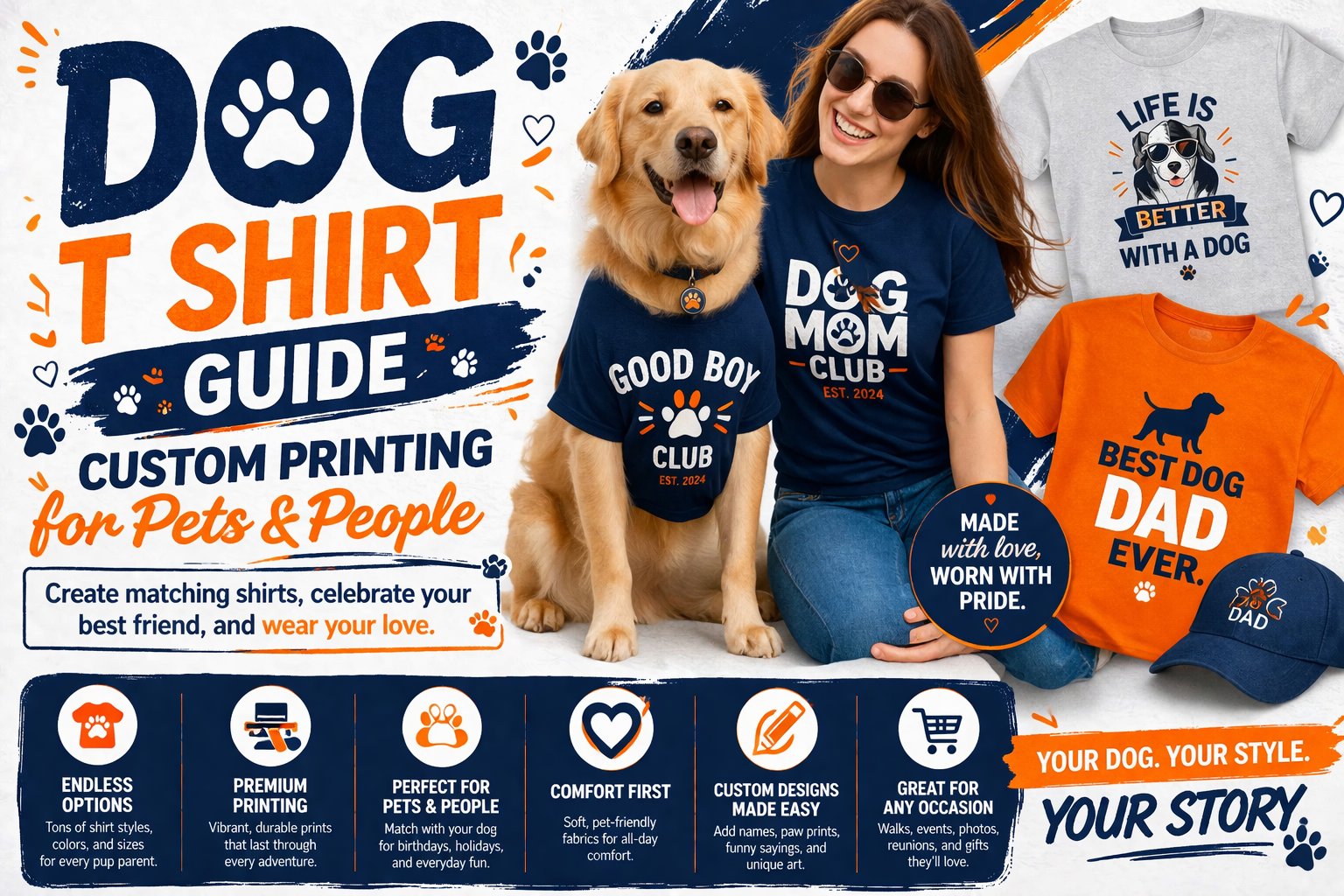
Need custom shirts for a charity dog walk, a pet-friendly office event, or a family reunion where the dogs are part of the fun too? A dog t shirt order usually means one of two things. You need shirts made for dogs to wear, or you need human shirts built around dog-themed artwork. Sometimes you need both, and that is where people often make expensive mistakes on fabric, sizing, and print method.
The demand is real. The global pet apparel market reached $2.1 billion in 2023 and is projected to grow at a 7.5% CAGR through 2030, with 66% of U.S. dog owners considering their pets family members, which helps explain why custom dog t-shirts keep showing up at social events, reunions, and branded gatherings (pet apparel market data).
Your Ultimate Guide to Custom Dog T-Shirts
A good order starts with one simple question. Is the shirt meant for the dog, the owner, or both as a matched set?
That choice changes everything. A human tee can prioritize hand feel, style, and graphic impact. A dog t shirt has to clear a much tougher standard. It needs to fit the body correctly, avoid rubbing, move with the dog, and still hold up after wear and washing.

Why demand keeps growing
Pet apparel is no longer a novelty-only category. Buyers now order it for:
- Event branding such as dog walks, rescue fundraisers, pet expos, and family reunions
- Matching sets for owners and pets in photos, content creation, and special occasions
- Team identity for school mascots, company outings, and community groups
- Retail merch for groomers, pet boutiques, trainers, and creators with dog-focused audiences
For first-time buyers, the trap is assuming one production setup works for every garment in the order. It does not. The best human tee for a soft full-front print is not always the best blank for a dog shirt that needs stretch and comfort.
What works on real orders
The strongest projects usually keep the artwork system consistent while changing the garment specs. That means:
- Use the same visual identity across pet and human pieces
- Scale the art differently for each garment size
- Pick fabric by wearer, not by convenience
- Match the print method to the material and order size
Tip: If dogs will wear the shirt for more than a quick photo, comfort outranks novelty every time.
A practical order also plans for speed. Event buyers often finalize names, counts, or sizes late. That makes flexible production important, especially when some pieces are one-offs and others belong to a larger coordinated run.
For Paws or People Defining Your Dog T-Shirt Project
The phrase dog t shirt hides two very different jobs. One is apparel engineering for an animal. The other is graphic apparel for a human customer. The artwork can connect the two, but the buying decisions should not.
Shirts made for dogs
A shirt for a dog has to solve for motion first. Dogs bend, twist, crouch, run, and pull at the chest and shoulders. If the body length is off or the chest is too tight, the garment stops being wearable even if the print looks great on the table.
The main priorities are:
Safe contact with skin and fur
Soft, breathable material matters more than trend fabric.Range of motion
The chest, neck, and front leg area need room to move.Stable print placement
A design that sits well on a flat mockup can distort once the shirt stretches across the ribcage.Simple construction
Less bulk usually means fewer pressure points.
A practical dog shirt is often cleaner and less overloaded than a human fashion tee. Small print areas tend to work better. So do placements that avoid heavy ink right over high-flex zones.
Shirts made for people with dog-themed designs
Human tees follow a different logic. Buyers usually care about:
- garment softness
- fit style
- retail look
- color matching
- design size and placement
- whether the shirt feels promotional or premium
A human shirt can carry larger artwork, detailed illustrations, breed graphics, event slogans, or matching typography that mirrors the dog version. Many brands build the stronger visual story on human apparel, then simplify that story for the pet garment.
Matching sets without mismatching function
The best paired orders do not force identical construction on both products. They share branding while respecting the wearer.
A good setup might look like this:
| Project type | Best priority |
|---|---|
| Dog shirt for an event | Comfort, fit, easy movement |
| Human event tee | Soft feel, print scale, visual impact |
| Matching owner-pet photo set | Color coordination, simplified dog print area |
| Retail merch line | Consistent branding across both categories |
Key takeaway: Matching does not mean identical. It means coordinated.
If you define that early, the rest of the order gets easier. You can choose fabric, print method, and sizing without trying to force one template onto two completely different garments.
Choosing Your Print Method for a Perfect Finish
Print method decides how the artwork feels, how it handles color, and how well it behaves on different garments. For a dog t shirt project, that matters even more because pet garments often use different fabric blends and smaller print zones than human tees.

DTG for soft prints on cotton-rich garments
Direct to Garment works best when you want a soft print feel on natural-fiber shirts, especially cotton-rich blanks. It is a strong option for detailed graphics, photo-style art, and small-run orders where every piece might be slightly different.
For dog shirts, DTG makes the most sense when the garment is primarily cotton and the design does not need to cross heavy-stretch zones. For human tees, DTG is often the easiest way to get a polished full-color result without building a large production setup.
What DTG does well:
- handles complex color blends
- prints detailed illustrations cleanly
- keeps the print integrated into the fabric feel
- works well for one-offs and short runs
Where DTG becomes less ideal is on garments that lean heavily synthetic or need maximum stretch tolerance.
DTF for versatility and stronger hold across blends
Direct to Film is the flexible workhorse for mixed-fabric projects. If your order includes dog shirts in blends and human tees in different materials, DTF usually opens more options.
It is especially useful when the garments are not all the same blank. You can maintain visual consistency across multiple substrates without rebuilding the art for a completely different print system.
DTF is often the better choice when you need:
- bright graphics on dark garments
- crisp edge detail
- stronger consistency across cotton, poly, and blends
- a print that handles movement well
The print has more surface presence than DTG, so the feel is different. That is not automatically a downside. It just means comfort and placement matter more on the pet garment.
For a closer technical comparison, this breakdown of DTF vs DTG printing is useful when you are deciding between softness and fabric flexibility.
Screen printing for larger, simpler runs
Screen printing still has a place in dog-themed apparel, especially on human event shirts. It works best when the design is simpler, the order count is higher, and the artwork does not rely on photo-level detail.
For dog shirts, screen printing can work, but the setup makes the most sense when the garment style is standardized and the design is simple. On varied pet sizes, that can become harder to manage.
Practical trade-offs that matter
Here is the short version:
- Choose DTG when softness and cotton compatibility matter most.
- Choose DTF when your order spans different materials and you need strong visual consistency.
- Choose screen printing when the design is simple and the run is larger.
Tip: For mixed pet-and-people orders, many buyers get the cleanest result by using one print method for dog garments and another for human tees.
That is not a compromise. It is usually the smarter production choice.
Best Fabrics for Dog T-Shirts and Human Tees
Fabric drives comfort, print performance, and whether the shirt gets worn again after the event. For dog apparel, bad fabric choices show up fast. The shirt twists, traps heat, rubs under the chest, or loses shape.
For custom dog t-shirts, 100% cotton or high-cotton polyester blends are the strongest starting point. These materials allow 30 to 40% more airflow than pure synthetics, reduce overheating risk by 15 to 25% in active dogs, and blends with 5 to 10% spandex support 20% greater range of motion (dog apparel fabric guidance).

Best picks for dogs
Cotton and cotton-rich blends win because they breathe better and feel gentler against the body. Dogs do not need fashion fabric. They need something that stays comfortable across movement and changing temperatures.
A solid dog shirt fabric usually offers:
- Breathability so the dog does not heat up quickly
- A little stretch so the shirt moves with the body
- A smooth surface for cleaner printing
- Enough structure to keep the shirt from collapsing or twisting
Low-quality synthetics often miss on multiple fronts. They can feel slick, hold heat, and fight against print quality unless the method is selected very carefully.
Best picks for human tees
Human apparel gives you more freedom. You can choose for softness, retail appearance, or durability depending on the project.
For matched pet-and-owner sets, cotton or cotton-rich tees usually create the most natural visual pairing because the drape and finish look more cohesive across the collection. If the human shirt is ultra-slick athletic polyester while the dog shirt is soft cotton, the set can feel disconnected even with identical art.
If you are sorting through blank options, this guide to the best fabric for t-shirts helps narrow the choice by wear case rather than trend.
What to avoid
Some fabrics look good online and fail in use. Common trouble spots include:
- rough hand feel
- poor stretch recovery
- excessive heat retention
- thin fabric that warps under print
- stiff seams that rub under the legs or chest
Practical rule: If the fabric already feels questionable in your hand, it will not feel better on a dog.
For event orders, buyers often focus heavily on artwork and color. Fabric deserves the same attention. The print can be perfect and the project can still disappoint if the base garment was wrong.
Sizing and Fit A Guide for Four-Legged Friends
Most failed dog apparel orders do not fail because of print quality. They fail because the shirt does not fit the body it was made for.
A correct fit affects comfort, movement, and how the design sits during wear. The two-finger rule is the simplest benchmark. Leave 0.5 to 1 inch of clearance at the neck and chest, which helps reduce returns by 25% in pet retail and lowers the chance of chafing or restricted breathing (dog sizing benchmark).
The three measurements that matter
You only need three numbers for most dog t shirt projects.
Back length
Measure from the withers to the base of the tail.Chest girth
Measure around the widest part of the ribcage.Neck girth
Measure where the collar normally sits.
Keep the tape level and do not pull it tight. If the tape compresses the fur heavily, you are already heading toward a shirt that will wear too snug.
Use the two-finger rule every time
After taking the raw measurement, build in wearable ease. You should be able to fit two fingers between the garment and the dog at the neck and chest.
That space matters because a dog is not standing still all day. The body expands during movement, and the shirt has to move with it.
Small mistakes create big problems:
- Too tight, and the dog may rub, resist the shirt, or breathe less comfortably.
- Too loose, and the shirt can shift, drag, or twist the print placement.
- Too long, and the back panel bunches or interferes with movement.
- Too short, and the shirt rides up and loses shape.
Breed ranges are only a starting point
Some standard charts list examples such as Small dogs at neck 6.5 inches, back 9 inches, chest 14 to 16 inches, and Medium dogs at back 14 to 24 inches and chest 23.5 to 28 inches in the verified sizing data above, but breed labels are only a starting point. Mixed breeds, broad chests, deep ribcages, and long backs can all break the chart.
That is why measuring the actual dog matters more than buying by breed name.
A quick visual can help before you finalize sizes:
Closures and fit behavior
Pullover styles can look cleaner and hold up well when the fabric has enough give. Adjustable closures can help when you are fitting a wider range of dogs in one event order.
The right choice depends on how standardized the group is:
| Order type | Better fit approach |
|---|---|
| One dog, custom piece | Measured pullover or custom-fitted |
| Small event with known dogs | Sized assortment with measured checks |
| Larger group with unknown variance | More forgiving closure or flexible fit style |
Tip: Ask owners to measure the chest first. That is usually the make-or-break number.
Designing Artwork That Wows on Any T-Shirt
Good artwork for a dog t shirt order does two jobs. It creates a strong visual identity, and it respects the physical limits of the garment. A design that looks balanced on an adult human tee can overwhelm a small dog shirt fast.
There is also a more interesting opportunity here. Most pet apparel still leans toward novelty graphics, while there is a real opening for functional dog apparel such as branded shirts with reflective elements for visibility or moisture-wicking garments for active dogs at events and company outings (functional dog apparel gap).
Design for scale, not just style
The print area on a dog shirt is smaller and more curved. That changes how artwork reads.
What usually works best on dog garments:
- simpler compositions
- fewer tiny text elements
- bold shapes
- centered or upper-back placements that avoid distortion-heavy zones
- reduced detail compared with the human version
Human tees can carry the richer graphic system. The dog version should feel related, not crowded.
Functional ideas worth considering
A lot of buyers default to “cute” and stop there. That leaves useful ideas on the table.
Some stronger concepts include:
- Reflective design accents for evening walks or outdoor team events
- Branded performance shirts for company picnics, charity runs, or pet-friendly festivals
- Service-oriented designs for handler groups, volunteer teams, or rescue staff dogs
- Matching event identifiers where the human shirt carries the full event graphic and the dog shirt carries a simplified badge, logo, or name
That kind of thinking makes the apparel more wearable after the event, which usually matters more than novelty.
Key takeaway: The best pet apparel designs solve a real use case, not just a photo moment.
File setup that prevents print problems
Keep the artwork file clean from the start. For most orders, use production-ready files such as PNG with transparent background, AI, or PDF, and build the art at high resolution.
Before upload, check:
- spelling and date details
- background transparency
- print size for both dog and human garments
- line thickness on small elements
- contrast against the garment color
If the same art goes on both pets and people, create separate print files sized for each product. Resizing one master file without adjusting composition often creates weak results.
If you need a practical primer on setup, this guide on how to design prints for t-shirts is a good reference.
The easiest workflow is to treat the dog version as a companion design, not a reduced copy of the human shirt. That shift alone improves most mixed orders.
Ordering Your Custom Shirts with T-Shirt Envy
The smoothest orders start with decisions, not guesswork. By the time you place the order, you should already know four things: who will wear the shirts, what fabric each garment needs, which print method suits the materials, and how the dog sizes were measured.
That preparation makes rush timelines much easier to handle.
A cleaner order workflow
A practical ordering flow looks like this:
Lock the use case first
Event wear, merch, matching sets, fundraiser apparel, or branded staff gear all call for different choices.Separate pet garments from human garments
Even when the artwork matches, keep product specs distinct.Upload final art files by garment type
One file for the dog shirt, one for the human tee, sized correctly for each.Confirm quantities and any rush needs early
Last-minute edits usually come from names, counts, or color changes.Track progress in one place
That matters most when your order covers multiple garments or multiple wearers.
Why the mobile workflow matters
If you are ordering while coordinating an event, desktop-only systems slow everything down. The TSE mobile app is useful because it lets you upload artwork, manage orders, and track production status without waiting until you are back at a desk.
That is especially helpful for:
- event planners collecting late size details
- school or team organizers approving designs on the move
- business owners managing branded apparel between meetings
- families or creators placing mixed small-batch orders quickly
What buyers usually get wrong
The biggest avoidable errors are simple:
- treating dog sizing like human sizing
- choosing fabric only by color
- sending one artwork file for every garment
- forcing the same print method onto every product in the order
- approving a layout without checking scale on the dog shirt
A reliable print partner should catch those issues before production. That is part of what makes a fast order successful instead of rushed.
Speed matters when the setup is right
Fast turnaround only helps if the fundamentals are solid. The phrase “Quick, Quality, Printing!™” means more when the order was built correctly from the beginning.
A strong dog t shirt project is not complicated, but it is specific. The pet garment has to wear well. The human garment has to look sharp. The artwork has to work across both. When those pieces are aligned, rush ordering becomes much less stressful.
Bring Your Vision to Life with T-Shirt Envy
A successful dog t shirt order comes down to a few smart choices. Define whether the project is for dogs, people, or both. Pick a print method that fits the fabric. Use breathable materials for pet wear. Measure the dog properly. Build artwork that fits the actual garment instead of forcing one design onto every size.
Do that well, and the final result looks better, feels better, and gets worn again.
If you need matching shirts for an event, branded pet apparel for your business, or a fast-turn custom run that includes both pets and people, keep the process simple and production-ready from the start. Download the TSE mobile app to upload your design, manage your order, and stay on top of deadlines without slowing down.
Start your custom order with T-Shirt Envy today. Download the TSE mobile app, upload your artwork in minutes, and experience Quick, Quality, Printing!™ for dog shirts, matching human tees, fundraiser apparel, team orders, and rush custom printing.


