
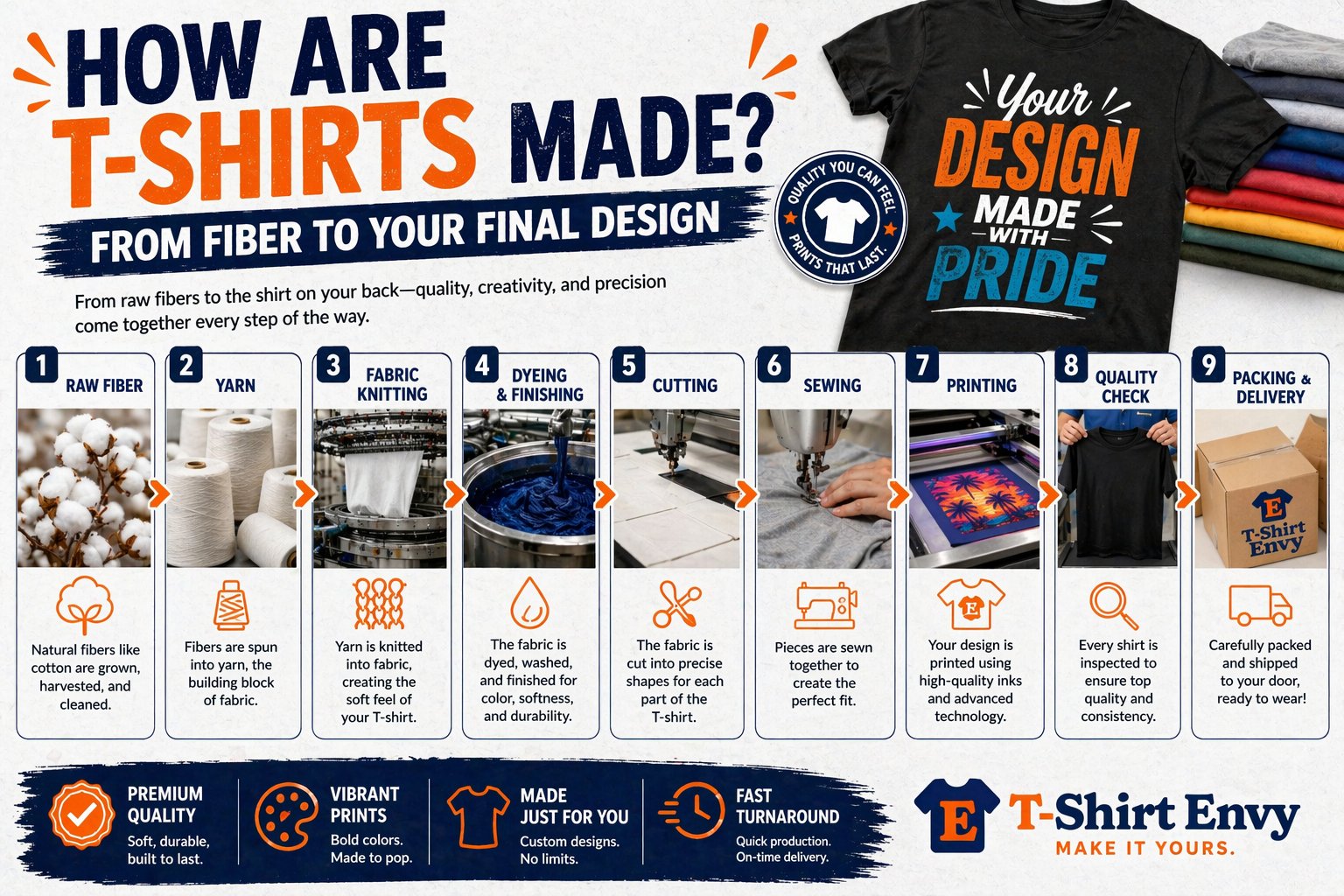
You’re probably here because you need custom shirts and want to know what you’re buying. Maybe it’s staff uniforms, event merch, team shirts, or a fundraiser order. You see terms like cotton, ring-spun, DTG, screen print, and double-needle stitching, and it all starts to sound more complicated than a basic tee should be.
That confusion is normal. If you’ve ever wondered how are t-shirts made, the answer is that a shirt is the result of dozens of production choices, and every one of those choices affects print quality, comfort, durability, speed, and cost.
From a production manager’s perspective, a t-shirt isn’t just a garment. It’s a canvas. If the fabric is unstable, the print won’t look right. If the sewing is sloppy, even a great design won’t feel premium. If the blank is wrong for the decoration method, you can lose vibrancy, stretch recovery, or wash performance.
This guide breaks the process down in plain language so you can understand what happens before your design ever hits the press.
Meta description: How are t-shirts made? Learn the full process from fiber to fabric, sewing, and printing, plus how each step affects quality, durability, and cost.
The Foundation From Fiber to Fabric
A t-shirt starts long before printing. It starts with the fiber.
For most everyday tees, that fiber is cotton. Some shirts use polyester. Others use blends, usually to balance softness, structure, moisture handling, and print compatibility. The first decision in manufacturing is simple but important: what is this shirt made from, and what job does it need to do?

Cotton begins as an agricultural product
Cotton feels familiar because it’s natural, breathable, and comfortable against the skin. But before it becomes a shirt, it has to be grown, harvested, cleaned, and separated from seeds. That farm stage carries a big resource load.
The production of one average cotton t-shirt requires 2,700 liters of water during the cotton growing phase alone, and that’s before spinning, knitting, dyeing, or sewing begin, according to Swagcycle’s overview of the life of a t-shirt. The same source notes that each shirt also requires about six miles of yarn once the cotton is spun.
That gives you a better way to think about a blank tee. It may look simple on a shelf, but a lot has already happened before anyone adds a logo or artwork.
Practical rule: If you want a shirt that feels better and prints cleaner, don’t start by asking only about price. Start by asking what the fabric is made of.
Polyester and blends solve different problems
Polyester starts from a manufactured raw material rather than a plant fiber. In practical terms, that usually means a smoother, more consistent surface and better moisture performance. It’s often chosen for athletic shirts, performance wear, and garments that need to hold shape well.
Blends sit in the middle. A poly-cotton shirt can feel softer than a basic polyester garment while still offering more structure than some all-cotton options. That matters when a business wants a shirt that works for staff wear, event use, and repeat washing.
If you’re comparing blanks for a brand launch or team order, a fabric guide like this breakdown of the best fabric for t-shirts can help you match the garment to the job instead of guessing.
Spinning turns loose fiber into usable yarn
After cotton is cleaned, manufacturers spin it into yarn. That yarn is what knitting machines will later turn into fabric.
This stage matters more than most buyers realize. The way fibers are prepared and spun affects:
- Softness: Finer, cleaner yarn usually feels smoother on the body.
- Print surface: A more uniform yarn gives printers a more consistent canvas.
- Durability: Better yarn construction helps the shirt hold up through wear and washing.
- Appearance: Lower-grade yarn can create a rougher face, which may distract from detailed artwork.
A cheap shirt often announces itself before printing even starts. It may feel fuzzy, uneven, or stiff. On press, those surface issues can make a print look less sharp than the design file looked on screen.
Why fiber choice matters to the customer
Customers usually notice the final result in three ways.
First, they notice hand feel. Does the shirt feel smooth, soft, and wearable, or does it feel like giveaway apparel that gets pushed to the back of a drawer?
Second, they notice shape retention. A shirt that twists, shrinks unevenly, or loses body quickly won’t support a premium brand image.
Third, they notice print compatibility. Some fabrics absorb ink beautifully. Others need a different decoration method to get the same visual impact.
That’s why the raw material stage isn’t just factory trivia. It’s the base layer of quality. If the foundation is wrong, every later step has to work harder to compensate.
Creating the Canvas Knitting and Finishing
Yarn isn’t a t-shirt yet. To become fabric, it has to be formed into a structure that can stretch, recover, drape, and accept decoration. For most tees, that structure is knit, not woven.
A woven dress shirt and a knit t-shirt may both start with thread, but they behave very differently. T-shirts need comfort and movement. That’s why manufacturers rely on circular knitting.

How circular knitting works
A circular knitting machine feeds yarn into needles arranged in a circle. Those needles create continuous interlocking loops, which form a tube of fabric. This method builds the shirt’s future surface one connected loop at a time.
According to Tex Asia’s explanation of t-shirt manufacturing, circular knitting creates fabric with 20 to 30% elongation, which gives standard knit tees their familiar stretch and comfort. The same source notes that this knit structure is especially useful for custom printing because it helps ink adhere without cracking.
That detail matters on a finished order. A shirt that moves with the body without fighting the print usually feels better, wears better, and keeps the decoration looking intentional.
Knitting creates the feel customers expect
When buyers say a tee feels “like a real t-shirt,” they’re usually responding to knit behavior.
Knits offer:
- Stretch for movement: The looped structure flexes more naturally than woven fabric.
- Softer drape: Jersey fabric hangs the way people expect casual tees to hang.
- Better comfort: The shirt doesn’t feel rigid through the chest, shoulder, or sleeve.
- A friendlier print surface: The fabric can support everyday wear without the decoration immediately feeling brittle.
A woven fabric would feel too stiff for most standard tees. That’s why knit construction is the normal choice for retail shirts, promo tees, and custom merchandise blanks.
A good print starts with stable fabric, not just a good machine.
Finishing changes raw knit into printable fabric
Freshly knitted fabric is not ready for cutting or printing. It still needs processing.
Manufacturers clean it, whiten it if needed, dye it if a color shirt is required, and apply finishing treatments to adjust feel and performance. These steps create the polished fabric surface people recognize in a finished blank.
Relaxation is one of the most overlooked parts of the process. After knitting and dyeing, the fabric needs time to settle. If that doesn’t happen, the material can shift later and create sizing problems.
Tex Asia notes that improper relaxation after dyeing can lead to 5 to 10% shrinkage, which can throw off consistency across a run of shirts. For a custom order, that can mean one size feels right and the next one feels off, even if the label says they match.
Why finishing matters for your custom design
From a production standpoint, finishing affects more than touch. It affects registration, placement, and predictability.
If the fabric surface is unstable, several problems can show up:
- Artwork placement can drift
- Printed areas can distort after washing
- Different shirts in the same order can feel inconsistent
- The final garment can look less premium even when the design is strong
For businesses and event organizers, consistency is the goal. You want shirt number one and shirt number one hundred to look like they belong together. Knitting and finishing are what make that possible.
Assembly The Art of Cutting and Sewing
Once the fabric is finished, manufacturers stop thinking in rolls and start thinking in garment parts. The tube or sheet of knit fabric then becomes a body panel, sleeves, neckband, and finally a complete shirt.
This stage looks simple from the outside. It isn’t. Cutting and sewing decide whether the shirt hangs correctly, whether the side seams stay straight, and whether the collar keeps its shape after repeated wear.

Cutting starts with patterns, not scissors
In modern production, factories usually use CAD-generated patterns to map every garment piece before cutting begins. Those patterns tell the cutter where each size and shape should fall on the fabric for the best yield and the most consistent fit.
According to Glim Industries’ guide to the t-shirt manufacturing process, precision cutting can slice 80 to 100 fabric plies simultaneously with ±1mm tolerance. That kind of accuracy is why size runs can stay consistent in larger production environments.
For customers, this shows up as predictability. If you order shirts for a staff team, you don’t want medium tees cut slightly differently across the batch. Clean cutting helps avoid that.
Bad cutting creates problems before sewing even begins
When fabric hasn’t settled properly, it can move under the cutter. That leads to mismatched panels, twisted bodies, or sleeves that don’t sit right once attached.
You may not identify the problem as “cutting distortion” when you open a shipment. You’ll just know the shirt looks off.
Signs of trouble often include:
- Torso panels that don’t hang evenly
- Sleeves that pull or rotate
- Side seams that creep forward
- Inconsistent fit across the same labeled size
That’s why experienced production teams care about fabric behavior before the blade ever touches it.
Sewing is where structure becomes visible
A t-shirt uses several stitch types, and each one has a job.
Glim Industries notes that assembly commonly uses 5-thread overlock construction for seams and double-needle stitching for hems. That’s a useful quality checkpoint for buyers because it tells you what to look for when you inspect a blank.
The overlock seam helps join and secure edges. The double-needle finish, often seen at the sleeve and bottom hem, adds a cleaner look and more durability for regular wear and washing.
Here’s a quick visual of the factory side of that process:
What to check on a finished blank
If you want to judge shirt quality quickly, don’t only look at the fabric. Look at the construction.
- Check the collar seam: It should sit flat, not wave or twist.
- Look at the hem: Double-needle stitching usually gives a more finished appearance.
- Inspect seam consistency: Uneven stitching can signal rushed or lower-control production.
- Stretch the shirt lightly: Seams should recover without looking stressed.
If the shirt body is well cut and the sewing is clean, the print has a far better chance of looking premium when it’s finished.
For custom apparel, that matters because decoration draws attention to the garment. Once a logo, team name, or full-front graphic is added, construction flaws become more obvious, not less.
Bringing Designs to Life Custom Printing Methods
At this point, the shirt exists as a finished blank. Now the customization stage begins.
Most customers initially focus here, and that makes sense. Printing is the visible part. But the smartest decoration decisions always match the method to the garment, the artwork, and the order type. A detailed photo print needs something different than a one-color event logo. A staff polo needs something different than a band tee.
This is also where production strategy matters most. Fast turnaround is one thing. The right method is another. The best shops build both into the process so customers get Quick, Quality, Printing!™ without choosing speed at the expense of finish.
Direct-to-Garment works like fabric-first digital printing
DTG prints directly onto the garment surface using specialized inkjet-style equipment designed for fabric. It’s a strong choice when a design has lots of color variation, gradients, or photographic detail.
Because DTG lays ink into the garment rather than creating a thick top layer, it can produce a softer feel on the right cotton-rich blank. That makes it popular for creator merch, startup apparel, art prints, and smaller runs where flexibility matters.
DTG is often a good fit when you need:
- Complex full-color artwork
- Low-quantity orders
- Fast changes between designs
- A softer printed feel on compatible shirts
The biggest factor is the blank. A smooth, stable shirt gives DTG a much better surface than a rougher or inconsistent one.
Direct-to-Film adds flexibility across garment types
DTF starts by printing a design onto a film, then transferring it onto the shirt with heat. It’s useful when you need strong color, crisp edges, and flexibility across different fabric types.
DTF often works well for:
- Small business logo runs
- Team names and back prints
- Multi-material orders
- Short-run event apparel
Compared with DTG, DTF usually feels a bit more like an applied transfer because it sits more on the surface. In return, it can handle a wide range of garments and is a practical solution for mixed orders.
Screen printing remains the classic for repeatable bulk graphics
Screen printing uses a mesh screen and pushed ink to apply a design one color layer at a time. It’s still one of the strongest options for simple graphics, bold logos, and larger runs.
When the artwork is clean and the order volume justifies setup, screen printing delivers a durable, high-impact result. It’s common for school spirit wear, company events, volunteer shirts, and promotional runs where consistency matters across many garments.
If you want a deeper explanation of the process itself, this screen printing overview gives a good foundation for comparing it with digital methods.
Embroidery changes the texture and perceived value
Embroidery isn’t ink at all. It uses thread stitched directly into the garment, which creates a raised, textured finish.
That makes it a common choice for:
- Left-chest company logos
- Uniform polos
- Hats and outerwear
- Premium branded apparel
Embroidery sends a different message than print. It feels more structured and more formal. For a corporate logo on workwear, that can be exactly the right move. For a large full-front illustration, it usually isn’t.
Choose embroidery when you want texture and permanence, not when you want photo detail.
Sublimation is built for the right polyester application
Sublimation uses heat to turn dye into gas so it bonds into polyester fibers. When the garment and design are right for it, the result can feel extremely integrated with the fabric because the image becomes part of the material rather than sitting on top.
This method is often used for performance wear and all-over polyester applications. It’s less about a thick print effect and more about embedded color on the correct substrate.
Choosing Your Customization Method
| Method | Best For | Feel on Shirt | Durability | Cost Profile |
|---|---|---|---|---|
| DTG | Full-color art, photos, small runs | Softer on compatible cotton garments | Good with proper care | Flexible for low quantities |
| DTF | Mixed fabrics, logo runs, short orders | More transfer-like surface feel | Strong for many everyday uses | Practical across varied garments |
| Screen Printing | Bulk orders, bold graphics, simple color separations | Ink sits on fabric with a classic printed hand | Durable for repeat wear | Efficient when quantities increase |
| Embroidery | Uniform logos, polos, hats, premium branding | Raised, textured stitching | Very durable | Higher perceived value for smaller logo areas |
| Sublimation | Polyester performance apparel | Integrated feel in the fabric | Strong when paired with the right garment | Depends on garment and design coverage |
How a production manager chooses
In a real shop, the decision usually comes down to four questions:
- What does the artwork require? Fine detail, solid spot colors, texture, or personalization?
- What garment is being decorated? Cotton tee, blend, polyester performance shirt, hat, or jacket?
- How many pieces are in the order? One-off, short run, or bulk event quantity?
- How fast does it need to move? Rush jobs and scheduled production aren’t always handled the same way.
T-Shirt Envy offers DTG, DTF, screen printing, embroidery, and sublimation, which means customers can match the method to the project instead of forcing every design through one system.
What matters most to the customer
Customers don’t need to memorize every machine type. They need to know what result they’re paying for.
If you want a soft full-color art print on a fashion tee, don’t choose the same process you’d use for hundreds of simple volunteer shirts. If you want a durable left-chest work logo, thread may outperform ink for the look you want. If you need variable names and numbers, transfer-based methods can solve a problem screen printing isn’t built to solve efficiently.
The print method is where the blank becomes your product. Choose it like a production decision, not just a design decision.
Connecting Quality Durability and Cost
Most buyers ask some version of the same question. Why do two shirts that look similar online end up priced differently?
The answer is cumulative. Cost doesn’t come from one thing. It comes from material choice, fabric prep, construction quality, decoration method, and order strategy working together.
Cheap blanks usually create expensive compromises
A lower-cost shirt can still work well for the right purpose. If you need basic event tees for one-time wear, that may be the right call. Problems start when customers expect premium softness, crisp print detail, and long-term durability from a garment built for a different use.
Here’s where trade-offs usually show up:
- Fabric surface: A rougher shirt can make artwork look less refined.
- Garment stability: Less controlled manufacturing can lead to twist, shrink, or uneven sizing.
- Construction: Weak finishing can shorten the life of the shirt even if the print looks good on day one.
- Perceived value: Customers judge the whole product, not just the graphic.
For a brand selling merchandise, that last point matters a lot. Buyers remember how the shirt feels after the package is opened.
Better quality usually protects the print investment
Printing is only part of the total value. If you put strong artwork on a weak blank, the garment can undermine the design.
A more stable, better-constructed shirt usually gives you:
- A cleaner canvas for decoration
- Better repeatability across an order
- Fewer surprises after the first wash
- A stronger impression when shirts are resold, gifted, or worn publicly
That doesn’t always mean you need the most expensive garment. It means the blank should match the job.
Cost also connects to waste
The traditional t-shirt manufacturing process follows a linear model and contributes to the apparel industry’s 10% share of global emissions, while the United States generated 17 million tons of textile waste in 2018, according to the EPA’s textile materials data. That context matters because poor buying decisions often create waste twice. First in production. Then again when low-quality shirts go unworn.
A better order isn’t always the cheapest initial invoice. Sometimes it’s the one people keep wearing.
How to make practical decisions without overbuying
If you’re comparing options for uniforms, merch, or event apparel, use a simple filter.
- For giveaways: prioritize cost control and readable graphics.
- For brand merch: prioritize feel, fit, and print surface.
- For staff uniforms: prioritize consistency, washability, and professional appearance.
- For fundraisers or resale: prioritize the shirt people will choose to wear again.
The right shirt is the one that fits the purpose, supports the decoration method, and still feels worth wearing after the event is over.
If you’re building an order online, the TSE mobile app can help you compare garment options, upload artwork, manage bulk or corporate orders, and track production without bouncing between emails and mockups. That makes it easier to weigh budget against fabric choice before the order is locked in.
Making a Sustainable Choice in a Fast-Fashion World
T-shirt production has real environmental costs, and buyers are paying more attention to them. That’s a good thing.
The apparel industry is responsible for 20% of global industrial water pollution from dyeing and finishing, and fast-fashion t-shirts may last only 10 washes on average, contributing to 92 million tons of textile waste annually, according to Modaknits’ summary of how t-shirts are made. The same source states that on-demand printing can cut overproduction waste by over 80% compared to bulk manufacturing.
That changes how small businesses, schools, and event organizers should think about ordering. The old model rewarded volume even when the actual need was uncertain. That often meant leftover shirts, wrong sizes, and boxes of apparel nobody used.
Better ordering habits reduce avoidable waste
You don’t have to solve the whole industry to make smarter choices. You just have to reduce avoidable excess in your own order.
A more thoughtful approach can include:
- Ordering to actual demand: Don’t pad quantities just because traditional production used to require it.
- Choosing garments people will rewear: A more wearable shirt stays in circulation longer.
- Matching the method to the use case: The right decoration helps garments stay presentable longer.
- Exploring lower-impact options: Resources like these eco-friendly promotional materials ideas can help teams align apparel choices with sustainability goals.
Why on-demand matters
On-demand printing is practical because it reduces the pressure to guess. If a creator wants a limited drop, a school wants a controlled fundraiser run, or a business needs rush apparel without shelves of extras, smaller-batch production can be a smarter move.
That doesn’t make every shirt sustainable by default. It does help prevent one of the biggest avoidable problems: making more garments than anyone will wear.
For customers, the sustainable choice often overlaps with the operationally smart choice. Buy what you need. Use a garment that fits the purpose. Print with intention. Reorder when demand is real.
If you’re ready to turn that knowledge into a custom order, T-Shirt Envy can help you choose the right blank, decoration method, and production path for your timeline. Start your custom order today, or download the TSE mobile app to upload your design, manage quantities, and keep your project moving from concept to delivery.


