
A booth manager once called after a sponsorship change forced a full apparel reset days before load-in. The panic wasn't really about shirts. It was about whether the team would still look organized, visible, and worth stopping for.
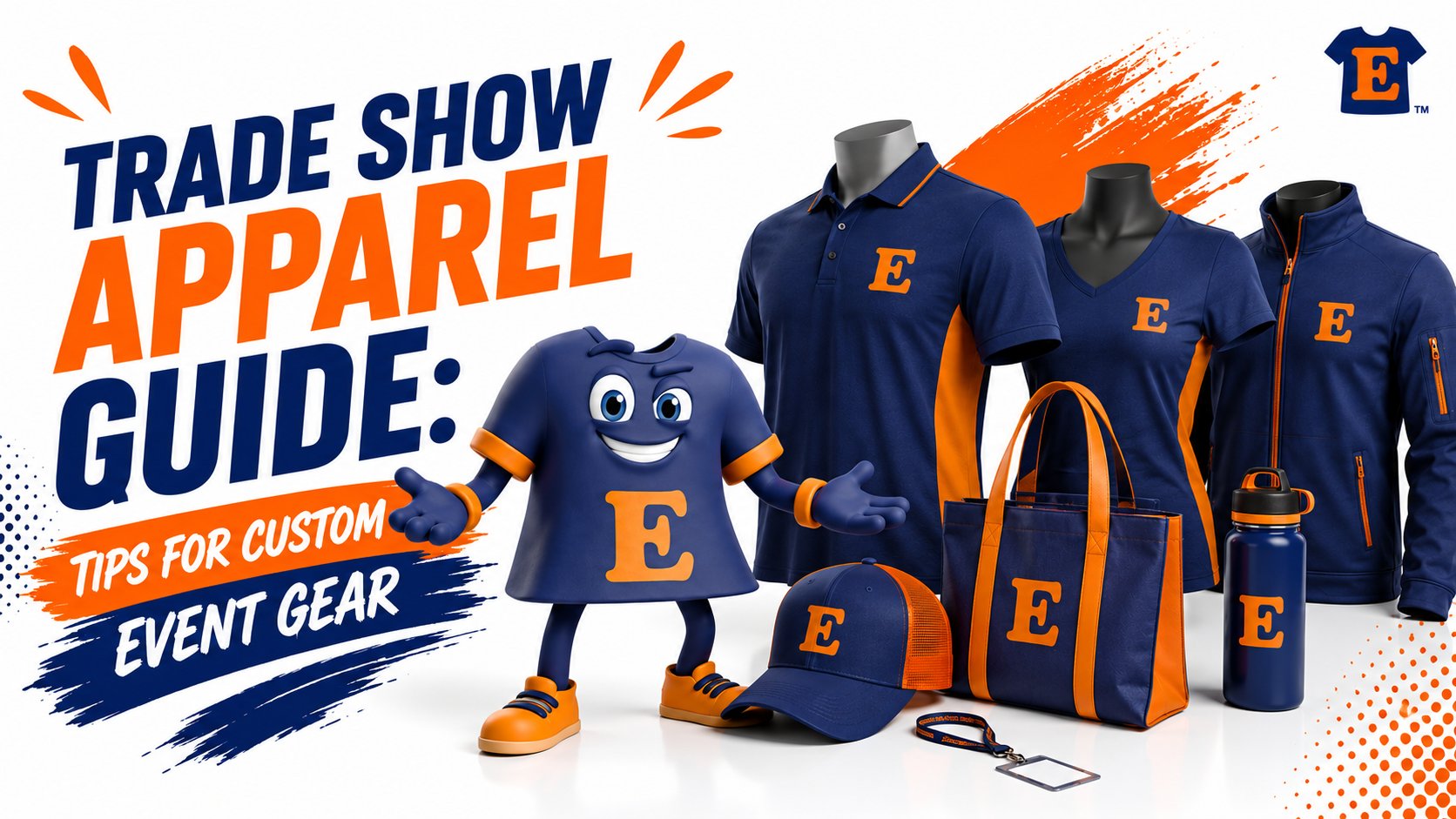
Trade show apparel works best when you treat it like part of the sales system, not a last-minute uniform order. Done right, it helps staff get recognized fast, supports stronger conversations, extends your brand beyond the booth, and keeps the whole team aligned under pressure.
Your Secret Weapon for a Winning Trade Show
The frantic version of trade show prep is familiar. Booth graphics are approved late. Shipping deadlines tighten. Someone realizes the team has a mix of old polos, random black tees, and one person who still plans to wear a dress shirt from a previous event. That's when apparel gets pushed into the “good enough” category.
That's usually a mistake.
On a crowded show floor, attendees make snap judgments. They scan for signals that tell them who belongs to a booth, who can answer questions, and which companies look put together. Trade show apparel handles all three jobs at once when it's planned properly.
What strong trade show apparel actually does
A solid apparel plan gives you more than matching tops. It creates:
Instant staff recognition: Attendees can spot your team without squinting at badges.
Brand consistency: Your people, booth, signage, and giveaway items all look like they came from one strategy.
Operational simplicity: Setup is smoother when everyone already knows what they're wearing each day.
Better photo coverage: Team shots, customer selfies, and social posts look cohesive instead of improvised.
Practical rule: If your apparel only answers “what should staff wear,” you're thinking too small. The better question is “what job should this apparel do on the floor?”
The most effective teams make apparel decisions early enough to connect them to event goals. A launch team might prioritize energy and visibility. An enterprise sales team may need something more polished for executive conversations. A startup chasing attention might want a shirt attendees keep and wear after the show.
Where teams usually go wrong
The common failures are predictable:
They choose style before function
They approve artwork that looks good on a screen but weak on fabric
They ignore venue logistics and temperature
They under-order backups
They wait too long and lose their best garment options
Trade show apparel should support movement, conversation, identification, and memory. When it does, it becomes one of the few booth assets that travels the floor with your staff instead of staying fixed in one place.
Apparel as a Marketing Engine Not Just a Uniform
One of the clearest examples came from a regional fitness franchise launching a new membership campaign at an industry expo. They dressed staff in matching branded performance tees and used giveaway shirts as part of the booth experience. The effect was immediate. Attendees could identify staff from a distance, and visitors who put on the giveaway shirts turned into moving brand impressions across the hall.
That's the shift many teams miss. Trade show apparel isn't only for internal coordination. It's one of the few assets that can work at the booth, in the aisle, at after-hours networking, and in event photos without any extra setup.

Why the stakes are higher than they look
The commercial value of apparel trade shows is massive. MAGIC is estimated to generate around $1.6 billion in order volume during each three-day exhibition, according to this trade show apparel industry benchmark. In that environment, every visible brand signal matters.
When buyers move fast, your team doesn't get a long runway to explain who you are. Apparel has to communicate category, confidence, and relevance almost instantly. That's why weak choices fall flat. A generic tee with a tiny logo may technically be branded, but it does very little to pull attention or support recall.
How apparel creates momentum on the floor
The fitness franchise example worked for three reasons:
| Apparel move | What it did on-site | Why it mattered |
|---|---|---|
| Matching staff shirts | Made the team easy to identify | Reduced friction for attendees looking for help |
| Giveaway tees | Extended the brand past the booth | Created floor-wide visibility without extra ad spend |
| Performance fabric | Kept staff comfortable during long expo hours | Helped the team stay polished and engaged |
Apparel performs best when it carries part of the marketing load. It shouldn't just label your staff. It should attract, reinforce, and travel.
The strongest trade show teams think in layers. Staff apparel helps with trust and visibility. Giveaway apparel creates secondary exposure. Premium details help people decide the brand is credible. Together, that's a marketing system, not a dress code.
Choosing the Right Garments for Your Team and Goals
Garment choice changes how your brand is perceived before anyone reads your brochure. It also affects comfort, posture, and confidence over long days under convention lighting. The wrong blank can make a good design feel cheap. The right one can turn basic staffwear into something attendees want to keep.

Matching the garment to the event
Use the event format and audience as your starting point.
| Garment type | Best fit | What it communicates |
|---|---|---|
| Premium ring-spun cotton tees | Casual expos, giveaways, startup booths | Relaxed, approachable, wearable |
| Lightweight performance polyester shirts | Active demo teams, warm venues, fitness and field brands | Energy, mobility, all-day comfort |
| Tri-blend shirts | Lifestyle brands, creator booths, retail-inspired activations | Softer, more premium, less promotional |
| Embroidered polos | B2B events, corporate networking, sales-heavy booths | Professional, stable, polished |
| Quarter-zips | Executive-facing settings, cooler halls, layered booth teams | Elevated, practical, premium |
If you're deciding between comfort and presentation, don't treat them as opposites. The better choice is usually the garment your staff will still look sharp in late in the day.
What works for staff versus giveaways
Staff apparel and giveaway apparel don't have to be the same product.
For staff, prioritize consistency. You want dependable sizing, clean decoration, and a silhouette that supports your brand. For giveaways, wearability matters more. Attendees keep shirts that feel good, fit a broad range of styles, and don't look like they were made only for one event.
A practical split often looks like this:
Staff uniform: Polo, performance tee, or quarter-zip
Public giveaway: Soft tee with a stronger graphic concept
VIP or partner apparel: Higher-end layer, hat, or embroidered piece
For brands comparing fabric feel and use case, this guide to the best fabric for T-shirts is useful when you're narrowing blanks for staffwear versus swag.
Sustainability affects the decision now
Short-run event apparel creates a real waste risk when teams over-order or choose garments nobody will wear again. That's why garment planning should include post-event use. Can the team re-wear it? Can excess units be held for future events? Does the style still make sense after the booth comes down?
Sustainability is no longer a niche concern; it's a strategic one. Buyers are actively looking for lower-impact options, and Texworld Los Angeles notes the growing interest in lower-impact materials and sourcing. On-demand production, recycled-content blanks, and reusable retail-style designs all help reduce waste without forcing a sacrifice in speed.
A shirt that only works for one event is usually a weaker investment than a shirt staff or attendees will wear again.
Designing for Maximum Impact on the Show Floor
Most trade show shirts fail for a simple reason. They're designed as if people will study them up close. On a show floor, people glance, pass, turn, and keep moving. Your design has to work in motion.
The strongest layout for trade show apparel is usually clean front, bold back. Keep the front controlled and readable. Use the back for visibility at distance.

Use the front for trust
Front decoration works best when it identifies the brand without fighting the conversation. A left chest logo or a clean centered mark does that well. It gives attendees a quick read when they're standing in front of a staffer.
This part should stay restrained. If the front is too busy, it starts to feel like promotional clutter instead of branded apparel.
Good front uses include:
Simple logo lockup
Small campaign mark
Name or department add-on for staff roles
Minimal icon treatment for cleaner brands
Use the back for recall
The back does the heavy lifting in a convention hall because people see it repeatedly as staff move around. A strong back print can carry the larger graphic, slogan, launch theme, or category statement that the front intentionally avoids.
That's why oversized back prints often outperform chest-heavy designs in crowded environments. They create memory. They also show up better in candid event photos.
The back graphic is often what attendees remember because they see it again and again as your team moves the floor.
Don't waste the high-value details
The most effective branding details are usually the ones that feel intentional rather than loud.
Consider these placements:
Left sleeve print: Good for a website URL or QR code when you want a discreet call to action.
Tagless neck label: Adds a retail-quality feel and makes giveaway apparel more wearable.
Inside neck message: Useful for slogans, campaign language, or a subtle brand signature.
Personalization: Staff names or team functions can help break the ice at the booth.
A practical design stack for many teams is simple: clean logo on the front, strong graphic on the back, discreet utility detail on the sleeve. That combination reads well in person and still feels like something people would wear after the event.
Selecting the Perfect Print Method for Your Design
Print method is where many trade show apparel plans either lock in quality or lose it. The same artwork can feel bold, soft, premium, or flat depending on how it's produced. You should choose the method based on the garment, the artwork, and how the apparel will be used, not on habit.

When screen printing is the right call
Screen printing is still the workhorse for trade show apparel when you need durable, bold branding across larger team orders. It performs especially well for straightforward logo systems, strong spot colors, and designs that need impact from a distance.
Choose it when:
Your artwork is clean and graphic
You need consistent output across a larger run
You want a durable print for repeated wear
Cost control matters on team quantities
For busy convention environments, screen printing usually gives the strongest balance of durability, visibility, and efficiency.
Where DTF and DTG make more sense
DTF and DTG are better choices when the artwork is more detailed, more colorful, or the order size is smaller. If the design includes gradients, fine elements, or a full-color illustration, digital methods often preserve the concept better than trying to force it into a simplified screen print.
Use them when:
| Method | Best for | Trade-off |
|---|---|---|
| DTF | Full-color graphics, flexible placement, smaller runs | Finish can vary by garment and artwork style |
| DTG | Detailed art on compatible garments, softer retail-style graphics | Garment choice matters more |
| Screen printing | Bold branding and larger team counts | Less ideal for highly complex image work |
If you're comparing digital methods directly, this breakdown of Direct to Film vs Direct to Garment helps clarify which one fits your artwork.
Why embroidery changes the signal
For polos, hats, quarter-zips, and executive-facing apparel, embroidery creates a different impression than ink-based decoration. It adds texture and structure, which often reads as more formal and more permanent.
That doesn't mean it belongs on every piece. It works best when the logo is simple enough to stitch cleanly and the garment category supports that premium look. On a soft retail tee meant for giveaways, embroidery can feel mismatched. On a corporate polo, it often feels exactly right.
A practical method mix is often stronger than forcing one print style across every item. Screen print the staff tees. Embroider the polos. Use DTF or DTG for the limited-run giveaway design. Different pieces can do different jobs.
Mastering Budgeting Quantities and Logistics
Apparel problems usually show up before the show starts. Wrong sizes, late additions, missing backups, and unlabeled boxes create stress that has nothing to do with design. Clean logistics prevent that.
Build the order from a roster, not a guess
Start with a master list of everyone who will wear branded apparel. Include role, garment type, size, and whether they need more than one piece. Sales staff, setup crew, presenters, and executives often need different combinations.
Then add a buffer. Popular sizes disappear first when there's a last-minute staffing change or a shirt gets damaged during setup. Extras are also useful for VIP handoffs, media guests, or a replacement when someone's fit request was too optimistic.
A simple planning sheet should track:
Staff name and role
Primary garment and backup garment
Confirmed size
Event day assignment
Delivery destination and handoff notes
Budget for the whole use case
The garment price is only one line item. You also need to account for decoration method, proofing timing, shipping, venue receiving rules, and whether the apparel will serve as staffwear, giveaway product, or both.
Cheap apparel gets expensive fast when it creates sizing issues, poor photos, or reorders under deadline.
If budget is tight, simplify in the right places. Reduce garment variations before you reduce quality below the point where people will want to wear the item. A smaller set of well-chosen pieces usually performs better than too many styles ordered without a clear purpose.
Pack like the event is already hectic
Once the order arrives, don't leave distribution for the hotel room or booth setup window. Pre-bag staff apparel by person and label it clearly. Include any matching accessories, printed instructions, or day-by-day wear notes in the same package.
A good on-site system includes:
Named staff kits packed before travel
One emergency apparel box with backup sizes
A separate giveaway carton so staffwear doesn't get mixed into public inventory
Venue labels and booth details attached to every shipped package
That level of discipline saves time and prevents the common scramble where half the team is dressed correctly and the other half is still hunting for a medium.
How to Handle Last-Minute Trade Show Apparel Needs
Rush apparel orders don't have to turn into bad apparel orders. The difference is whether the workflow is disciplined. Last-minute trade show changes happen all the time. A sponsor changes, a message shifts, headcount increases, or someone finally notices the old apparel no longer matches the booth.
When time is short, the winning move is to reduce variables fast.
What speeds up rush production
The first requirement is production-ready artwork. Vector files are ideal, and high-resolution transparent PNGs can also work depending on the print method. The longer a team spends recreating files, fixing backgrounds, or guessing at colors, the less time is left for actual production.
The second requirement is inventory realism. Rush projects move faster when you choose in-stock garments and flexible decoration methods instead of insisting on a specific blank that may not be available.
For rush orders, a strong production checklist looks like this:
Send usable artwork immediately
Choose garments with reliable stock
Approve proofs fast
Confirm venue delivery details before printing starts
Keep design revisions tight
There's a practical production reason behind this. For rush orders, a professional spec sheet with precise points of measure, grading rules, and construction details is critical because it helps keep garments consistent across the run, as explained in this guide to garment spec sheets and tech packs. That matters when the team needs a unified look on the floor and there's no time for avoidable fit surprises.
Use tools that remove approval lag
Mobile ordering helps when the decision-makers are traveling, on-site, or split across teams. The TSE mobile app is useful for uploading designs, reviewing orders on the go, and tracking production without waiting to get back to a laptop. That kind of speed matters most when approvals are the bottleneck.
If you're dealing with a compressed deadline, it also helps to review a provider's rush custom shirt options before locking the garment and method.
What not to do under pressure
Last-minute apparel fails when teams panic and overcomplicate the order. Avoid these common mistakes:
Introducing a brand-new garment category no one has tested
Revising the artwork repeatedly after proofing starts
Sending incomplete shipping details
Insisting on low-stock colors because they “match the booth a little better”
Skipping the final review of names, sizes, or placement
One mention is enough here: T-Shirt Envy offers same-day, 24-hour, and no-minimum rush production, which makes it a practical option when a trade show order changes close to event date and the team still needs multiple print methods or coordinated pieces. Speed only helps when the process behind it is controlled.
Quick, Quality, Printing!™ only works in practice when the artwork, inventory, approvals, and shipping details all move in sync.
Stand Out and Succeed with T-Shirt Envy
Trade show apparel performs better when you stop treating it like a uniform line item and start treating it like a system. The garment signals your brand. The design controls visibility. The print method shapes perception. The logistics determine whether any of it works smoothly under event pressure.
The teams that get the most from trade show apparel usually make a few disciplined choices. They match the garment to the audience. They design for movement and distance. They choose decoration based on artwork, not habit. They plan quantities and distribution before the boxes arrive. And when timing gets tight, they simplify instead of improvising.
That's how apparel starts pulling real weight at an event. It helps people find your team faster, supports a stronger booth presence, and creates branded exposure beyond the footprint you paid for.
If you need to manage apparel without slowing down the rest of your event prep, using the TSE mobile app to upload artwork, manage orders, and track production can keep the process moving while your team handles everything else.
Start your next custom trade show apparel order with T-Shirt Envy. Download the TSE mobile app, finalize your design, and get your event gear moving with fast turnaround and reliable production.


