
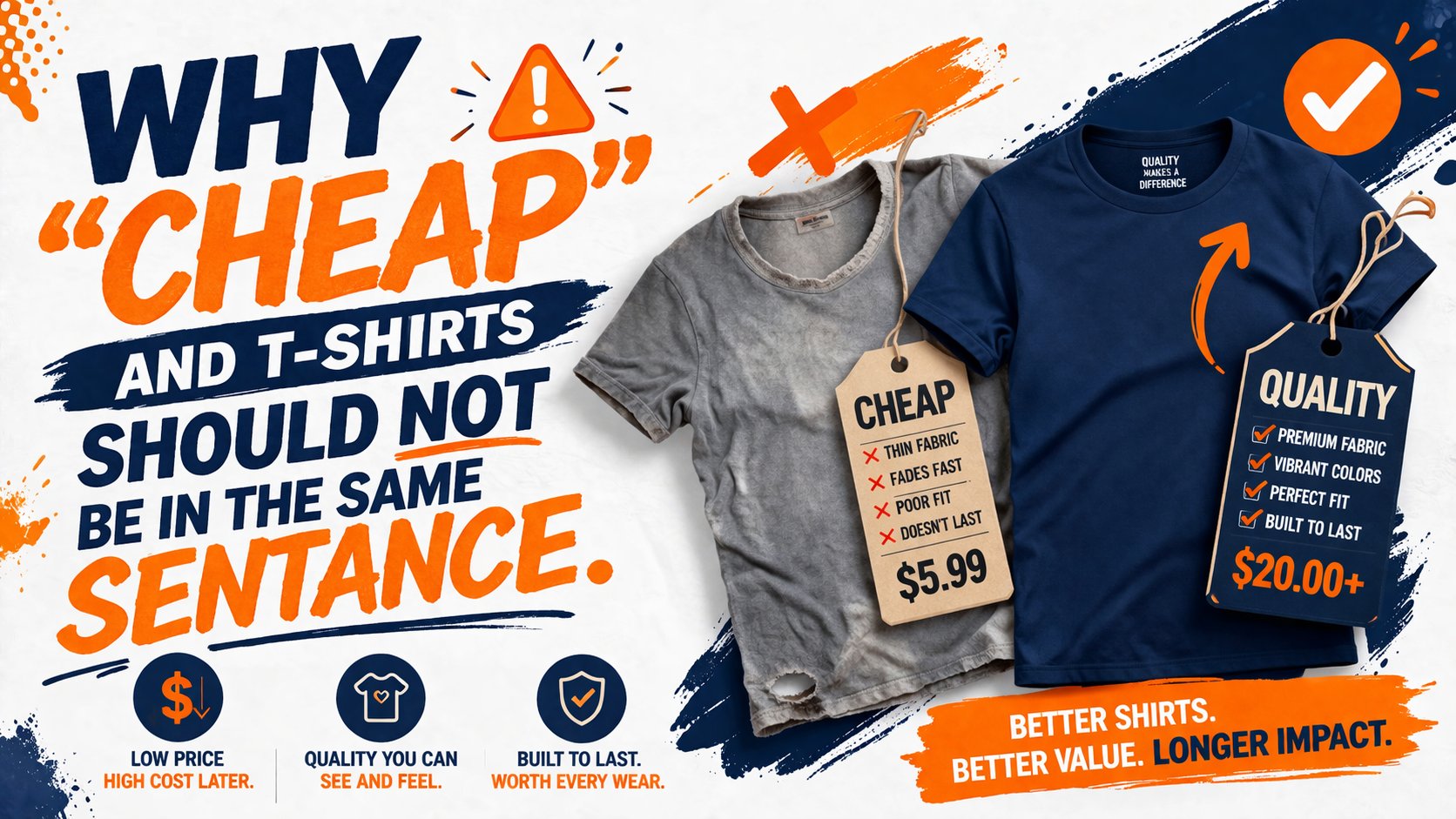
Meta description: Why "cheap" and t-shirts should not be in the same sentance. Learn how low-cost blanks hurt print quality, durability, and long-term brand value.
Most buyers get bad advice about custom apparel. They are told to shop the lowest quote, compare unit prices, and call it a win.
That advice is exactly why "cheap" and t-shirts should not be in the same sentance. If you care about your brand, your event, your staff, or your merch, the cheapest shirt is usually the most expensive mistake in the order.
A custom t-shirt is not just fabric. It is a print surface, a uniform, a marketing asset, and a signal. When the shirt shrinks, twists, fades, pills, or feels rough after a few washes, your logo goes down with it. The “deal” disappears fast.
At T-Shirt Envy, “cheap” is practically blasphemous. If your only goal is finding the lowest possible price, this is not your shop. That is not arrogance. That is accountability. A printer that stands behind the work, fixes issues within its control, and replaces garments when needed cannot build its business on throwaway quality.
You would not walk into a luxury automotive dealership and ask for the cheapest vehicle on the lot. That question misses the point. Custom apparel works the same way. The question is simple: do you want to spend less today, or get more value from every shirt you buy?
The Myth of the 'Good Deal' in Custom Apparel
The market has trained buyers to chase the lowest number on the quote. That sounds smart until the shirts arrive thin, limp, and forgettable.
A “good deal” in custom apparel is not the lowest upfront price. It is the order that still looks good after repeated wear, still fits right after washing, and still makes your team look sharp in public.
That matters more than many admit.
If you are ordering for staff uniforms, school spirit wear, company merch, or promo giveaways, you are not buying disposable fabric. You are buying repeat visibility. You are buying consistency. You are buying trust in the moment someone puts your shirt on.
A shirt that falls apart quickly was never affordable. It was just underpriced on day one.
Cheap pricing often depends on cutting the exact things buyers notice later. Softer hand feel gets replaced with rougher fabric. Better construction gets replaced with shortcuts. A reliable blank gets swapped for whatever can hit the target price.
There is nothing strategic about that.
The hard truth is simple:
- Low-price blanks create high-price problems when they fail early.
- Weak garments ruin strong artwork because the shirt and the print age badly together.
- Replacement orders erase savings when you have to reorder sooner than expected.
A buyer focused only on the quote often learns the true cost after the event, after the first wash, or after the first complaint.
The Anatomy of a 'Cheap' T-Shirt
Cheap is not a price tag. Cheap is what the garment becomes after two washes, a twisted side seam, and a collar that quits before your brand gets real use out of it.

Fabric tells the truth fast
A weak blank usually exposes itself before ink ever touches it. The hand feel is dry or papery. The body looks acceptable on a table, then turns see-through under light, stretches out at the chest, or shrinks into a different fit after the first laundry cycle.
That starts with fiber quality. Low-end shirts often rely on shorter, rougher cotton fibers that pill faster, feel harsher, and lose their shape sooner. Better blanks use cleaner, longer-staple yarns and more stable knits, which is why they feel smoother, wear longer, and hold a more consistent silhouette. If you need help comparing blends, weights, and knit types, review this guide on the best fabric for t-shirts before you approve a blank.
A shirt that loses its shape early drives up your real cost per wear. A garment worn twice and discarded is expensive, even if the invoice looked cheap.
Construction shortcuts show up after washing
Cheap shirts also fail in places buyers miss during a quick quote comparison. Cut quality slips. Seam alignment drifts. Stitch tension varies from panel to panel. The shirt may look passable straight out of the box, then torque, twist, and hang unevenly once it has been washed and dried.
Analysts at Plain & Simple found clear construction differences between low-end and premium garments, including noticeably worse seam alignment and far higher failure rates in flat-lay testing on cheap shirts: cost-per-wear quality analysis from Plain & Simple.
Buyers pay for those shortcuts later. Staff stop wearing the shirt. Customers relegate it to sleepwear. Event merch disappears from rotation almost immediately. Your cost per impression rises because the garment stops earning its keep.
Price alone is a bad filter
A higher retail price does not guarantee a better blank. Green Heart Collective points out that clothing prices often reflect branding, positioning, and margin as much as material or construction, and the gap between a £5 t-shirt and a £50 one can come down to label value more than true build quality: analysis of how clothing price often reflects marketing more than quality.
Use construction as your filter. Check fabric weight, fiber quality, stitch consistency, collar recovery, shrink performance, and how the shirt sits after washing. That is how experienced buyers avoid fake savings and buy blanks that lower long-term cost.
Why Your Print Fails on Low-Quality Blanks
Your print quality is only as good as the shirt under it.

Thin fabric sabotages good artwork
Buyers spend hours approving artwork, then ruin the result with the cheapest blank in the catalog. That decision shows up fast. The print looks duller, the hand feel gets rougher, and the shirt starts aging before the design has had a chance to do its job.
Low-quality blanks fail because the surface is inconsistent. Thin fabric shifts on press, stretches out of shape, and gives ink or thread less support. A clean file cannot fix an unstable garment.
DTG makes this problem obvious. On flimsy blanks, pretreat goes down unevenly, ink sits less consistently, and wash performance drops fast. The result is a print that looks acceptable for the handoff photo and disappointing after real use.
Every decoration method relies on garment stability
Cheap blanks do not break one way. They create different failure points depending on how you decorate them.
- DTG loses impact on thin or uneven fabric because coverage looks weaker and the print degrades faster with washing.
- Screen printing cracks and distorts sooner when the shirt twists, shrinks, or keeps stretching under the ink film.
- Embroidery puckers when the fabric cannot hold stitch density without pulling around the design.
- DTF transfers feel mismatched on weak blanks because the graphic can outlast the shirt, which makes the whole piece feel disposable.
If you want the production reason behind that, this walkthrough of the screen printing process step-by-step shows how much the garment affects the final print.
Great artwork on a weak shirt is premium paint on a crumbling wall. The finish does not fix the foundation.
Cheap blanks create hidden replacement costs
This is not just a print shop complaint. It is a budget problem.
A shirt that loses its shape or wrecks the print after a handful of washes stops being worn. That means your cost per wear climbs, your cost per impression climbs with it, and reorders come sooner than they should. For brands, schools, teams, and companies, that is how a “cheap” order turns into an expensive one.
The smarter move is simple. Start with blanks that can hold print cleanly, wash well, and stay in rotation long enough to justify the order.
Convenience should not mean blind ordering
Fast ordering is useful. Blind ordering is careless.
Pair your design with pre-vetted garments instead of sorting by lowest price and hoping the print holds up. Tools like the TSE mobile app become useful here. You can upload artwork, review garment options on the go, manage bulk orders, and track production without giving up quality control.
A better blank protects the print. It also protects the economics of the entire order.
The True Cost of Cheap The Cost-Per-Wear Trap
Cheap shirts are expensive shirts with a delayed invoice.

Serious buyers should judge apparel by cost per wear, not unit price. A shirt that gets worn twice and forgotten costs more than a better one that stays in rotation for years.
Low price hides high replacement cost
The first invoice only shows what you paid to receive the box. It does not show what you will pay when the shirts shrink, lose shape, fade out, or get pushed to the back of a drawer after a few washes.
That is the whole trap.
Cheap apparel looks efficient because the order total is lower. The math changes the moment people stop wearing the shirt. Then you are paying for replacements, rush reorders, and lost use from something that was supposed to keep representing your brand.
Bulk orders make bad decisions expensive fast
One weak shirt is a nuisance. One hundred weak shirts are a budget problem.
The video comparison makes the point clearly. For a 100-shirt order, a $5 shirt that lasts one year costs $500 and needs to be bought again the next year. A $15 shirt that lasts three years costs $1,500 upfront, which works out to $500 per year over its usable life. The annual cost is the same. The better shirt gives you longer use, fewer replacements, and a better-looking brand during those three years.
That is why cheap blanks are a poor business decision for staff apparel, school programs, company merch, and event teams that need repeat wear. You are not saving money. You are shifting spending into future reorders and getting worse performance in the meantime.
Use cost-per-wear like a buyer, not a bargain hunter
Cost-per-wear is simple. Divide the total cost of the shirt by the number of times it will realistically be worn.
That framework forces better questions:
| Question | Cheap-first thinking | Value-first thinking |
|---|---|---|
| Why am I buying this? | Lowest initial spend | Longest useful life |
| Who will wear it? | One-time recipients | Staff, customers, teams, repeat use |
| What matters most? | Unit price | Wear life, comfort, print retention, fit |
| What happens if it fails? | Replace it later | Avoid reorders and wasted spend |
A shirt that stays in rotation protects your budget. It also keeps delivering impressions without asking you to buy the same job twice.
There is a narrow exception. If the shirt is for a true one-off and nobody expects to wear it again, lower-cost blanks can be acceptable.
For anything tied to your brand, your team, or ongoing visibility, buy for lifespan. That is the more economical choice.
How Cheap T-Shirts Damage Your Brand Perception
Every branded shirt says something about the organization behind it.
If the shirt feels rough, fits poorly, or starts looking worn out too quickly, people do not separate the garment from the brand. They connect them. Fair or not, they assume your standards are the same as your merch.
Your shirt becomes your message
A sharp, durable shirt does quiet work for you. Staff look more organized. Event crews look more credible. Customers who receive branded apparel are more likely to keep wearing something that fits well and feels good.
The opposite also happens.
A stretched collar, faded print, or boxy blank makes your brand look careless. The shirt stops being a marketing asset and starts being evidence that you cut corners.
People notice quality instantly
No one has to study a garment to feel the difference. They know when a shirt is soft, holds shape, and wears well. They also know when it feels disposable.
For teams and businesses, that matters in ordinary moments:
- Frontline staff wear the brand in front of customers.
- Event crews become the visual standard for the whole event.
- Merch buyers decide whether your shirt is worth wearing again.
- Sponsors and partners notice whether your apparel looks polished or rushed.
A bad shirt does not just disappear. It gets seen in public, judged, and remembered.
Cheap tells the wrong story
If your apparel looks low-grade, the story is obvious. This brand wanted the lowest price more than it wanted a good result.
That is not a message any serious business should send.
Choosing Quality Apparel A Smart Buyer’s Guide
Cheap can test well on a quote sheet and still fail as a buying decision.
Smart apparel buyers use a simple filter. They judge a shirt by how long it stays wearable, how well it prints, and what it costs over the life of the garment. That is the only standard that protects budget and results at the same time.
Start with performance, not price tags
High price does not guarantee a better shirt. A low price does not automatically mean poor durability either.
A source article on apparel durability reported that expensive shirts do not always rank higher than significantly cheaper ones for durability. This should end the lazy assumption that buyers can spot value by price alone.
Use specs. Use construction. Use expected wear life.
For a practical breakdown of that approach, read investing in quality and T-Shirt Envy’s advantage.
Buy with a cost-per-wear mindset
The better question is not, “What does this shirt cost today?”
Ask, “What does this shirt cost per wear?”
A £4 shirt worn twice before it twists, shrinks, or becomes a poor print carrier costs £2 per wear. A £9 shirt worn 20 times costs 45p per wear. The second option gives you more visibility, fewer reorders, fewer complaints, and a better return on every printed piece.
That is how serious buyers control spend. They stop treating apparel like a one-time purchase and start treating it like a long-term asset.
Check the blank before you approve it
Use a short screening list:
Ring-spun cotton
Smoother surface. Better hand feel. Cleaner print results.Side-seamed construction
Better shape retention and a more consistent fit.Balanced fabric weight
Enough body to support the print and survive repeat washing without feeling stiff.Tight, even stitching
Collars, hems, and shoulder seams should look clean and consistent.A fit people will wear more than once
Repeat wear lowers your cost per impression and your cost per wear.
Ask the printer better questions
Buyers who care about long-term value ask sharper questions before placing the order:
- Which blank holds detail best for this artwork?
- Which shirt keeps its shape after repeated washing?
- Which option fits the intended use case, one-day event or repeated wear?
- Which blank gives me the lowest cost per wear, not just the lowest unit price?
That is how you avoid fake savings.
A “cheap” shirt that needs fast replacement was never cheap. It was expensive in installments.
Invest in Apparel That Lasts
Cheap t-shirts are not a strategy. They are a shortcut that usually leads to weaker prints, faster garment failure, more replacements, and a lower-quality brand image.
There is a fair place for budget shirts. A one-time event, a throwaway gag, or a short-lived promo can justify a lower-cost blank. No serious advisor should pretend otherwise.
But most branded apparel is meant to do more than survive a day. It needs to represent a business, a team, a school, or a creator in public. That means the shirt has to hold up.
Buyers who care about long-term value should stop asking for the cheapest shirt in the room. Ask for the right shirt for the job. That shift saves money, protects the print, and keeps your brand from looking disposable.
Start your next order with T-Shirt Envy if you want apparel that works as hard as your brand does. Use the TSE mobile app to upload designs, manage bulk orders, and track production on the go. If you want speed without sacrificing standards, experience Quick, Quality, Printing!™ and get your custom order started today.


