
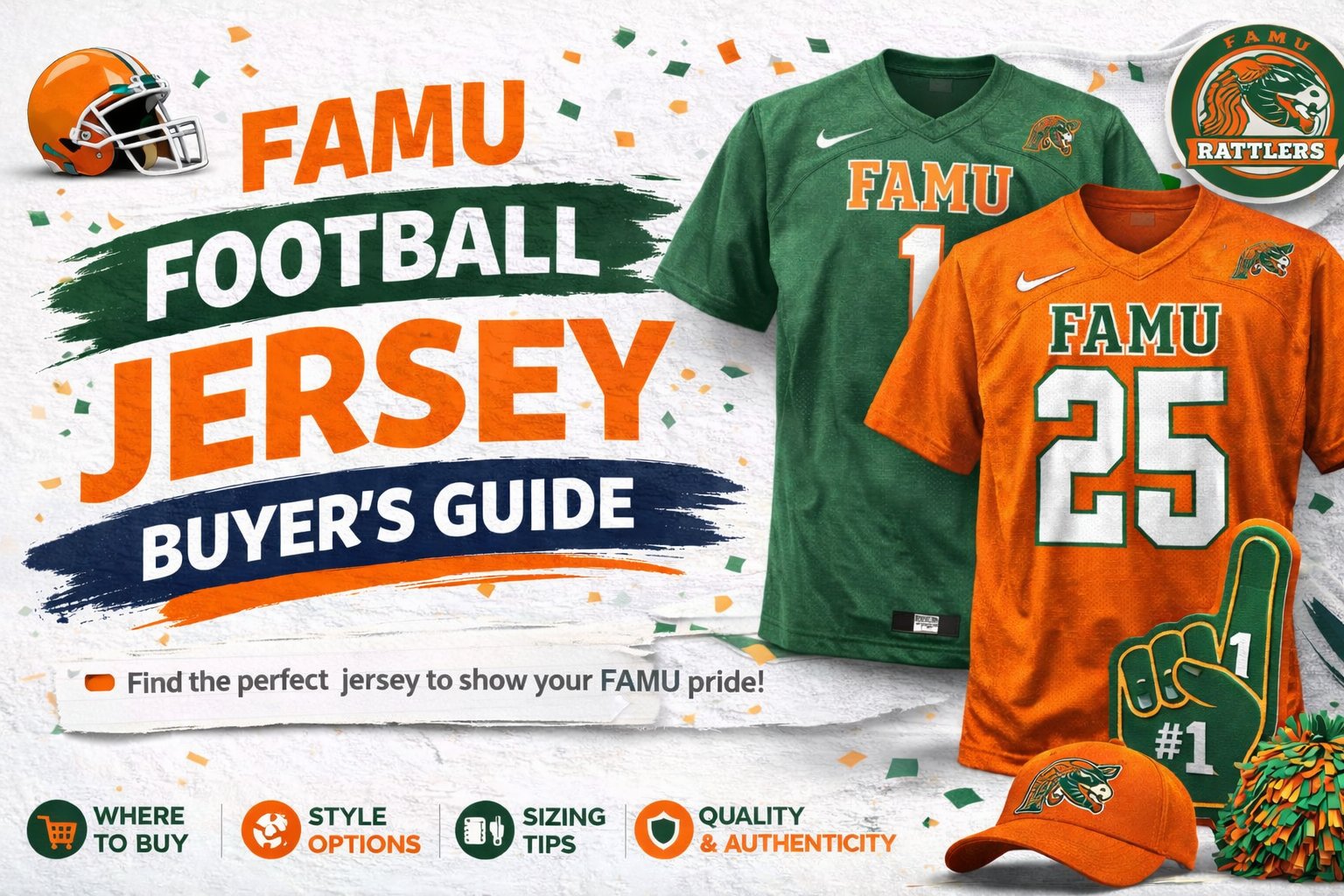
Meta description: Your famu football jersey guide for authentic, replica, and custom options, plus fit, printing methods, care tips, and fast local ordering advice.
You’re probably here because game day is getting close, the outfit matters, and the wrong famu football jersey can ruin the whole look. Maybe you want something that feels close to what the team wears. Maybe you need custom spirit wear for a tailgate, reunion, fundraiser, or student group. Either way, most product listings don’t tell you what matters.
That’s the gap. A great jersey isn’t just about color and logo placement. It’s about fabric, fit, print method, comfort in Florida heat, and whether the final piece looks sharp after repeated wear. If you care about getting it right the first time, you need more than a product page.
More Than a Jersey It's Rattler Pride
On game day, the jersey does a job before anyone says a word. It signals loyalty, memory, and belonging. In Tallahassee, orange and green carry weight that goes far beyond fanwear.

A FAMU jersey matters because the program’s history is serious. The Florida A&M Rattlers football program holds 17 black college football national championships, plus 29 SIAC titles, eight MEAC titles, and one SWAC title, which is why the jersey carries real significance for alumni, students, and fans across HBCU culture (Florida A&M Rattlers football history).
What the jersey represents
Some teams sell color. FAMU sells legacy.
That’s why a generic green football top with a random number won’t hit the same way. The details matter. The shade matters. The feel matters. If you’re putting together game-day apparel, reunion merch, or a commemorative piece, you’re working with a symbol people know immediately.
Practical rule: If the jersey is meant to honor a real program identity, don’t cut corners on color balance, logo placement, or fabric quality.
Why buyers get stuck
Buyers don’t struggle because they lack options. They struggle because the options blur together.
Common problems include:
Official-looking listings: Photos look polished, but they don’t explain construction, print application, or how the jersey fits off the body.
Fanwear confusion: Buyers mix up authentic, replica, and custom pieces, then expect all three to perform the same way.
Last-minute needs: Tailgates, classics, school events, and organization orders often happen on tight timelines.
That last point matters more than people think. A jersey can be historically meaningful and still miss the mark if it arrives late, feels heavy, or cracks after the first wash.
Decoding Jersey Types Authentic Replica and Custom
Jersey shopping gets easier once you separate the three lanes. Authentic. Replica. Custom. They look similar online, but they serve different purposes.

Authentic jerseys
Authentic jerseys aim to mirror the on-field standard as closely as possible. They usually have a more athletic cut and more performance-focused construction.
These work best for collectors, serious fans, and buyers who want the closest thing to player-issued styling.
What usually works well:
Closer game-day look: Better for display, collecting, and premium fanwear.
Performance feel: Typically better if you care about a structured athletic silhouette.
Higher construction expectations: Buyers usually expect stronger detailing and cleaner application methods.
What doesn’t always work:
Less forgiving fit: Athletic cuts can feel restrictive if you want casual wear.
Higher commitment: If you just want a comfortable stadium jersey, authentic can feel like too much piece for the purpose.
Replica jerseys
Replica jerseys are built for fans first. They usually prioritize comfort, easier wear, and broader appeal.
If you want something to wear regularly, this is often the safer choice.
Replica is usually better when:
You want comfort: A looser fan fit layers better over tees or hoodies.
You need versatility: Easier for tailgates, watch parties, campus events, and travel.
You’re buying for a group: More forgiving sizing makes ordering simpler.
The trade-off is simple. Replica pieces can look great, but they may not deliver the same premium construction feel an authentic buyer expects.
Custom jerseys
Custom jerseys solve a different problem. They’re for buyers who want control.
That might mean:
A family name and number for game day
A chapter, club, or reunion design
A staff or promo jersey for an event
A one-off concept that official stores don’t offer
Custom is the strongest option when the goal isn’t just to own a jersey. It’s to create one that fits the moment.
A custom jersey wins when the event, the name, or the message matters more than strict retail uniformity.
FAMU Jersey Comparison Authentic vs. Replica vs. Custom
| Feature | Authentic Jersey | Replica Jersey | Custom Jersey (T-Shirt Envy) |
|---|---|---|---|
| Primary purpose | Closest to on-field style | Fan comfort and regular wear | Personalization and event-specific use |
| Fit | Athletic, more structured | Relaxed, easier for casual wear | Depends on garment selected |
| Material focus | Performance-driven | Comfort-driven | Chosen based on print method and use case |
| Custom names and numbers | Limited | Limited | Built for it |
| Best for | Collectors and dedicated fans | Everyday game-day wear | Groups, creators, reunions, fundraisers, rush needs |
| Main trade-off | Less forgiving fit | Less premium on-field feel | Quality depends on choosing the right blank and print method |
Which one should you buy
Buy based on use, not impulse.
If you want a collector-style piece, go authentic. If you want easy wear, go replica. If you need a jersey for a specific event, personalized gift, or organization, custom usually gives you the best result because you can control the garment, decoration method, and timeline.
Verifying Authenticity and Spotting Fakes
Counterfeit jerseys usually fail in the details. The thumbnail image might look fine. Problems show up in hand.
What to inspect first
Start with the obvious physical signals:
Fabric feel: Cheap jerseys often feel slick, stiff, or oddly shiny instead of balanced and breathable.
Number edges: Crooked edges, lifting corners, or uneven alignment usually point to poor production.
Stitch consistency: Loose thread, skipped stitching, and bunching around seams are warning signs.
Logo application: A logo should look intentional and clean, not thick, blurry, or off-center.
Tags and finish matter
Look at the inside as much as the outside.
A fake often gives itself away through rushed finishing. Seams twist. Side panels don’t line up. Labels feel generic. Sizing can be inconsistent even within the same order.
A good check is to turn the jersey inside out and inspect how the piece was built. If the inside looks messy, the outside won’t age well either.
Red flags from sellers
Counterfeits also show up in how they’re sold.
Watch for these problems:
Unclear product descriptions: If the listing avoids specifics on fabric, application method, or fit, be cautious.
Over-edited photos: Heavy filtering often hides texture and finish quality.
No close-ups: If you can’t see seams, numbers, or logo detail, you’re buying blind.
Weak customization language: Sellers who claim full personalization but don’t explain how they print or apply graphics usually can’t deliver a polished result.
If a seller won’t show the stitching, the print surface, and the neckline up close, assume there’s a reason.
The practical standard
Authenticity isn’t only about licensing. It’s also about whether the piece is built well enough to wear with confidence. Even when buying custom, the same standard applies. Clean alignment. Correct color handling. Strong application. Reliable garment choice.
That’s what separates a jersey that looks sharp in photos from one that still looks right after the season.
Mastering Sizing and Fit for Game Day Comfort
Fit is where most jersey orders go wrong. Buyers choose based on their normal T-shirt size, then get surprised when the jersey wears tighter in the shoulders or boxier through the body.

Athletic fit versus fan fit
Authentic-style cuts usually sit closer to the body. That works if you want a clean silhouette and you’re not layering much underneath.
Replica and custom fan jerseys usually give you more room. They’re easier for all-day wear, especially if you’re moving between sun, shade, and packed stadium seating.
One issue in the market is that official listings often stay vague about broader fit options. Existing jersey content often focuses on standard unisex fits while demand for extended sizing and sustainable options continues, including a 30% consumer preference for green apparel options noted in this market context (FAMU jersey retail category context).
Measure before you buy
Use a shirt or jersey you already like. Lay it flat.
Then check:
Chest width: Measure across from armpit to armpit.
Body length: Measure from the highest point near the collar to the hem.
Shoulder feel: If you’ve ever had a jersey pull when reaching forward, this is the area to compare closely.
For fabric behavior, it also helps to understand how material choice changes comfort. A quick read on the best fabric for t-shirts gives useful context for how different garments wear in heat, even when you’re shopping specifically for jersey-style apparel.
What usually works best
If you’re between sizes, your choice depends on how you’ll wear it.
For layering: Size toward roomier wear.
For a cleaner silhouette: Stay closer to your actual chest measurement.
For group orders: Don’t assume everyone wants the same cut. Ask how each person plans to wear it.
A jersey that looks perfect on a product page can still fail if the shoulder width and body length don’t match how you actually wear fan gear.
Customizing Your Own FAMU Football Jersey
Customization presents compelling opportunities. A custom jersey gives you control that standard retail doesn’t. You’re not limited to what a store stocked for the season. You can build for the event, the audience, and the exact look you want.

There’s real demand for that flexibility. Official stores offer pre-made jerseys, but they leave a lot unanswered about personalization, which is why custom providers stand out with no-minimum options and decoration methods like DTG, DTF, and embroidery (FAMU jersey customization gap).
What custom solves that retail doesn’t
Retail is built for broad demand. Custom is built for your situation.
That matters when you need:
A specific name and number
A chapter, band, or organization identifier
A reunion or fundraiser date
Sponsor branding for an event team
Matching jerseys across mixed sizes
For inspiration, football t-shirt design ideas can help you think through number style, graphic placement, and whether your design should lean classic, bold, or commemorative.
Choosing the right print method
Not every print method belongs on every jersey. Many buyers make expensive mistakes in this area.
For the FAMU logo and similar artwork, here’s the practical recommendation from a print shop standpoint:
DTG for black shirts in small rush quantities
If you need black shirts in a quantity of 1 to 5, DTG is the clean move for a rush order. It handles detailed artwork well and works especially nicely when speed matters.
DTG is strongest when:
You need a short run
Artwork has multiple colors
The order has to move fast
You want a soft print hand on the right garment
DTF for other colors and larger runs
For other shirt colors and larger quantities, DTF usually gives more flexibility. It holds color well and adapts better across a wider range of garments and order sizes.
DTF is a better fit when:
You need strong color pop across multiple pieces
You’re printing on varied garment colors
The run is larger than a tiny rush batch
You need consistency across a group order
Fabric matters as much as the print
A custom jersey only works if the blank garment supports the design. Official jersey construction gives a useful benchmark here. FAMU jerseys use 100% polyester mesh with open-hole construction, and that build supports breathability in humid conditions. That same type of material allows for 30 to 50% more air permeability, which is why quality custom work should start with the right mesh base when you want a jersey feel instead of a regular tee feel (FAMU baseball jersey material specs).
That’s the difference between something that looks like spirit wear and something that wears like a jersey.
Here’s a useful production look at how decorated sportswear comes together:
What works and what doesn’t
Custom jerseys look best when the design respects the garment.
What works:
Limited front message hierarchy
Clean number sizing
Strong contrast between orange, green, white, and black elements
Decoration method matched to the garment and quantity
What doesn’t:
Overloading every panel with graphics
Ignoring seam placement
Using a heavy decoration approach on a lightweight athletic blank
Treating a jersey like a flyer
Keep the front simple, let the name or number carry the back, and make sure the print method matches the garment color and order size.
Ordering with less friction
If you’re handling a custom order, convenience matters almost as much as design. The TSE mobile app makes it easier to upload artwork, manage orders on the go, and keep tabs on production without a pile of back-and-forth messages. That’s useful for school groups, event organizers, and anyone trying to lock in spirit wear quickly.
When speed and finish both matter, the standard should be Quick, Quality, Printing!™. That only works when the print method, garment, and timeline are aligned from the start.
Caring For Your Jersey to Ensure Longevity
A jersey can look great on pickup day and go downhill fast if it’s washed like a basic cotton tee. Athletic garments need a little more discipline.
Washing rules that protect the print
Start simple.
Turn it inside out: That reduces direct abrasion on logos, numbers, and name application.
Use cool water when possible: Heat is hard on decorated surfaces.
Skip harsh detergent habits: Heavy chemical loads and rough additives can wear down print surfaces faster.
For a broader care baseline, this guide on how to wash screen printed t-shirts covers the kind of handling principles that also help decorated jerseys last longer.
Drying and storage
Drying is where many jerseys get damaged.
A safer approach:
Air dry when you can: It’s gentler on graphics and shape.
Avoid excessive heat: High heat can stress print applications and trim details.
Hang or fold carefully: Don’t crush the decorated area under heavy stacks.
Special note on different applications
A stitched jersey and a printed jersey don’t age the same way. Rubber-style applications, DTF graphics, and other printed elements need less heat and less friction. If you want the jersey to hold its appearance, care habits matter as much as production quality.
The rule is straightforward. Wash cold, turn inside out, go gentle, and don’t cook it in the dryer.
Smart Purchasing From Pricing to Local Options
Buying smart means balancing look, use, and timing. The wrong decision usually comes from focusing on only one of those.
What to compare before you order
National online retailers offer convenience, but they often leave you with limited control. You get whatever fit, finish, and stock status they’ve decided to carry.
Local production gives you a different advantage set:
Hands-on decision making: You can talk through garment and print choices before the order is locked.
Faster problem solving: If art needs adjustment, that can happen quickly.
Better fit for group orders: Schools, clubs, staff teams, and event planners usually need more flexibility than retail provides.
Why material choice changes value
If you want a jersey that performs well in warm weather, start with the right blank. Official FAMU jersey construction uses 100% polyester mesh with open-hole construction, and that design supports breathability with 30 to 50% more air permeability in this product context. A custom order built on a similar mesh base can deliver the right look and feel while staying suitable for DTG or DTF decoration, as noted earlier in the material discussion.
That matters because the best custom jersey doesn’t try to imitate quality with heavy ink on the wrong shirt. It starts with a garment that already behaves like athletic wear.
The practical buying call
For a single fan piece, retail may be enough.
For rush needs, organization wear, mixed sizing, event branding, or personalized game-day apparel, local custom production is usually the better play because you can control the timeline, the decoration method, and the final result with much less guesswork.
Frequently Asked Questions About FAMU Jerseys
Can I put my own name and number on a famu football jersey
Yes, on a custom jersey. That’s one of the clearest reasons to go custom instead of buying a pre-made retail piece. It’s the better option for reunions, family sets, tailgates, and school organizations.
What print method is best for a FAMU-style logo
For black shirts in small rush quantities, DTG is the practical recommendation. For other garment colors and larger quantities, DTF is usually the stronger choice because it scales better and keeps strong color presence across a wider range of apparel.
Are custom jerseys good for bulk orders
Yes. They’re often a better fit than retail for chapters, teams, clubs, staff groups, conferences, and fundraisers because sizing, names, and artwork can be coordinated in one order.
What fabric should I choose for a jersey feel
Choose a polyester mesh blank if you want a real jersey feel. A regular cotton tee can carry the artwork, but it won’t wear like athletic apparel.
Is a replica jersey better than a custom jersey
It depends on your goal. Replica is usually better for standard fanwear. Custom is better when you need personalization, event-specific messaging, mixed size flexibility, or a tight turnaround.
If you need a jersey that looks sharp, fits the occasion, and gets produced without the usual hassle, T-Shirt Envy is built for that kind of work. Start your custom order today, or download the TSE mobile app to upload your design, manage your order, and experience Quick, Quality, Printing!™ without slowing down your schedule.


