
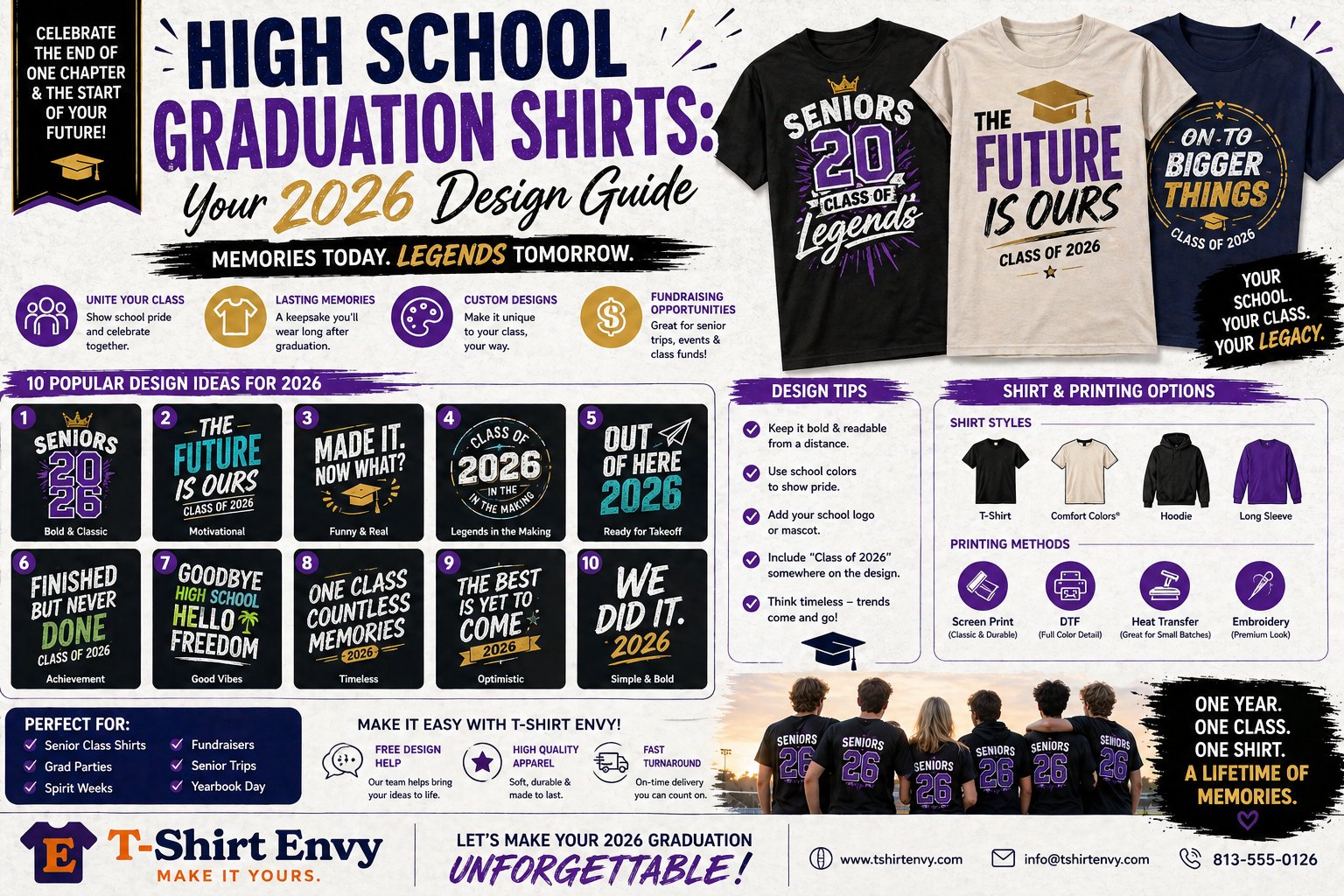
Meta description: High school graduation shirts made simple. Learn design, fabric, printing, ordering, rush timelines, and care tips for a smooth class shirt project.
Senior year has a way of turning every small task into a big one. One minute you're talking about a class shirt idea in the hallway. The next, you're collecting sizes, comparing artwork, checking school colors, chasing approvals, and realizing graduation is coming fast.
That’s why high school graduation shirts need more than a cool graphic. They need a solid plan. The strongest shirt projects happen when someone treats the order like an event, not just a product. A little structure upfront saves a lot of stress later.
Your Guide to Unforgettable High School Graduation Shirts
A senior committee usually starts the same way. A few students want something funny. A few want something clean and classic. Someone wants every graduate’s name on the back. Someone else wants a mascot, a slogan, and a photo collage all on one shirt. The excitement is real, but so is the pressure.
That pressure makes sense. The demand for graduation keepsakes is tied to a major milestone, and the U.S. public high school graduation rate rose from 80% in 2011–12 to 87% in 2021–22 according to the National Center for Education Statistics. More students reaching the finish line means more classes want something worth remembering.
Practical rule: If the shirt only looks good on a mockup, it’s not ready. It needs to work on real people, in real sizes, on a real deadline.
The good news is that a successful shirt order doesn’t require design experience. It requires a few smart choices in the right order. Start with the class identity, match it to the right garment, choose the printing method that fits the artwork, and keep the approval process tight.
Brainstorming Your Perfect Graduation Shirt Design
The design phase gets easier when you stop asking, “What should we put on a shirt?” and start asking, “What should this class be remembered for?”
With most U.S. high schools not requiring uniforms, graduation apparel gives students a visible way to show class identity. About 90% of U.S. high schools don’t require uniforms, which helps explain why custom spirit wear matters so much in senior year, as noted by Helpful Professor’s school uniform statistics overview.

Start with one design direction
Pick one lane before anyone opens a design app.
- Funny direction gives you room for inside jokes, class nicknames, playful illustrations, and bold text.
- Sentimental direction works well for graduate names, a meaningful quote chosen by the class, or a timeline feel.
- Classic school spirit direction keeps the focus on the school name, mascot, class year, and school colors.
If your committee tries to combine all three, the layout usually gets crowded fast.
Build the shirt like a poster
A good shirt design needs a visual hierarchy. People should know what they’re looking at in a second or two.
Try this simple structure:
Lead message
Put the main statement first. That might be “Class of 2026,” the school name, or the class slogan.Supporting graphic
Add one anchor image, not five. A mascot in a cap, a diploma graphic, or a clean crest usually works better than a busy collage.Back print content
Save long lists for the back. Graduate names, signatures, clubs, or a larger class phrase fit better there.
Keep one “hero element” on the shirt. If everything is shouting, nothing stands out.
Make collaboration easier
Students often have ideas spread across screenshots, notes apps, and social media saves. Put everything in one folder and vote on directions before anyone finalizes art.
If your class wants inspiration before sketching, these senior class t-shirt ideas are useful for spotting themes that can be adapted to your school. If you also want matching extras for cars or senior gifts, some committees use tools that let them design custom car stickers online so the graduation look carries beyond the shirt.
Choosing the Right Shirt Style and Fabric
Style affects whether students wear the shirt once or keep reaching for it after graduation. That’s why the blank matters almost as much as the print.

A basic tee is the safest choice for broad class participation. It’s familiar, easy to size, and simple to coordinate for photos, rehearsals, or senior events. Long sleeves and hoodies feel more like keepsakes, especially when the class wants something students will wear well past graduation day.
Fabric affects the print
Think of cotton as a classic canvas. It feels familiar, breathes well, and works especially well when your design has lots of detail.
Polyester and poly blends feel more like performance apparel. They’re a smart pick when the class wants brighter all-over color or a sportier finish. If your committee needs a deeper primer before choosing blanks, this guide to t-shirt materials for custom designs gives a useful fabric breakdown, and this article on the best fabric for t-shirts helps connect material choice to print results.
A quick visual can help when your team is comparing shirt types and fit expectations.
Use this simple selection filter
| Priority | Better choice |
|---|---|
| Detailed front art | 100% cotton tee |
| Sporty feel | Poly or poly blend |
| Colder weather event | Long sleeve or hoodie |
| Broadest group appeal | Classic crew neck |
The wrong shirt can make even strong artwork feel off. Soft hand, good fit, and the right fabric make the design feel intentional.
Understanding Your Custom Printing Options
Print method affects more than how the shirt looks on a mockup. It affects how the ink sits on the fabric, how the design holds up after repeated washes, how much flexibility you have for late changes, and how predictable the final result will be once the order is in production.

A good way to choose is to start with the artwork, then match it to the shirt, then confirm the quantity. That order prevents a common mistake. A class falls in love with a design style first, then learns too late that the garment or print method does not support it well. T-Shirt Envy helps prevent that by checking the technical fit before production starts, so the planning team can stay focused on approvals, deadlines, and the event itself.
DTG for detailed class art
Direct to Garment, or DTG, works like an inkjet printer for fabric. It is a strong choice for graduation shirts that include soft shading, multiple colors, handwritten signatures, or photo-style elements that would be awkward to build with separate ink layers.
DTG usually performs best on cotton-heavy garments, which is one reason fabric choice matters before the proof is finalized. If your class design has a memory-wall feel, a collage effect, or detailed artwork from student submissions, DTG often keeps more of that original character intact.
Screen printing for bold, cleaner layouts
Screen printing is usually the better fit for designs built from solid shapes and clean text. A class name, mascot, graduation year, and a few spot colors are often right in its wheelhouse.
It is the method many schools pick when they want a traditional senior shirt look with strong visibility from across the gym, field, or parking lot.
Use screen printing when your design needs:
- Clear, solid color areas
- Easy readability at a distance
- Reliable consistency across a larger batch
If your design includes photos, fades, or lots of tiny color transitions, another method may preserve the artwork better.
Heat transfer and DTF for flexible orders
Heat-applied decoration is useful when the order has moving parts. Maybe staff shirts need a different logo. Maybe seniors want names on the back. Maybe the committee approves the main design but keeps debating small add-ons.
That is where DTF, or Direct to Film, often helps. It handles a wide range of fabrics and works well for designs that need flexibility without rebuilding the entire order setup. If your group is deciding between digital print methods, this guide to DTF vs. DTG printing differences can help you compare how each option behaves before you approve final artwork.
A simple rule helps here. If your project has more customization and more chances for last-minute edits, heat-applied methods deserve a close look.
Embroidery and sublimation for special cases
Embroidery is a stitched decoration, not a full-shirt print method. It works best for small left-chest logos on polos, quarter-zips, jackets, or advisor apparel. For a senior shirt front with lots of names or detailed graphics, embroidery usually feels too limited and too heavy.
Sublimation is different. It dyes polyester fabric rather than laying ink on top of it, which makes it a better fit for all-over graphics, wraparound effects, and bright athletic-style shirts. If your class wants that full-coverage look, the garment choice has to support it from the start.
The easiest way to avoid surprises is to treat printing like a matching process. Detailed art points toward DTG. Bold school-spirit graphics often point toward screen printing. Personalized add-ons often point toward DTF or heat transfer. Staff pieces and premium extras may point toward embroidery. Once those pieces line up, the order gets much easier to manage.
The T-Shirt Envy Ordering Process From Start to Finish
A smooth order starts with one person owning the checklist. That can be a class sponsor, event planner, or senior class president. Everyone can contribute ideas, but one person should control the final files, size list, and deadline.

Keep the order moving with a simple workflow
Collect the essentials first
Final design direction, shirt color, garment style, quantity estimate, and event date should be decided before requesting production.Prepare artwork clearly
Send the cleanest version you have, even if it’s a rough sketch plus reference images. That’s enough to start a usable proof in many cases.Confirm sizing in one pass
Don’t collect sizes through scattered texts. Use one sheet, one form, and one deadline.Approve the proof carefully
Check spelling, graduation year, mascot version, print placement, and back name list. Most costly mistakes happen here.
One available option for managing this process is T-Shirt Envy, which accepts custom apparel orders through its website and the TSE mobile app. The app can help organizers upload artwork, place orders on the go, and track production status without juggling screenshots and emails.
Final approval should always happen from one master file, not multiple versions floating around a group chat.
Navigating Pricing Turnaround Times and Rush Orders
It is Monday afternoon. Senior photos are this week, the class wants shirts by Friday, and half the size list is still missing. That kind of timeline can still work, but only if pricing choices are clear and approvals move fast.
The final quote usually comes from four parts working together: the garment, the print approach, the artwork detail, and the quantity. A basic cotton T-shirt with a one-location print is usually simpler to produce than a hoodie with front, back, and sleeve artwork. Specialty garments can also change the production path and the cost. Polyester shirts with full-color graphics, for example, often call for sublimation rather than standard ink printing.
Pricing gets easier to control when you treat the order like a school event budget. Every extra print location, ink color, garment upgrade, or art revision adds time or labor, and sometimes both. If you need to protect the budget, keep one feature special instead of making every part premium.
Deadlines that usually cause trouble
Rush jobs rarely fail because a print shop cannot print fast enough. They fail because the project stalls before production starts.
The usual slowdowns are easy to spot:
- Missing sizes that keep the order from being finalized
- Multiple people revising the design after the class already reviewed it
- No single approver to give the final yes on art and quantities
- Garment swaps late in the process that force the order to be re-quoted or re-proofed
A shirt order works a lot like planning graduation itself. The ceremony may last an hour, but the success comes from dozens of small decisions made on time. T-Shirt Envy can handle the technical side of quoting, proofing, and production scheduling, but the school team still needs one person ready to approve details quickly.
How to keep a rush order realistic
Start with the wear date and count backward. Leave room for proof review, roster cleanup, production, and delivery or pickup. If the date is tight, choose options that are faster to produce cleanly, such as simpler artwork, fewer print locations, and in-stock garments.
Ask one practical question early: what can your group decide today? That answer matters more than the perfect design idea that takes three extra days to approve.
Rush service is possible for some orders, including fast turnaround options such as same-day or 24-hour production, but speed only helps after the design, sizes, and payment details are locked in. The smoother the approval chain, the more likely your class gets shirts on time and without last-minute stress.
Caring For Your Custom Graduation Shirts
A graduation shirt is part keepsake, part everyday tee. If you want it to stay bright and wearable, care matters.
Wash it inside out in cold water. Use a mild detergent and skip harsh settings when you can. Low heat drying is safer than blasting it on hot, and air drying is even better for preserving print quality.
If the shirt has a detailed print, don’t iron directly on the artwork. Fold it carefully, store it clean and dry, and it’ll hold up better for reunion photos, college move-in days, or the random moment years from now when you pull it out and remember exactly who signed the back.
Start your custom order with T-Shirt Envy when your class is ready to turn ideas into high school graduation shirts that are organized, wearable, and built for the deadline. Download the TSE mobile app to upload artwork, manage details, and keep your project moving from first draft to final pickup.


