
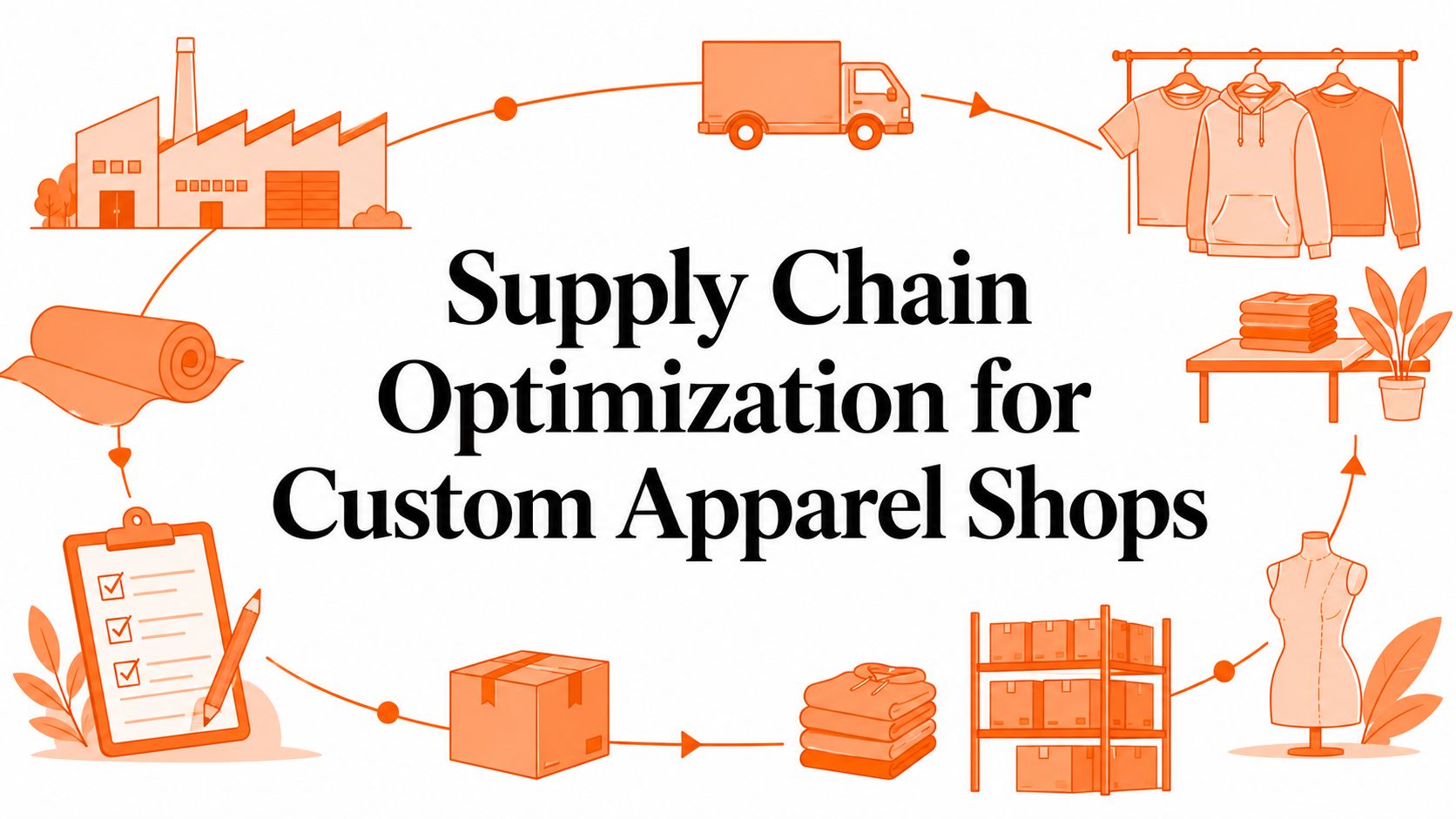
A rush order lands at 9:00 a.m. A corporate event starts tomorrow. The customer needs 200 shirts, but the blanks are split across three locations, artwork still needs approval, and every production queue already has commitments. One shop has the right color, another has the sizes, and the fastest print method may not be the cheapest.
That's the operating reality behind supply chain optimization for custom apparel shops. This work isn't about building a massive factory system. It's about connecting purchasing, inventory, artwork, production, and delivery so a one-of-one creator order and a deadline-driven corporate run can move through the business without unnecessary friction.
Why Supply Chain Optimization Matters for Custom Apparel
A custom apparel shop carries an unusual kind of complexity. The products may look simple, but every order can vary by garment style, size, color, decoration method, artwork, quantity, location, and promised delivery time. A shop that serves creators, schools, event organizers, startups, and corporate teams can't manage that mix with a single “make it cheaper” rule.
Supply chain optimization means aligning demand signals, inventory placement, production capacity, and logistics with the service promise made to the customer. For a printer, that means knowing which blanks are available, where they're located, which machine can handle the artwork, whether the team has the capacity, and how the finished order will reach the customer on time.

The rush order exposes every weak link
Consider the 200-shirt corporate order. If the blanks are scattered, employees spend time searching instead of producing. If the artwork file arrives in the wrong format, the production queue pauses. If the order gets routed to a location without the right equipment, the team loses more time transferring it. If shipping starts only after production is complete, a small delay can erase the delivery window.
Optimization changes the question from “Can we print this?” to “What is the most reliable path from approved artwork to delivered apparel?” That path may use DTF for detailed full-color artwork, screen printing for a larger consistent run, or embroidery when the customer needs a more structured branded look. The correct answer depends on deadline, garment, artwork, quantity, and available capacity.
Speed and cost must be managed together
The lowest unit cost isn't always the lowest total cost. A cheaper process can become expensive when it requires extra handling, longer setup, a transfer between locations, or expedited freight. Likewise, holding every possible size and color at every shop creates convenience but ties up cash in inventory that may move slowly.
A practical supply chain balances:
- Availability: Keep the blanks and supplies that support common orders close to the work.
- Flexibility: Preserve options for no-minimum runs, unusual artwork, and rush requests.
- Quality control: Match the print method and production location to the order requirements.
- Deadline certainty: Build a fulfillment path that includes production, inspection, packing, and delivery.
- Working capital discipline: Avoid treating every possible garment variation as essential stock.
A widely cited supply chain benchmark connects this discipline to financial performance. Companies with optimized supply chains can operate with 15% lower supply chain costs, hold less than 50% of the inventory held by less-optimized peers, and achieve cash-to-cash cycles at least 3× faster, according to this supply chain management benchmark. The same source reports that 79% of companies with high-performing supply chains achieve revenue growth above their industry average. These figures don't create a custom apparel forecast, but they clarify why optimization supports both margin and growth.
For T-Shirt Envy, the operating principle is “Quick, Quality, Printing!™”. That promise depends on more than a fast printer. It requires accurate order information, reachable inventory, capable production teams, and fulfillment coordination that works under pressure.
Key Components of an Optimized Apparel Supply Chain
A custom apparel supply chain has six connected components. Improving one while ignoring the others usually shifts the bottleneck instead of removing it.

Demand forecasting
Large manufacturers may forecast by product family and sales period. A custom printer needs a more local, event-aware view. Review upcoming conferences, school seasons, sports schedules, fundraisers, weddings, festivals, and corporate campaigns. A quiet historical week can become a capacity problem when several organizations schedule events for the same weekend.
Forecasting also needs to separate repeatable demand from custom demand. A business ordering branded uniforms has a different pattern from an artist testing a limited run. Forecasting every design individually won't work, but tracking demand by blank type, size profile, color family, print method, and customer category can reveal useful purchasing signals.
Research links forecasting accuracy with working capital. One study measured forecast accuracy using MAPE and defined inventory turn as COGS divided by average inventory, showing how forecasting and inventory efficiency connect in operational and financial terms (forecast accuracy and inventory turn research).
Inventory management
Inventory management is harder when one product category includes many garment styles, sizes, colors, and materials. Count stock by usable option, not just by total pieces. A large quantity of unpopular garments doesn't help fulfill a black medium rush order.
Use location-level visibility. A shirt available in Tallahassee isn't immediately available to a Tampa customer unless the transfer or shipment fits the deadline. Label fast-moving blanks, separate customer-owned goods, and reconcile physical counts with the order system often enough to trust the number.
Procurement
Supplier relationships determine what's possible during a rush. Consolidating purchasing where it makes sense can reduce receiving complexity, but relying on one source for every critical blank creates a different risk. Keep approved alternatives for garments that frequently support corporate, school, team, and event orders.
Evaluate suppliers on more than price. Check consistency, color availability, size coverage, lead-time reliability, damage handling, and communication. A supplier that responds clearly during a shortage can be more valuable than one offering a slightly lower unit cost.
Production scheduling
Every decoration method has different economics. DTG can suit detailed artwork and small quantities. DTF supports vibrant designs across suitable garments and can work well when flexibility matters. Screen printing becomes attractive for consistent larger runs, while embroidery supports logos and premium workwear. Sublimation has its own garment and artwork requirements.
Schedule around setup, curing, hooping, pretreatment, color changes, rework risk, and inspection. A rush order shouldn't jump to the front of every queue. It should enter a decision process that considers the promised deadline, available equipment, artwork readiness, and the disruption imposed on existing customers.
Reviewing T-Shirt Envy's production capacity can help teams think more clearly about capacity planning before they promise a deadline.
Logistics
Multi-location fulfillment adds options, but only when teams share reliable information. Coordinate transfers, pickup windows, parcel shipments, and middle-mile movements with the same order record. Don't ask a customer to manage internal routing problems.
For practical guidance on handoffs, consolidation, timing, and transportation coordination, use these reliable middle-mile logistics tips as a supplemental operational resource.
Returns
Custom apparel usually can't be placed back into general stock after decoration. A return policy must distinguish production defects, wrong garments, customer artwork errors, and customer preference changes. Photograph defects, record the job details, and connect the resolution to the original order.
Returns data can improve upstream decisions. If a particular garment, artwork handoff, or print method repeatedly creates rework, the answer may be a process correction rather than a refund policy change.
Metrics and KPIs That Drive Real Improvement
A small apparel shop needs a focused set of indicators that support daily decisions about stocking, scheduling, and process changes. This matters even more in high-mix, low-volume work, where rush orders, no-minimum runs, and coordination between locations can distort averages.
Fill rate measures the share of demand satisfied immediately from available stock. In joint location and inventory models, fill-rate constraints can create a convex mixed-integer nonlinear program. A published decomposition-based outer approximation method produced solutions averaging 0.15% from optimal and at worst 2.2% from optimal in numerical experiments (published fill-rate optimization research). For a custom apparel shop, apply the measure to promised garments and required materials. Record whether each order was fulfilled without delay or substitution.
Build the dashboard around decisions
A spreadsheet is enough to start. Consistent definitions and scheduled review matter more than a new system.
| KPI | Benchmark Range | How to Measure | Why It Matters |
|---|---|---|---|
| Fill rate | Set a target by service promise and garment category | Orders fulfilled immediately from available stock divided by total orders | Shows whether inventory supports same-day and rush commitments |
| On-time delivery rate | Establish a baseline, then improve it by location and service type | Orders delivered or ready by the promised time divided by completed orders | Reveals whether promises match actual execution |
| Production cycle time | Record separately for DTG, DTF, screen printing, embroidery, and sublimation | Timestamp artwork approval, production start, completion, and inspection | Shows which methods fit urgent jobs |
| Inventory turnover ratio | Compare categories rather than forcing one universal target | COGS divided by average inventory, using the definition described in reorder process guidance | Identifies stock that ties up cash or fails to support demand |
| Cost per rush order | Create an internal baseline by rush category | Add labor, expedited materials, transfers, freight, and rework | Shows whether speed is reducing margin |
| Artwork-to-production handoff time | Track from approved file to production-ready ticket | Record approval and queue-entry timestamps | Exposes delays before printing begins |
Review the same definitions at every location. Otherwise, one shop may count an order as on time when it is ready for pickup, while another counts only completed delivery. That inconsistency makes comparisons unreliable.
Use trends instead of isolated scores
A single late order rarely explains a system. Repeated patterns deserve investigation. Review the dashboard weekly and ask whether rush orders miss deadlines because blanks are unavailable, artwork approvals stall, or one production method is overloaded. Check whether inventory discrepancies cluster at one location or garment category.
Each metric should lead to an action. A falling fill rate for a popular blank may require different purchasing quantities or location placement. Rising handoff time may call for standardized file names, proof approvals, and production tickets. Increasing rush cost should trigger a review of labor, freight, transfers, and rework before the next aggressive promise is made.
Why Technology Investments Fail to Deliver Results
A rush order can expose a shop's technology problems within minutes. A forecasting tool may recommend more black medium blanks, yet that advice has limited value when inventory counts are stale, the order platform cannot show stock by location, and purchasing still relies on disconnected email threads.
PwC found that 92% of operations and supply chain leaders say at least one reason their technology investments have not fully delivered expected results, while 83% cite two or more reasons. The most common causes were integration complexity at 47% and data issues at 44%, according to PwC's digital supply chain survey. For a high-mix custom apparel operation, those weaknesses surface as missed rush deadlines, duplicate work, and poor coordination between locations.

The integration gap appears at the worst moment
Rush service makes disconnected systems especially expensive. A customer submits artwork, but the file remains in a shared inbox. Production receives another version, while fulfillment cannot confirm whether the job is approved. Each team may have software, but the order still lacks one trusted workflow.
Before adding a platform, trace one order from design upload through delivery. Mark every manual re-entry, approval delay, location transfer, and point where staff must ask for an update. That map shows whether a new tool will remove work or add another screen.
The supply chain optimization technology market shows the scale of investment in analytics, automation, and visibility. One market report values the global market at $6.15 billion in 2025 and projects it to reach $12.57 billion by 2034, implying an 8.5% CAGR from 2026 to 2034, as reported by Verified Market Reports. Market growth does not establish that every platform suits a custom print shop. It does show why buyers need to judge tools against actual rush-order and multi-location constraints.
Choose friction reduction over feature volume
Audit systems against the handoffs that affect deadlines:
- Order identity: Can every location see the same customer, quantity, garment, and deadline?
- Artwork status: Can staff distinguish uploaded, approved, revised, and production-ready files?
- Inventory location: Can the team see usable stock at each shop?
- Production state: Can customer service see whether a job is queued, printing, inspected, or ready?
- Exception ownership: Does one person know who acts when stock, artwork, or equipment blocks an order?
The TSE mobile app provides a customer-facing example of a connected flow. Customers can order custom shirts on the go, upload designs quickly, manage bulk or corporate orders, and track production status without relying on separate manual conversations. Technology earns its place when it removes delay-producing handoffs without forcing a no-minimum shop to buy features it will rarely use.
Implementation Roadmap for Custom Print Shops
Optimization works best as a sequence of controlled changes. Start with constraints customers feel directly, then build the records and routines needed for better decisions under deadline pressure.
Phase one focuses on quick wins
Consolidate blank supplier accounts where practical and maintain a shared list of approved alternatives. Set par levels for garment styles, sizes, and colors tied to recurring work. A par level signals when replenishment needs attention rather than guaranteeing full coverage of every style.
Create one production calendar across locations. Mark conferences, school events, sports seasons, fundraisers, holidays, and known corporate campaigns. Add equipment availability and staff coverage, so customer service can check capacity before promising a deadline. Record maintenance tasks in an equipment maintenance schedule to reduce avoidable interruptions.
Phase two connects the process
Standardize the artwork handoff. Each job should carry a clear file, garment specification, quantity, print method, approval status, deadline, and location. Use a rush-order triage checklist:
- Confirm the deadline: Ask when the customer needs the order ready, rather than focusing only on the requested print time.
- Verify the blanks: Check exact size, color, style, and location.
- Validate artwork: Confirm approval, resolution, placement, and production compatibility.
- Select the method: Match DTG, DTF, screen printing, embroidery, or sublimation to the job.
- Assign the location: Choose the site with the strongest combination of stock, equipment, and capacity.
- Price the exception: Include expedited materials, transfers, labor, and delivery before confirmation.
- Communicate ownership: Name the person responsible for the next handoff.
Review inventory weekly with a simple template covering opening count, receipts, committed orders, physical count, discrepancies, projected demand, reorder decision, and owner. Pair that review with equipment availability and staffing checks, since a stocked blank still misses its deadline if the assigned site cannot produce it.

Phase three adds network intelligence
Once basic records are dependable, pool inventory across locations. T-Shirt Envy's current locations in Tampa and Tallahassee, with Miami, Atlanta, and Houston planned, create opportunities to place stock according to local demand and transfer orders when the economics support it.
Negotiate lead times and substitutions with suppliers using actual order history. Connect forecasts to local event calendars and seasonal patterns. Cross-train staff on multiple print methods while assigning complex or high-risk work to trained specialists. Broader skills help cover rushes and absences; specialization preserves quality and throughput where process variation carries a cost.
Use the roadmap to test each change against real orders, including no-minimum runs, rush requests, and transfers between locations. A resilient workflow gives the team a clear response before the rush arrives.
Building a Resilient and Scalable Supply Chain
Efficiency alone can make a custom apparel shop fragile. If the business stocks too little of a popular blank, the same-day promise fails. If it stocks every variation everywhere, cash gets trapped and slow-moving inventory grows. Resilience means choosing where flexibility is worth paying for.
Design the network around deadline certainty. Keep strategic availability for high-demand blanks, maintain credible supplier alternatives, and route each order to the location and print method that can fulfill it reliably. For a small-batch shop, that approach matters more than copying a high-volume factory model.
AI can support demand forecasting, inventory optimization, and supply planning, which McKinsey identifies as leading generative AI use cases in supply chain in its supply chain risk research. Emerging tools such as ambient sensing and autonomous data collection may improve visibility for distributed operations, but they won't repair inaccurate counts or disconnected workflows.
The foundation remains straightforward:
- Clean data that reflects physical inventory and real order status.
- Integrated systems that preserve information from design through delivery.
- Supplier relationships that support alternatives and honest lead-time conversations.
- Clear escalation rules for rush orders, stockouts, rework, and equipment issues.
- A service promise that matches actual capacity.
T-Shirt Envy's model includes 1-hour, same-day, and 24-hour services with no minimums for rush orders, supported across DTG, DTF, screen printing, embroidery, and sublimation. That range demonstrates the practical side of supply chain optimization for creators, businesses, teams, schools, organizations, and event planners. Customers can order through the website or use the TSE mobile app when they need to upload a design, place an order, or manage fulfillment while away from a desk.
Bring your next rush order, corporate run, creator collection, or no-minimum project to T-Shirt Envy, with custom printing across multiple methods and garments. Use the website or the TSE mobile app to order on the go and experience Quick, Quality, Printing!™ when your deadline can't move.


