
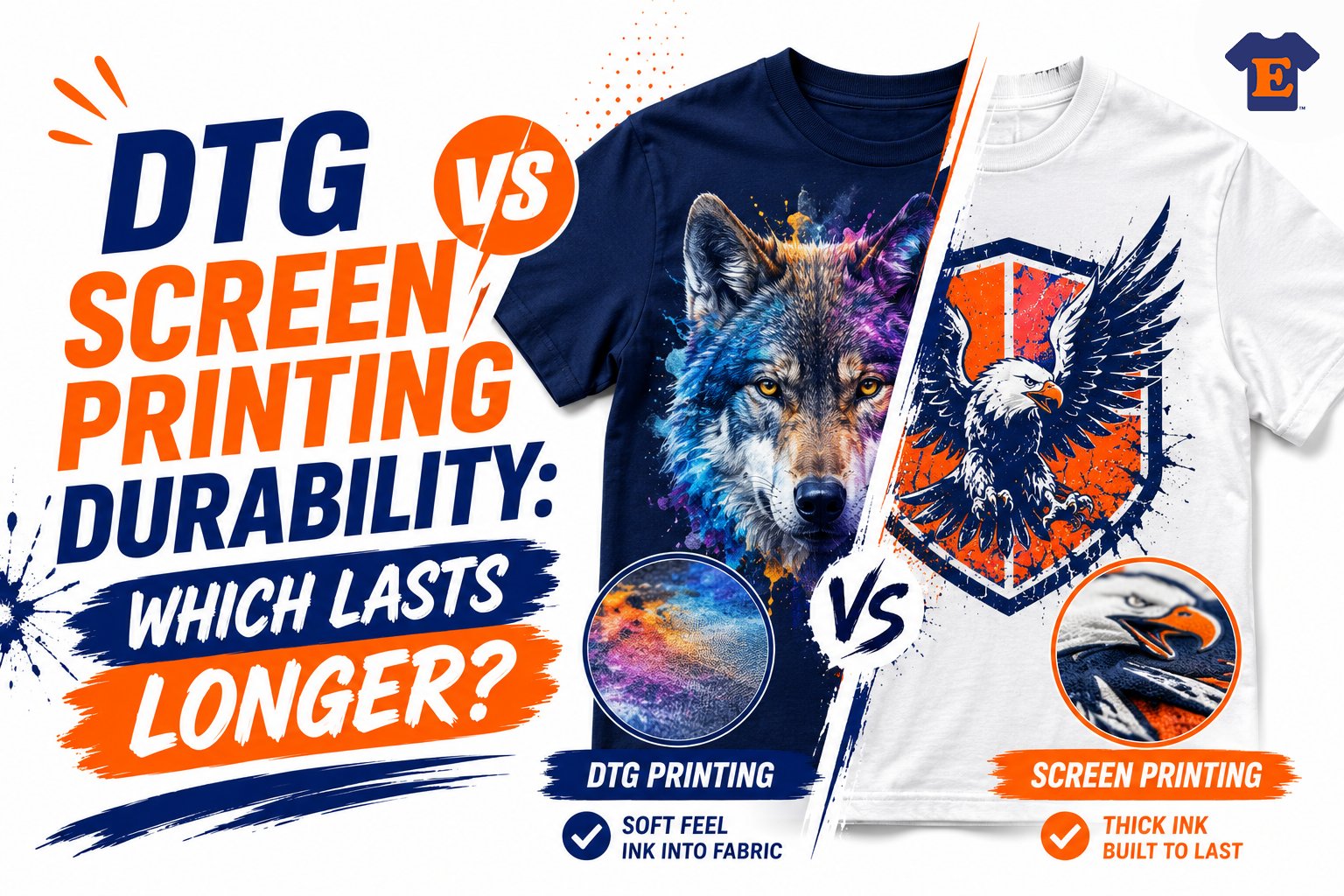
Meta description: Compare dtg vs screen printing durability with real wash-test insights, failure modes, and practical guidance for uniforms, merch, and bulk orders.
A landscaping company once split a uniform order between DTG and screen print because they needed shirts fast for new hires and tougher shirts for full-time crews. A few months later, the difference was obvious: the screen-printed uniforms still looked retail-ready, while the DTG prints showed more fading under sun, hot washing, and daily wear.
That is the answer to dtg vs screen printing durability. It isn't a debate about which method is universally better. It's a business decision about what matters more for your job: speed, detail, softness, no-minimum flexibility, or maximum lifespan.
The Real Choice Behind Your Custom T-Shirt
That landscaping order answered the durability question faster than any sales pitch could. The rush shirts for new hires went through DTG because the artwork had fine detail and the client needed a small batch immediately. The permanent crew shirts went through screen print because those garments were headed into heat, mud, sun, and hot wash cycles every week.
Both choices were correct. They were solving two different production problems.

On our floor, buyers usually start with durability, but that is only part of the decision. I care just as much about how the print is likely to fail. DTG usually loses ground through fade and reduced punch on dark garments after repeated abuse. Screen print usually holds color longer, but if the ink deposit, curing, or artwork choice is wrong, the complaint shifts to feel or cracking on heavy coverage areas.
That difference matters because a fashion brand, a school event coordinator, and a field-service company do not judge the same defect the same way. A merch seller may accept some fade if the print looks sharp on day one and the order can launch fast. A contractor buying uniforms will notice color loss, edge breakdown, and overall worn-out appearance because those shirts keep representing the business long after the first wear.
| Print method | Best fit | Durability profile | Production strength | Watch-outs |
|---|---|---|---|---|
| DTG | Small runs, detailed art, on-demand orders | Holds up well when the garment, pretreat, and cure are dialed in, but tends to show fading sooner under rough washing and daily workwear use | Fast setup for short runs and artwork with fine detail | More sensitive to fabric choice, dark garment prep, and harsh laundering |
| Screen printing | Bulk orders, uniforms, workwear, simple bold graphics | Usually keeps color, opacity, and overall print appearance longer in hard-use environments | Strong choice for repeatable bulk production | Less efficient for low-quantity custom orders and highly variable one-off art |
Use a simple job-based filter. If the shirt is part of the job, such as uniforms, service apparel, staff wear, or branded workwear, screen print is usually the safer business decision. If the shirt is part of a launch, event, test run, or limited drop, DTG often makes more sense because it trades some long-term toughness for speed, detail, and flexibility.
That is why good shops recommend both methods. The better option depends on how fast you need the order, how detailed the art is, and how much abuse the garment needs to survive.
How We Measure Print Durability at T-Shirt Envy
A restaurant group came to us after a bad reorder. Their first batch looked fine out of the box, but six weeks into regular wear the chest prints had dulled, the edges looked fuzzy, and the dark shirts showed the damage first. The problem was not "durability" in the abstract. It was a mismatch between how the shirts were going to be used and how the print was built.

On a production floor, prints fail in specific ways. Some lose color. Some lose opacity. Some keep the image but change feel and start looking tired. Others break down under hot dryers, heavy wash cycles, or repeated abrasion. Those failure modes matter because a merch brand, a school, and a contractor will complain about different things first.
The three things that matter
We judge print durability in three separate buckets:
- Wash endurance is how long the print stays saleable through repeated laundering before wear becomes obvious.
- Color retention is how well the ink keeps saturation, especially on dark garments and large filled areas.
- Print integrity is whether the image keeps clean edges, even coverage, and a consistent surface over time.
Our in-house wash tests are built around those three checks. We run samples through repeated home-laundry cycles, compare them against control pieces, and log where the print starts to lose acceptable appearance for the job it was sold for. For bulk uniform programs and repeat business orders, we also track reprint reasons, because customer complaints usually show up before a lab-style failure threshold does.
In our internal testing, properly cured screen prints held full vibrancy for 50+ wash cycles with only minor fading. DTG prints typically stayed highly vibrant for about 25 to 35 washes before noticeable softening and color fade started to show, especially on darker garments. That lines up with what we see in production. Screen print usually gives us more margin on dense graphics, dark garments, and shirts headed into weekly rotation. Our custom screen printing process for bulk and uniform orders is built around that use case for a reason.
Industry guidance points in the same direction. In this durability comparison covering screen printing, DTF, and wash performance, the cited takeaway is straightforward. Well-executed screen printing tends to outlast other methods in fade resistance and crack resistance, while DTG performance depends much more on pretreat quality, curing, garment choice, and care.
That difference shows up fastest on dark shirts with large solid areas. Those jobs expose weak opacity and uneven wear early, which is why they are useful stress tests in real production.
This quick production video helps show why setup and execution matter so much in real output quality:
The method matters, but execution matters just as much. A well-produced print outlasts a rushed one every time.
Key Factors Affecting DTG vs Screen Printing Durability
Durability gets decided long before the first wash. On our floor, the jobs that hold up are the ones where the print method matches the garment, the artwork, and the way the shirt will be worn.

Ink sits differently and wears differently
Screen print and DTG fail in different ways because the ink lives in different places on the shirt. Printful's explanation of DTG and screen printing notes that screen print lays down a thicker ink layer on top of the fabric, while DTG ink absorbs into the fibers.
That difference matters most once the shirt leaves the sample table. Screen print usually gives better resistance to abrasion, fade, and edge breakdown on heavy-use jobs. DTG gives a softer hand and stronger detail, but under rough treatment its weak points show up faster, usually as color loss, surface wear, or a dulling of large printed areas.
We see that gap most clearly on uniforms, equipment crew shirts, and staff apparel that gets washed hard and dried hot. For those orders, our screen printing service for uniforms, teams, and bulk apparel is usually the safer production call.
Fabric choice changes the outcome fast
Garment fiber can make a good print look bad in a hurry.
DTG performs best on quality cotton because the ink bonds better to cellulose fibers, as noted earlier. Ring-spun cotton is usually the cleanest lane for DTG if the buyer wants detail and a softer feel. Once you move into poly blends, the trade-off gets sharper. Color can look less full, the print can wear unevenly, and the shirt texture starts showing through sooner.
Screen print gives us more consistency across cotton, blends, and polyester mixes. That does not mean every blend is equal. It means screen print usually gives the production team more room to control opacity and hold up through repeated use.
Dark garments raise the stakes. DTG on black or navy depends heavily on pretreat quality and a solid white underbase. If either one is off, the print may look fine on day one and age poorly after regular washing.
Design style decides what kind of stress the print has to survive
The artwork itself creates the failure point.
Large solid areas are tough on DTG, especially on dark shirts. They can show wear faster because any fading, fiber rise, or uneven ink coverage becomes obvious across a broad field of color. Screen print usually handles those blocks better because it keeps stronger opacity and cleaner edges over time.
DTG has a real advantage on highly detailed graphics, tonal illustrations, and short runs with full-color art. That is why it works well for merch drops, one-off designs, and event shirts that need visual range more than long service life. A simple two-color logo for a maintenance team is a different decision. If that shirt is headed into weekly rotation, screen print is usually the better business choice.
Use case matters more than print theory.
- Large solid prints expose fading and uneven wear faster, especially with DTG on dark garments.
- Fine-detail, full-color artwork often fits DTG better when order size is small and visual detail matters most.
- Spot-color logos and uniform graphics usually hold up better in screen print.
- Back prints on workwear need stronger resistance to friction, repeated washing, and heat.
Pretreatment and curing set the ceiling
A print rarely outperforms its setup.
DTG depends heavily on even pretreatment, correct moisture control, and full curing. If pretreat is patchy or the cure is light, the print may start breaking down early even when the artwork looked sharp at press. Screen print has its own discipline, but it usually gives more forgiveness once ink deposit and cure are dialed in.
The practical failure modes are consistent in production:
- Cheap blanks paired with DTG can lead to weak color hold and faster visible wear.
- High-heat drying shortens the life of DTG prints faster than many buyers expect.
- Dense full-front graphics on dark shirts put more pressure on DTG than on screen print.
- Mismatching the method to the job causes more durability problems than the print technology itself.
A creator tee for light casual wear and a landscaping uniform do not belong in the same decision bucket. The better choice depends on speed, detail, garment type, and how hard the shirt will be used once it gets into the customer's hands.
The Bottom Line What Our Data Reveals
The durability conversation gets more useful when you stop asking which method wins in theory and start looking at what fails in actual orders.
From our production records and customer service tracking, screen print reprint rates for durability issues stay under 1%. DTG durability-related reprints tend to fall between 3% and 5%, depending on garment type and wash habits.
That spread tells you something important. Most print problems don't show up in a perfect sample. They show up after the customer takes the shirt home, dries it too hot, wears it in rough conditions, or runs it through repeated commercial laundering.
Where DTG complaints usually come from
Most DTG durability issues trace back to a short list of conditions:
- High-heat drying
- Low-quality cotton garments
- Heavy industrial laundering
- Large full-front designs with dense ink coverage
Those aren't edge cases. They're common realities for staff shirts, gym apparel, crew wear, and event uniforms.
According to Underground Printing's discussion of durability failure modes, one of the biggest gaps in current coverage is that buyers need to understand how prints behave under industrial laundering, abrasion, and care mistakes, not just normal home washing. That's exactly where screen print usually separates itself from DTG in production records.
What this means for buyers
If you're ordering apparel for employees, crews, school staff, coaches, or outdoor teams, don't judge durability by how a fresh sample looks on day one. Judge it by failure risk.
Screen printing has the lower long-term reprint rate because it handles abuse better. DTG sees more complaints when the shirt becomes a tool instead of a fashion piece.
For clients managing multiple locations or recurring staff orders, tracking order status and handling repeat purchases through the TSE mobile app helps keep those projects organized without adding email back-and-forth. That matters when you're balancing rush replacements, restocks, and art updates.
And yes, this is the point where Quick, Quality, Printing!™ has to mean something. Speed without method matching just creates avoidable reprints.
The cheapest mistake in custom apparel is choosing the wrong print method before the first shirt is made.
Your Project Decoded When to Choose DTG or Screen Print
Two orders can look almost identical on approval and perform completely differently six weeks later. We see it every month. A photo-heavy band tee for a weekend drop usually does fine with DTG. A landscaping crew shirt with the same coverage can come back early for replacement because sun, sweat, hot dryers, and repeated washing punish the print in a different way.

The decision is less about which method is "better" in general and more about which failure mode you can live with. DTG gives you speed, detail, and low-quantity flexibility. Screen print gives you a wider safety margin against fading, cracking, and surface wear when the shirt is part of a job, not just a launch.
Choose DTG if speed, image detail, and low quantity matter most
DTG fits projects where artwork drives the order and reorder risk is low. That usually includes photo prints, gradients, small test runs, creator merch, fundraiser shirts, and short-turn event apparel.
Use DTG when you need:
- Short runs or one-off orders
- Detailed, full-color, or photographic artwork
- Fast setup with no screens to burn
- Soft prints on cotton
- Quick proof-to-production turnaround
For buyers comparing methods, our DTG printing services are the right fit when you need flexibility more than maximum resistance to heavy wear.
DTG also works well when the product page has to sell the design before the shirt ever ships. If you're building launch visuals, this guide on transforming e-commerce shots into lifestyle photos is a useful companion to mockup prep.
Choose screen printing if the shirt needs to survive hard use
Screen printing is the safer production choice for uniforms, workwear, staff shirts, outdoor crews, school programs, and any repeat order where replacement cost matters. The print layer is better at holding up under friction and routine abuse when the art is set up correctly for the garment and use case.
Use screen print when you need:
- Uniforms and work shirts
- Bulk orders with repeat runs
- Bold logos, spot colors, and simple graphics
- Longer wear life under frequent washing
- Better consistency across recurring orders
The business side matters here. A bulk order that lasts longer usually costs less over the full life of the program, even if setup takes more time at the front end. That is why operations managers, facilities teams, and franchise groups usually choose screen print for ongoing staff apparel.
A quick decision filter
Use these four questions before approving art:
- Will the shirt be washed often, dried hot, or worn on the job? Choose screen print.
- Does the design depend on gradients, texture, or photo detail? Choose DTG.
- Is this a small run, test launch, or rush order? DTG is usually the faster fit.
- Will you need matching reorders over time? Screen print is usually the stronger long-term buy.
One client summary gets the point across fast. If the shirt is meant to sell the artwork, DTG usually wins. If the shirt is meant to survive the workweek, screen print usually wins.
How to Maximize the Life of Your Custom Apparel
The right print method matters. Care still matters after that.
A strong screen print can be shortened by bad laundry habits. A well-made DTG shirt can keep looking good much longer when it's washed and dried properly. Most durability complaints start with heat, friction, and rough treatment.
Care habits that help both methods
Use these basics to protect printed apparel:
- Wash inside out: This reduces direct abrasion on the print surface.
- Use cold or cool water when possible: Lower heat is easier on both garment fibers and printed areas.
- Skip harsh bleach: Bleach is rough on both color and fabric.
- Avoid high-heat drying: Heat is one of the fastest ways to age a print.
- Don't iron directly over the image: Pressing heat straight onto decorated areas can damage the print.
For teams ordering staff shirts or repeat event apparel, it helps to send care instructions with the handoff instead of assuming everyone already knows them. That one step cuts a lot of preventable wear.
Match care to use case
Uniforms, gym wear, and school apparel usually fail faster because they live a harder life. They get washed more often, dried hotter, and worn with less caution.
That's why design prep matters before production even starts. If you're refining artwork for different shirt colors, this guide covering 7 pro ways to swap colors is useful for cleaning up concepts before they hit print.
If you want garment-specific care guidance for long-wearing prints, this article on how to wash screen printed t-shirts is worth bookmarking.
One last practical rule
Buyers usually regret two things. They either overbuy durability they didn't need, or they underbuy it and end up reordering sooner than expected.
If the project is fashion-forward, short-run, detailed, and time-sensitive, DTG is often the right answer. If the project is operational, repetitive, high-friction, and long-term, screen printing is usually the right answer.
Need help choosing the right print method for your next merch drop, staff uniform, or bulk order? Start your custom order with T-Shirt Envy, or download the TSE mobile app to upload artwork, manage orders, and keep production moving. Experience Quick, Quality, Printing!™ and get your project started today.


